
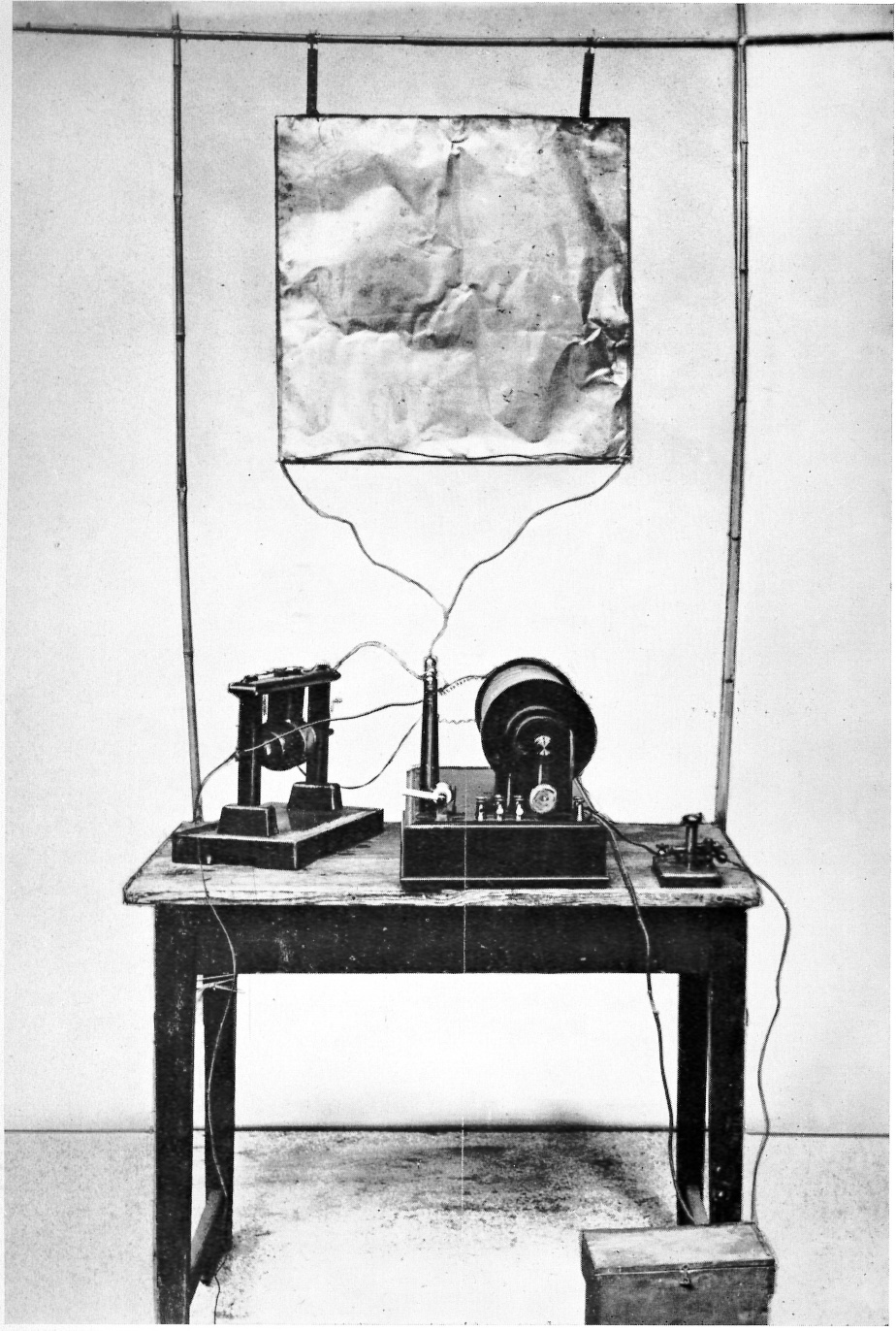
Recreation of the first radio transmitter with a monopole antenna, built by Guglielmo Marconi in August 1895 during his development of radio communication. It was a spark-gap transmitter which generated radio waves by an electric spark between two electrodes of a Righi spark gap (left, on table). The high voltage to produce the spark was generated by an induction coil (center) powered by a battery (on floor). A telegraph key (right, on table) in the primary circuit allowed the operator to switch the transmitter on and off rapidly, producing pulses of radio waves which spelled out text messages in Morse code. The unique feature of this transmitter is that it includes Marconi’s invention of a monopole antenna. Marconi found that by connecting one side of the transmitter to an elevated copper sheet “capacity area” (top) and the other side to ground (earth), he could transmit longer distances than when using the previous dipole antennas invented by Hertz. This crucial innovation reduced the frequency of the radio waves, and radiated vertically polarized waves which had a greater range. With it Marconi achieved the first radio transmissions of practical distance, about 3 1/2 miles.


