
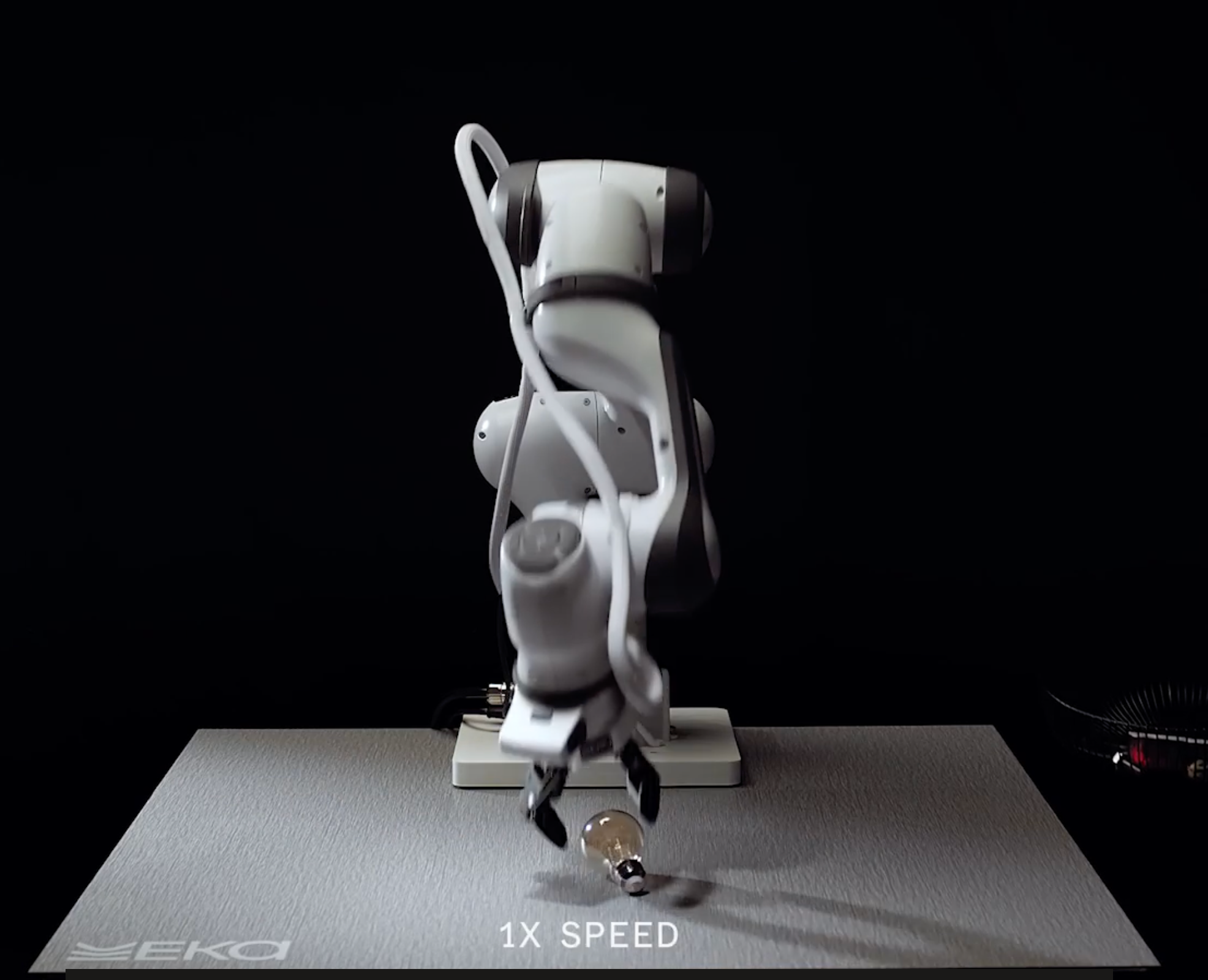
Eka Robotics has raised $150 million in Series A funding at a post-money valuation of $1.45 billion, putting a serious spotlight on a robotics problem that has resisted flashy demos for years: reliably manipulating unfamiliar objects. The startup’s approach combines a force-sensitive gripper with a physical AI system designed to help robotic arms respond to touch, weight, and resistance instead of relying on sight alone. The new funding and valuation mark a major early vote of confidence in Eka’s approach.
Founded by MIT professor Pulkit Agrawal and former Google DeepMind researcher Tuomas Haarnoja, Eka is building what it calls a Vision-Force-Action, or VFA, model. The company’s core argument is that robots need a richer understanding of the physical world than cameras and language models can provide. Vision can identify an object, but force feedback helps determine whether it is slippery, fragile, stuck, unexpectedly heavy, or positioned differently than expected.
That emphasis could give Eka an advantage in warehouses, factories, and other environments where objects are constantly changing. The company says its system can handle roughly 1,500 objects weighing up to one kilogram per hour, with a success rate above 95 percent. Those figures are still company claims rather than an independently established industry benchmark, but the reported combination of speed, range, and smooth movement is what has drawn unusual attention from robotics specialists.
Eka’s official positioning frames force as the native language of physical intelligence. Its website says the VFA foundation model is intended to unite generality, performance, and safety, while adapting across objects, tasks, and environments. That is an ambitious target: industrial robots are often highly reliable within tightly controlled workflows, while more general-purpose machines tend to sacrifice speed or precision when conditions change.
The funding round was led by Andreessen Horowitz and F-Prime, giving Eka the financial runway to move beyond impressive demonstrations and prove that its system can operate economically in production. The company’s challenge now is less about showing that a robot can pick up many objects once and more about maintaining that performance across long shifts, varied lighting, damaged packaging, unfamiliar workspaces, and meaningful safety requirements around human workers.
If Eka can turn its force-first model into a dependable platform, the implications extend well beyond one robotic arm. General-purpose manipulation is a crucial piece of the broader physical-AI race, and progress there could affect logistics, manufacturing, retail fulfillment, and eventually household robotics. For now, Eka’s billion-dollar valuation reflects a compelling bet: that teaching machines to feel what they are touching may be the missing ingredient in making them genuinely useful.


