
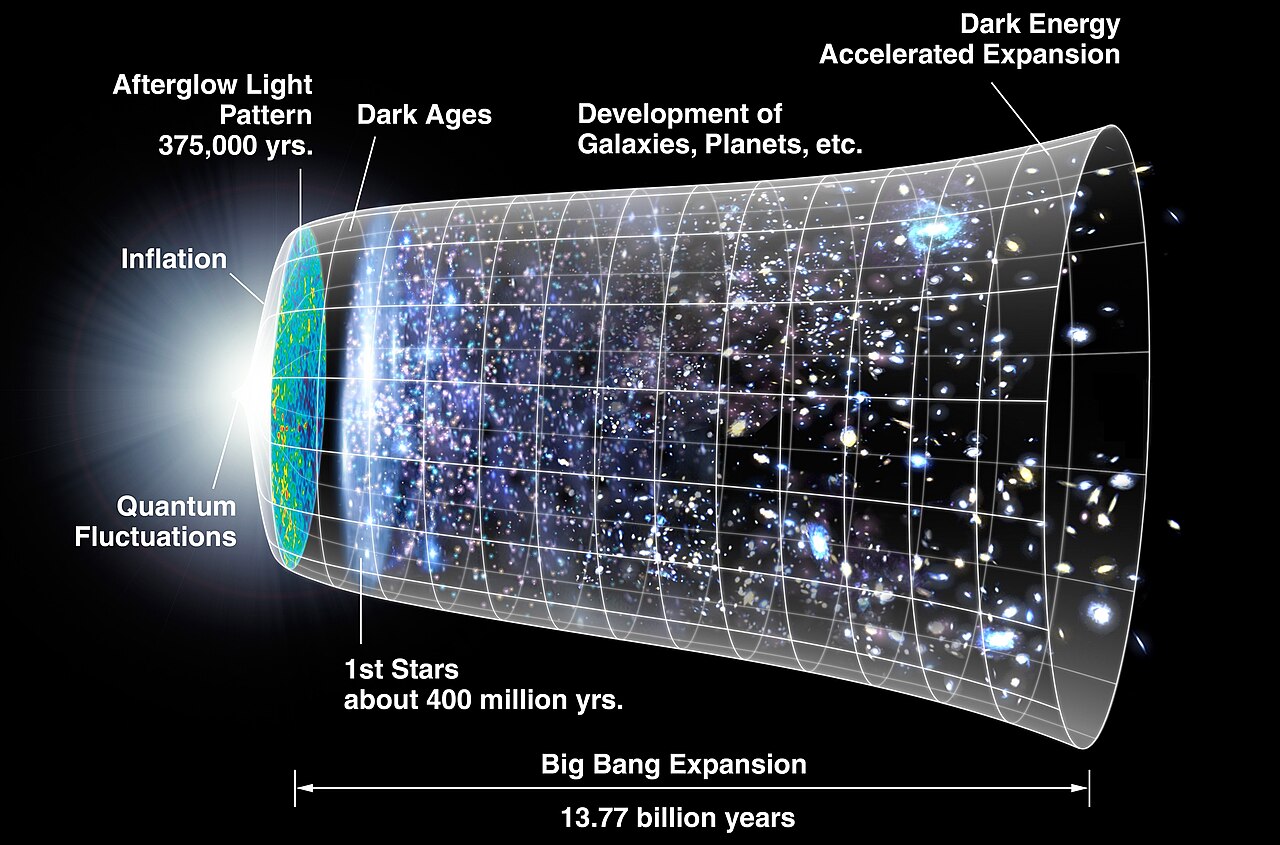
Astronomers have extracted one of the early Universe’s most important numbers with record precision: the amount of helium created during the first few minutes after the Big Bang. By studying light from 15 unusually pristine, distant galaxies, an international team has reduced the measurement’s uncertainty to just 0.5 percent—roughly three times better than earlier estimates. The result offers an unusually sharp look at the Universe’s first five minutes.
The observation campaign used more than 130 hours on the Large Binocular Telescope, a facility with twin 8.4-meter mirrors in Arizona. Instead of surveying a huge number of galaxies and extrapolating backward to estimate the original helium abundance, the researchers selected compact systems that have experienced relatively little chemical enrichment. Their gas preserves a composition much closer to the one left behind by the young cosmos.
The team measured more than 10 helium emission lines alongside 15 hydrogen lines with the MODS spectrographs, instruments developed at Ohio State University. Comparing those signals allowed the scientists to model subtle effects—including temperature, density and other sources of systematic error—that become decisive when the target is sub-percent accuracy. The University of Minnesota describes the work as a five-paper series in The Astrophysical Journal. The university’s account details the telescope campaign and spectrograph work.
The reported primordial helium mass fraction is Yp = 0.2458 ± 0.0013. That figure matters because helium abundance is one of the three classic pillars supporting Big Bang cosmology, alongside the Universe’s expansion and the cosmic microwave background. The amount of helium produced in the early fireball also depends on conditions such as the expansion rate and the number of light neutrino families, making it a valuable stress test for the Standard Model of particle physics.
Researchers at the University of Minnesota, Ohio State University and institutions including Gonzaga, Northwestern, the University of Texas at Austin, Indiana University, UC Santa Cruz, the University of Illinois, Universidad Nacional Autónoma de México and TRIUMF contributed to the project. The result does not replace observations of the microwave background or other light elements; instead, it gives cosmologists an independent, more tightly constrained measurement of the same primordial era.
That distinction is important for what comes next. A more precise helium value can expose small disagreements between theory and observation, potentially pointing to unrecognized systematic effects—or physics beyond the current model. For now, the achievement is a significant refinement rather than a demolition of standard cosmology: the first minutes of cosmic history remain remarkably consistent with the broad Big Bang picture, but researchers now have a sharper instrument for looking for cracks in it.


