
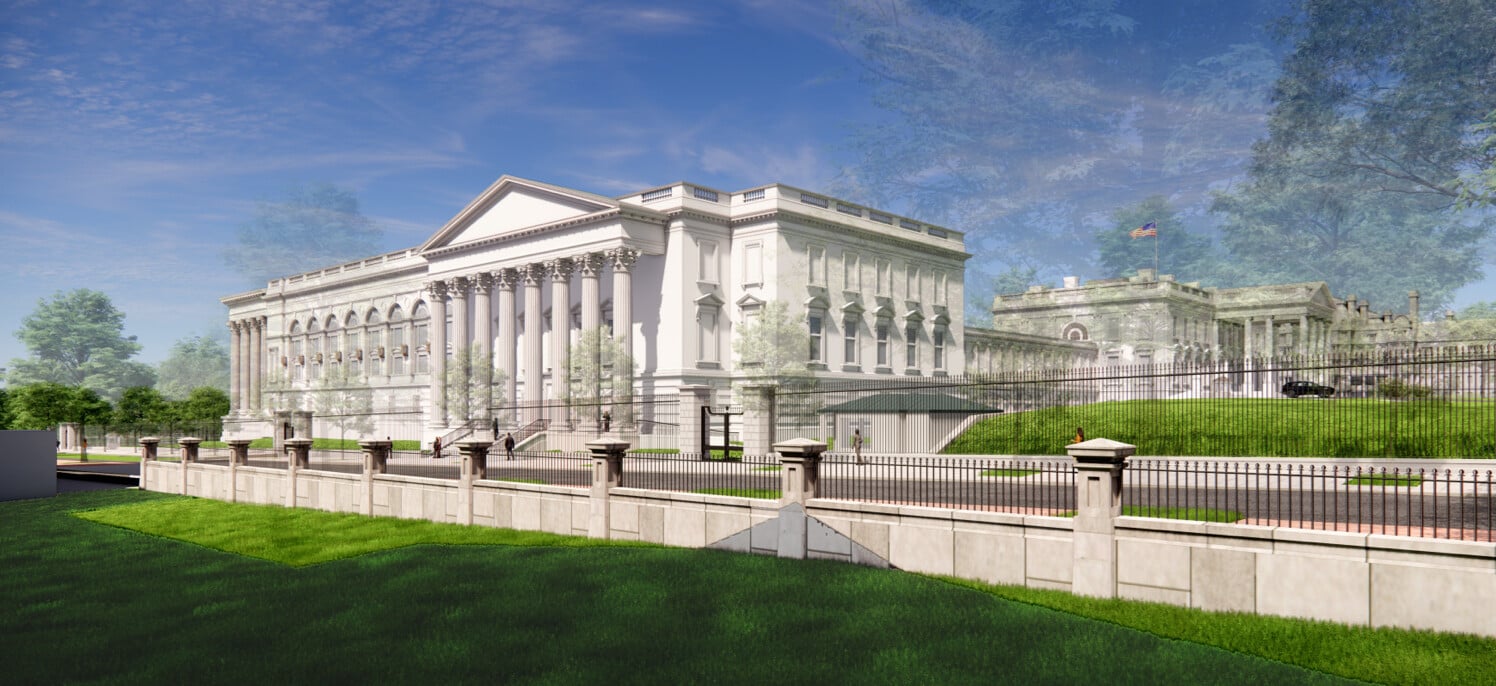
The United States Supreme Court has cleared the way for President Donald Trump’s massive new White House ballroom to keep rising, voting 5-4 to lift a halt on construction even as Chief Justice John Roberts warned the project is “likely unlawful.” The conservative majority did not decide whether the $400 million addition complies with federal law, instead ruling that the National Trust for Historic Preservation cannot sue because it lacks the legal standing required to challenge the project.
The ballroom, envisioned as a grand new event space on the White House grounds, is slated to replace the East Wing, which Trump ordered demolished last year without seeking approval from Congress. Court filings describe a 90,000‑square‑foot structure that the administration says is roughly 65% complete and intended to host large-scale gatherings and high-profile events. A federal district court and the D.C. Circuit Court of Appeals had previously concluded that the National Park Service and the Office of the Executive Residence lacked authority to move forward without explicit congressional authorization, citing statutes that bar new buildings on federal grounds in Washington, D.C., without such approval. Those rulings effectively froze aboveground construction until Trump’s team turned to the Supreme Court for emergency relief.
On August 14, the administration asked the justices to block the lower courts and allow work to continue while the underlying lawsuits play out, arguing that halting the project mid-stream would waste resources and undermine security planning for the executive complex. One week later, Roberts issued a brief administrative stay that temporarily let construction proceed, signaling that the high court wanted more time to study whether the injunction should stand. The order issued on August 31 went much further: in an unsigned opinion, five justices concluded that the National Trust had not shown the kind of concrete injury required under Article III of the Constitution, and therefore its case is unlikely to survive. Roberts, joined by the court’s three liberal justices, broke with the conservative majority, writing in dissent that the ballroom project appears to violate federal law and that the court should not enable what he characterized as an unlawful expansion of the White House complex.
For preservationists, the fight over Trump’s ballroom is about more than one opulent venue; it’s a test of how far a president can go in reshaping one of the most symbolically loaded buildings in American political culture without Congress signing off. The National Trust for Historic Preservation, a congressionally chartered nonprofit that has long advocated for protecting landmarks like the White House, argued that the project flouted both the National Park Service’s conservation mandate and statutory limits on new construction in the capital. Lower courts agreed that the Trust had associational standing to represent members concerned about the loss of historic fabric and the drastic alteration of the site, but the Supreme Court’s majority was skeptical that those interests translated into the kind of individualized harm federal courts require before taking a case. That narrow standing ruling allowed the justices to avert a direct pronouncement on the legality of the ballroom itself, even as the dissent warned that dodging the merits could invite future presidents to treat legal constraints as optional.
The decision slots into a broader pattern of emergency rulings in which the Supreme Court has increasingly used its so-called “shadow docket” to make high-stakes calls about executive power, often with little full briefing or oral argument. For court-watchers and civics geeks, the ballroom case reads like something out of a political thriller or dystopian alternate history: a president demolishes part of the White House, pushes a luxury expansion through over preservation objections, then secures a narrow Supreme Court victory that keeps the cranes swinging while legality remains unresolved. In practical terms, the ruling means construction is likely to reach completion long before any lawsuit definitively answers whether the project should have gone forward, raising the specter that any future court victory for preservationists could come only after the new structure is already embedded in the White House landscape. For now, Trump’s ballroom stands as a real-world set piece in an ongoing constitutional drama, where questions of architectural legacy, presidential ambition, and judicial restraint all collide on the most famous lawn in American politics.
Image Credits
In-Article Image Credits
The Great Whitehouse Ballroom Trump via Wikimedia Commons with usage type - Public DomainFeatured Image Credit
The Great Whitehouse Ballroom Trump via Wikimedia Commons with usage type - Public Domain


