Astronomers Valeri Hambaryan and Ralph Neuhӓuser have discovered proof that a massive short duration gamma-ray burst hit the earth in the 8th century. The intense blast of high-energy radiation could have caused a mass-extinction event if it had been just a tad bit closer to the earth. Scientists estimate that the event emanated from 3,000…
Category: Astronomy and Space
European Space Agency launches asteroid deflection project in effort to knock asteroid off its earth-bound course
The European Space Agency has launched its Asteroid Impact and Deflection Assessment (AIDA) project in an effort to search for a way to counter the threat of an earth-bound asteroid, potentially by knocking the asteroid off its course. The idea is to send two small spacecraft to intercept an steroid known as 65803 Didymos, and…
Cornerstone of Mars Curiosity Rover mission, drilling Martian surface, is about to begin
No spacecraft has ever penetrated the rocky surface of Mars, or any planet for that matter, but that is about to change. In the past few weeks, Curiosity Rover has been stationed in a region called Yellowknife Bay, which features fractured ground with different temperature swings compared to other nearby terrain – and plenty of…
The results are in: small planets like our own are extremely abundant in the universe
The results are in – our galaxy harbors at least one hundred billion planets, many of them Earth-sized meaning, small planets like our own are extremely abundant in the universe. On Monday, scientists announced that NASA’s Kepler space telescope has discovered another 461 potential new planets, most of which are the size of Earth or…
Asteroid to buzz Earth on Wednesday. Don’t hold your breath though. Better chance of collision in 2029
The 1,000-foot-wide Apophis asteroid is set to buzz the Earth on Wednesday (1/9/13) passing a mere 9 million miles above Earth, but the chances of a fateful impact are next to nil (but keep holding your breath, there’s a better chance in 2029 when it passes only 18,000 miles from the Earth’s surface). Still, Apophis…
Five planets found orbiting Tau Ceti, one of the closest Sun-like stars in our system
Astronomers have discovered five planets, including one in the habitable “Goldilocks Zone”, surrounding Tau Ceti, one of the closest and most Sun-like stars in our neighborhood (it has the same specteral classification as the Sun). Located just 12 light-years away from Earth, the planets are about 2-6 times the mass of Earth. The single planet…
Chinese orbiter completes close flyby of asteroid 4179 Toutatis
The Chinese lunar orbiter Chang’e 2 has completed a maneuver that allowed a close flyby of asteroid 4179 Toutatis, a five-kilometer (three mile) long space rock that recently had a “close” encounter with Earth. The flyby was made on December 13, 2012. According to Chinese state-run Xinhua news agency, the probe made a close approach…
Running out of fuel, NASA to control crash both GRAIL spacecraft into Moon on December 17
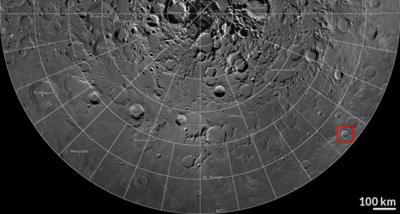
NASA announced today that its two Gravity Recovery and Interior Laboratory (GRAIL) Spacecraft, named Ebb and Flow, are running out of fuel and will be control crashed into a lunar mountain on December 17, 2012 at approximately 5:28 PM EST (Flow will crash 20 seconds after Ebb). The impact area is at latitude 75.62° N,…
Earth buzzed by not one, but two asteroids today
A newly discovered asteroid, 2012 XE54, and an old-timer, 4179 Toutatis, are buzzing Earth today. Asteroid 2012 XE54 was only discovered a few days ago (December 9) and passed between the Earth and Moon at a distance of 141,000 miles. In a rare event, it was also eclipsed by Earth’s shadow as it passed. The…
U.S. Air Force secret X-37B space plane set to launch from Cape Canaveral
The U.S. Air Force is set to launch its so-called secret X-37 Orbital Test Vehicle space plane from Cape Canaveral, Fla. Tuesday for the third test flight of the prototype space craft. The Air Force’s third Orbital Test Vehicle (OTV-3) mission is scheduled for lift off from Launch Complex 41 at Cape Canaveral Air Force…