
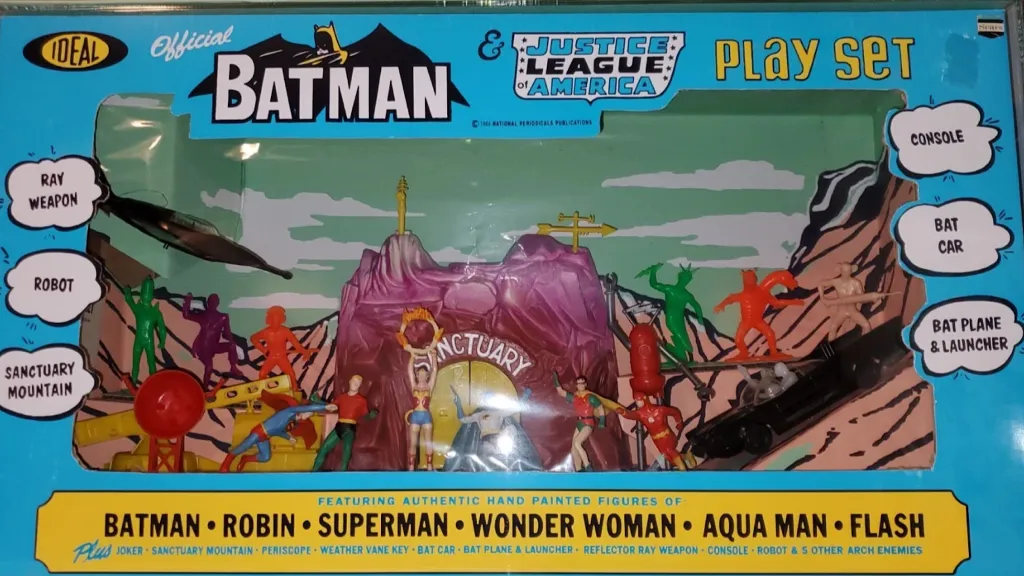
A sun-faded hunk of hollow purple plastic is currently trying to command nearly $25,000 on the secondary market, and Batman collectors are paying attention. The piece in question is the 1966 Official Batman and Justice League of America Playset by Ideal, a Sears-exclusive oddity that looks like a flea-market reject but has quietly become one of the most coveted DC collectibles of its era.
As first highlighted by ComicBook.com, the playset centers on a large “Sanctuary” — a purple plastic mountain hideout with opening doors, a periscope, and a spinning weather-vane key. Packed around it are a free-rolling Bat Car, a launchable Bat Plane, a console-style Batcomputer, a robot, and a reflector-ray weapon, all rendered in that unmistakable mid‑’60s toy plastic. The real draw, though, is the set of hand-painted miniatures of Batman, Robin, Superman, Wonder Woman, Aquaman, and the Flash, who face off against single-color, non-articulated figures of Joker, Mouse Man, the Key, Kaltor, Brainstorm, and Thunderbolt. Taken out of context, it looks like the kind of thing you’d haggle down to five bucks at a garage sale — but context is exactly why it’s worth serious money.
When Ideal released the playset in 1966, the Adam West Batman TV series had turned Gotham’s guardian into a full-blown pop phenomenon, sparking what fans now call “Batmania.” The show’s campy tone and wall-to-wall merch blitz pulled Batman out of comic-shop niche status and into prime-time mainstream culture. Ideal was one of the companies riding that wave, producing everything from role-play gear to vehicles. For kids at the time, this particular Sears-exclusive set was a big deal because it was effectively the only way to get a full Justice League lineup in toy form: Batman and Robin packed right alongside the heavy-hitters of DC’s superhero pantheon.
That Sears connection is a big part of why surviving examples are so scarce today. The playset appears to have been offered for a relatively short window through the retailer’s catalogs, and it was built from thin, easily cracked plastic. According to archival data cited by major auction house Heritage Auctions, only three complete sets have passed through their hands in roughly the last two decades, each with all figures, vehicles, and the mountain play environment intact, plus the display-worthy window box packaging. Even in that rarefied context, realized prices for boxed, complete examples have topped out just under the $15,000 mark, making the current eBay seller’s roughly $25,000 asking price an aggressive, if not unheard-of, gamble.
Price aside, the playset’s reputation among DC collectors puts it in rarefied company. Alongside Ideal’s infamous 1966 Official Batman Utility Belt — another Adam West-era artifact that has sold for five figures in high-grade condition — the Batman and Justice League of America Playset is often cited as a “holy grail” of ’60s superhero toys. The irony is that, on a purely aesthetic or engineering level, both pieces are primitive by modern standards: brittle plastic, simple paint dabs for detail, and almost no articulation. Their power comes from scarcity, their association with a watershed moment in superhero pop culture, and the fact that nearly every kid who owned one back then absolutely destroyed it through play.
That fragility is what fuels today’s market dynamics. While a few complete sets surface in high-end auctions, many collectors slowly assemble their own from separate listings: a loose Bat Plane here, a scuffed Aquaman figure there, a replacement Joker sniped from a different lot. Individual pieces reportedly hover around the $1,000 mark depending on condition, which makes building a “Franken-set” a long, expensive scavenger hunt. For completists, the original window box — with its bright, period-perfect artwork explaining what half the strange accessories are even supposed to be — is almost as important as the toys themselves, and near-mint packaging can swing values dramatically.
Still, whether the current $25,000 listing finds a buyer will depend on the usual hard truth of collecting: an item is only worth what one person is willing to pay on one particular day. Recent auction results suggest that the going rate for a complete set sits closer to the mid-teens, and anything higher is essentially pricing in the seller’s nostalgia, optimism, or both. Yet for hardcore DC and vintage toy aficionados, this garish purple mountain and its tiny Justice League remain a perfect time capsule of 1960s toy-making and TV-fueled superhero mania — proof that in the right context, even the flimsiest plastic can turn into a five-figure treasure.


