
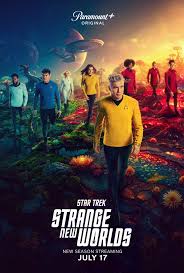
Star Trek: Strange New Worlds is about to lean harder than ever into its retro mission statement. In a new round of interviews promoting the next season, executive producers Akiva Goldsman and Alex Kurtzman revealed that season 4 of the Paramount+ series will be structured as a fully episodic run of “adventure-of-the-week” stories, setting the stage for a shorter, more serialized fifth and final season that will formally pass the Enterprise from Captain Christopher Pike to James T. Kirk.
The shift was outlined in an interview with Polygon, where the showrunners stressed that the upcoming 10-episode fourth season is designed as a collection of largely self-contained missions. While Strange New Worlds has already embraced a more old-school format than fellow modern Trek series like Discovery and Picard, its first two seasons still threaded ongoing arcs about Pike’s foreknowledge of his fate, La’An’s trauma, and the Gorn threat. According to the producers, season 4 will downplay long-running plotlines in favor of stories that reset at the end of each hour, closer to the structure of The Original Series and The Next Generation.
At the same time, Goldsman and Kurtzman confirmed that the series is heading toward an endgame. As reported by outlets including TrekMovie and Screen Rant, Paramount+ has ordered a six-episode fifth season that will serve as Strange New Worlds’ finale and focus on the formal transition of command to Kirk, played by Paul Wesley. The producers emphasized to Polygon that season 5 will feel very different from season 4, with a more heavily serialized narrative that tracks the handover of the Enterprise and locks the show’s continuity into place with the opening of The Original Series.
That two-step structure—episodic in season 4, serialized in season 5—reflects the tightrope Strange New Worlds has been walking since it launched in 2022. The show was pitched as a corrective to what some fans saw as “mystery box” fatigue in modern Trek, trading overarching conspiracies for genre-hopping one-offs: courtroom dramas, fantasy riffs, musicals, and classic morality plays. At the same time, Kurtzman’s broader “Star Trek Universe” on Paramount+ has been built on long-term character arcs and cross-series continuity. Making season 4 a purer episodic throwback lets the series indulge its “planet-of-the-week” DNA one last time, while reserving the myth-arc intensity for a focused final chapter.
The decision also ties directly into how the writers want to handle Pike’s story. From the pilot, Strange New Worlds has centered on Anson Mount’s Christopher Pike living under the shadow of a catastrophic future injury he knows is coming, thanks to his encounter with a time crystal on Discovery. Earlier seasons periodically returned to that knowledge, teasing how Pike’s acceptance of his fate shapes his command style. By walling off a mostly stand-alone fourth season, the creative team can let Pike simply be the captain of the week again—rescuing colonists, navigating first contacts, and juggling crew drama—before season 5 zooms in on the moment when his time in the chair is finally up.
Fan response to the news has been largely positive in early online chatter, with commentators on sites like Reddit’s r/StarTrek and Trek forums welcoming a full-throated embrace of episodic storytelling. Many point out that Strange New Worlds’ most acclaimed installments so far—the courtroom episode “Ad Astra per Aspera,” the Gorn horror story “All Those Who Wander,” or the Lower Decks crossover “Those Old Scientists”—already functioned as self-contained tales. At the same time, some fans are wary of the shortened six-episode final season, worrying that a compressed run may struggle to resolve Pike’s arc, cement Kirk’s rise, and pay off the ensemble’s subplots without feeling rushed.
On the industry side, Strange New Worlds’ structural pivot is another sign of how streaming genre shows are rethinking rigid season-long serialization. Disney’s Marvel and Star Wars series have already started experimenting with more standalone episodes and anthology formats, while even long-serialized animated shows like Star Trek: Lower Decks balance episodic hijinks with light continuity. By making one season almost entirely episodic and the next tightly serialized, Kurtzman’s team is effectively A/B testing two different modes of modern Trek within the same show, which could influence how future Star Trek projects are developed for Paramount+.
For now, the message from the Strange New Worlds brain trust is clear: season 4 is meant to be a celebration of why weekly, self-contained Star Trek adventures still work in 2020s TV, while season 5 will be a concentrated goodbye that locks Pike, Spock, and the Enterprise into their familiar places in franchise lore. If the plan holds, fans are looking at one more year of classic “strange new worlds” before the series’ final stretch keys directly into the era of Captain Kirk—and whatever new Star Trek project takes the baton after that.


