
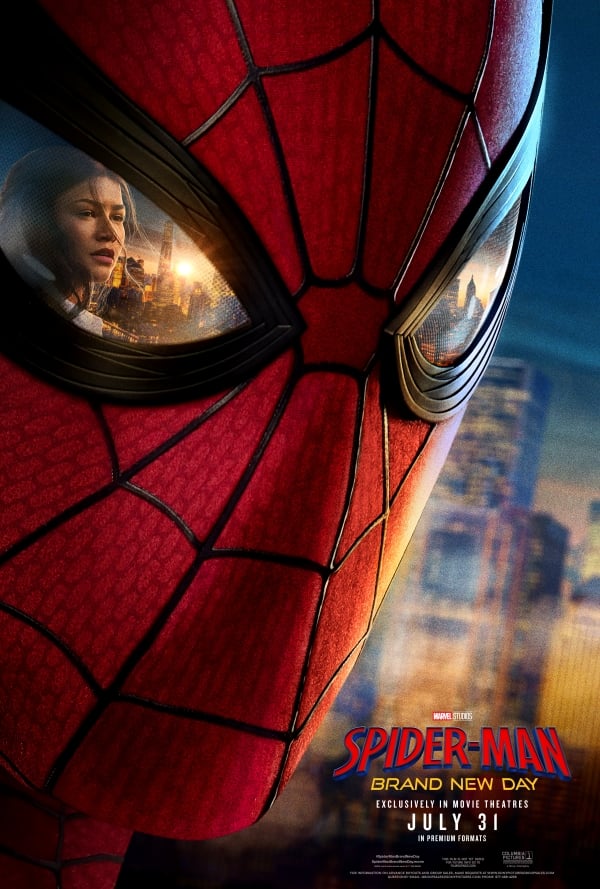
Spider-Man: Brand New Day doesn’t just close the book on Peter Parker’s post–No Way Home exile; it finally answers whether he’s the “Spider” or the “Man” – and in the process quietly lights the fuse on Marvel’s long-teased mutant era.
Brand New Day picks up four years after Peter asked Doctor Strange to erase all memory of him from the world, leaving a lonely, anonymous life where even MJ and Ned no longer know who he is. Still grieving Aunt May and convinced his loved ones are safer without him, Peter has lived as a ghost in his own story, a hero without a human anchor. The film pushes that existential crisis to the breaking point, framing everything around Jean Grey’s blunt question: “Are you the Spider, or are you the Man?” Peter’s attempt to be only the Spider leads him to copy Bruce Banner, adopting inhibitor tech that suppresses his newly emerging mutation the way Banner tries to tame the Hulk. When those inhibitors turn both heroes into pawns – Hulk into a controllable weapon, Peter into a tool for Damage Control – Brand New Day forces him to tear off the mask and the tech alike, embracing both identity and mutation in one transformative moment.
That transformation plays out against Jean Grey’s arrival as the MCU’s most overtly mutant character to date, and she’s no cameo. Held in a Department of Damage Control black site and experimented on by Bill Metzger, Jean discovers her sister Sara died in the same program, triggering an evolution in her powers that lets her immobilize a massive chunk of Manhattan inside a psychic bubble while coordinating Hand ninjas like chess pieces. Her telepathy lets her “jump” between minds and even take over Banner’s Professor Hulk body, while her trauma-fueled telekinesis becomes precise enough to manipulate thousands of people at once. Where Doctor Strange’s memory spell once robbed Peter’s friends of agency, Jean’s uncontrolled powers threaten to strip the entire city of autonomy – a dark mirror that forces Brand New Day to confront what it really means to rewrite someone else’s mind.
The ethical fulcrum of the film lands squarely between Peter’s empathy and Frank Castle’s ruthlessness. Punisher is introduced as the hardline solution to Jean: a sniper rifle, a clean kill, and no more collateral damage. The plan backfires when his bullet hits Spider-Man instead, a gut punch that reframes Frank’s crusade as another tragedy of good intentions and bad methodology. Jean’s evolved abilities become Peter’s literal lifeline; she dives into his mind and puppets his body long enough for Castle to rush him to a hospital, holding his consciousness intact until doctors stabilize him. It’s a stunning inversion of the usual “telepath as threat” trope, turning Jean into the person who refuses to let Peter die alone. When she finally leaves the city on a bus, her arc feels less like an exit and more like a proto–X-Men origin – a traumatized mutant who has seen firsthand what human institutions will do to weaponize her kind.
Peter’s real victory, though, comes not in the lab but in the quiet psychic space he invites Jean to share. Instead of fighting her, he opens his mind and offers a memory of Aunt May comforting him after discovering his secret, a moment where May’s unconditional love extends to Jean as if she were family too. Both have lost almost everything, yet Peter insists connection is still possible; he won’t abandon her, even after all the harm they’ve inflicted on each other. That willingness to be Peter Parker – vulnerable, relational, unmasked – is what finally lets him reconcile being both Spider and Man. It also ripples outward: Banner willingly lets himself be defeated and taken to a psychiatric hospital after regaining control, hinting that even the Hulk can choose help over isolation. Punisher, shaken by nearly killing the one hero who tried compassion, is forced to confront the cost of his “kill first” ethos in a world where mutants and enhanced beings are no longer hypothetical.
The emotional payoff lands in a single, deceptively small gesture: a handshake. After spending the entire film believing he must remain a stranger, Peter approaches Ned as just Peter, the guy who brought flowers to a party earlier in the movie. Ned recognizes him as that random guest, not as his former best friend – until their old secret handshake slips out of him automatically. The spell that erased Peter from everyone’s memories cracks in that instant, suggesting Strange’s magic can’t fully overwrite the deepest bonds between people. Brand New Day ends with Ned smiling and saying “Peter?”, and Peter finally accepting that he doesn’t have to be alone to be Spider-Man. MJ, seen clutching the necklace Peter once gave her atop Midtown High’s roof, still doesn’t consciously remember their relationship, but the film leaves the door open for her own quiet awakening.
Then the post-credits scene blows the story wide open. Ned’s homemade Spider-Tracer app pings a new sighting, fails to find Spidey in New York, and keeps zooming out – city, country, planet – until it locks onto a signal somewhere in deep space and flashes “Location found” alongside the promise that “Spider-Man will return.” That tag has already sparked speculation that Brand New Day is designed as a bridge into Avengers: Doomsday and Avengers: Secret Wars, with Peter pulled into the cosmic fight against Doctor Doom and whatever multiversal fallout follows. Coupled with Jean Grey’s introduction, Damage Control’s mutant experimentation, and Hulk’s reframed Gamma “mutation,” the film quietly positions Spider-Man at the center of a coming mutant saga rather than just another street-level crossover. Brand New Day answers the biggest Spidey question by insisting he is both Spider and Man – and then kicks him off the ledge into a future where being a mutant, a friend, and a hero will all collide on a much bigger stage.


