
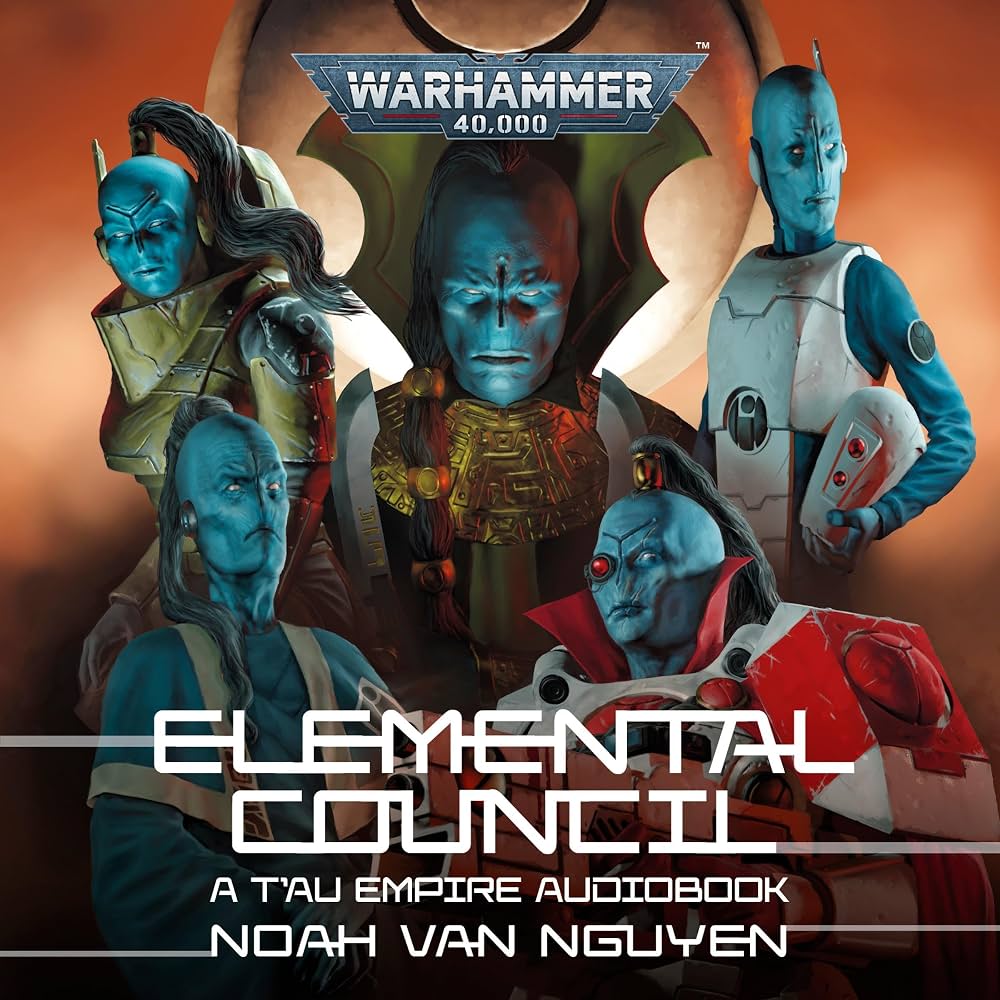
Games Workshop has taken its war on generative AI from legalese footers to the soundscape of the 41st millennium, adding a spoken anti–AI training warning to the end of its new Warhammer 40,000 audiobook, The Wicked and the Warped. The message, read out by narrator Richard Reed, explicitly forbids using the recording for data mining or training artificial intelligence systems, turning a routine copyright notice into a direct shot across the bow of the tech industry.
The audiobook adapts Robert Rath’s Necrons novel The Wicked and the Warped, a Black Library release that continues the long-running rivalry between ancient Necron overlords Trazyn the Infinite and Orikan the Diviner. The story sees the two immortal schemers entangled in the mystery of a world from the Necrons’ past, a premise that leans hard into Warhammer 40K’s mix of cosmic horror, dead civilizations, and spiteful immortals. The audio edition, released in mid-August 2026 and running over 13 hours, is performed by Reed, a familiar voice to Black Library listeners. At the close of the book, he delivers the new warning: Games Workshop reserves all rights and bars the recording from being “used or reproduced in any manner for text and datamining activities, or developing or training artificial intelligence models or systems.”
That warning doesn’t come out of nowhere. Games Workshop has been unusually blunt about generative AI, both on its web properties and in corporate filings. Black Library’s official site carries a prominent notice that any use of its content to train generative AI is “expressly prohibited,” a stance echoed in legal sections across the company’s online footprint. Earlier this year, the UK firm behind Warhammer 40,000 and Age of Sigmar implemented an internal policy banning employees from using generative AI for official content and design work, covering everything from miniature concepts and faction art to rulebook illustrations, marketing images, and tie-in fiction. CEO Kevin Rountree has repeatedly stressed in financial reports that Games Workshop does not use AI in product design or IP creation, linking that choice to protecting the “integrity and ownership” of its universe and to a commitment to “respect our human creators.”
The company has even turned potential AI scandals into opportunities to underline its approach. After fans spotted odd product imagery, including a notorious six-fingered Space Marine that looked suspiciously like an AI slip-up, Games Workshop launched internal investigations to confirm that the errors were human, not machine-made, and that staff were following anti-AI policies. Rountree described these reviews as part of a broader effort to avoid complacency on AI, saying management is monitoring how other companies are using the technology while keeping Warhammer’s creative pipeline strictly human-driven. While a few senior managers are allowed to explore AI tools in a limited, experimental capacity, the company insists that none are “excited” about deploying them in production, underscoring how out of step Warhammer’s custodians are with much of the tech world’s AI enthusiasm.
That tension is the backdrop for the new narrated warning. Over the past two years, AI training on books has become one of the most explosive fights between tech companies and the publishing world, with investigative reports alleging that firms have quietly fed massive troves of copyrighted works into their models. One report detailed how a tech giant acquired and scanned huge quantities of physical books for training data, allegedly destroying them in the process, while court filings revealed a separate initiative in which millions of books were shredded and digitized to train an AI assistant. Authors, including high-profile figures like George R.R. Martin, have responded with lawsuits accusing AI firms of infringement, leading US courts to advance new legal theories about copying, derivative works, and the limits of fair use—though definitive rulings are still pending.
For Warhammer fans, the on-air warning is both a curiosity and a clear signal. On one level, it’s a lore-adjacent oddity: in a universe where machine spirits and techno-heresy are canon, the real-world rights holders are effectively declaring AI a kind of modern heresy against their IP. On another, it situates Games Workshop at the vanguard of creative industries pushing back against the assumption that everything published is fair game for model training. Whether such verbal prohibitions ultimately carry legal weight against opaque AI data pipelines is an open question that will likely be answered in court rather than in the closing minutes of a Necron audiobook. But by embedding its stance directly into the listening experience, Games Workshop is making sure that every fan who hits play on The Wicked and the Warped hears, loud and clear, that the company’s grimdark future is one where the humans stay in charge of the stories—even if the machines are very good at reading them.


