
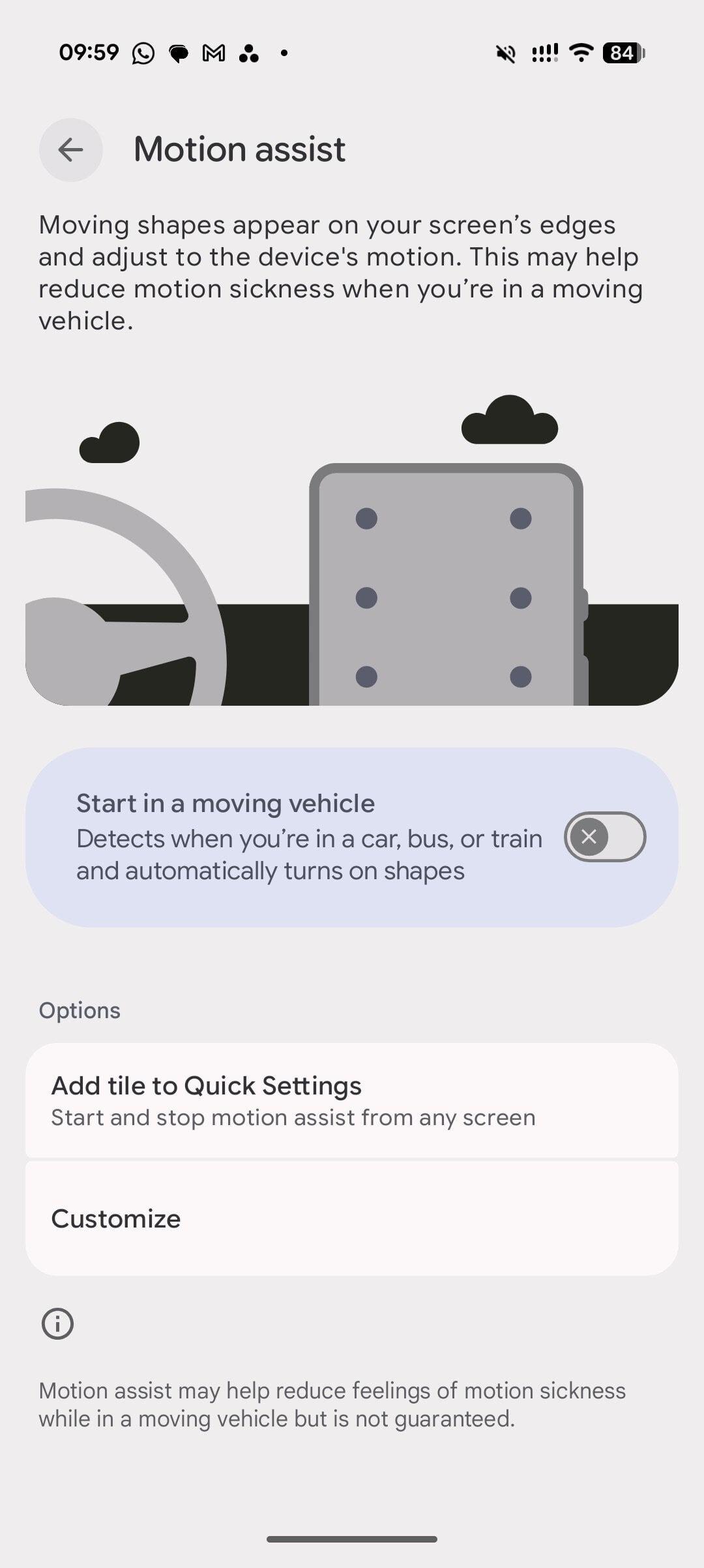
Android 17 is quietly getting one of its most sci-fi-looking upgrades yet: Motion Assist, a native anti-nausea mode that paints animated dots across your screen to help fight phone-induced car sickness. The feature is rolling out in phases to Pixel phones first, with a wider Android hardware rollout expected after Google finishes its initial testing wave.
Motion Assist’s core trick is surprisingly simple: when your phone detects that it’s in a moving vehicle, it overlays small, high-contrast dots around the edges of the display that shift in response to the car’s movement. As the vehicle turns, brakes, or accelerates, those dots glide across the perimeter of the screen in the opposite direction of the motion, visually signaling that your body is in motion even if your eyes are locked on a static app or webpage. The system draws on the phone’s accelerometer and gyroscope to track changes in speed and direction in real time, translating that sensor data into smooth, continuous movement of the dots. By giving your visual system motion cues that match what your inner ear is feeling, Google is directly targeting the sensory mismatch that scientists consider a primary cause of motion sickness.
On devices running Android 17, Motion Assist lives in the Google Play services-powered section of system settings, under the Personal and device safety category. Once enabled, it can kick in automatically whenever Android determines the phone is inside a moving vehicle, sparing users from digging through menus every time they get in a car or bus. For those who want manual control, Google also exposes Motion Assist through a Quick Settings tile, allowing you to toggle the dots on or off with a single swipe and tap from the notification shade. When the feature is active, Android posts a persistent notification confirming Motion Assist is running, with a shortcut to disable it if the shifting dots become distracting or you simply hop out of the vehicle.
Google’s approach closely mirrors Apple’s Motion Cues feature, which arrived on iOS in 2024 with its own set of moving screen indicators designed to ease discomfort when using an iPhone in transit. Like Motion Assist, Motion Cues places visual elements—dots and subtle shapes—around the display that move in sync with the phone’s motion to keep the brain’s sense of position aligned with what the inner ear detects. Android watchers had already spotted references to “Motion Cues” and related APIs in Android 17 development builds, suggesting Google had been working on its own system-level implementation for months before the company settled on the Motion Assist branding now showing up on Pixel phones.
For Android users, this marks a shift from relying on niche third-party apps to having a first-party, platform-wide solution that can sit on top of any app—from comics readers to streaming video to mobile games—without developers needing to add special code. Early reports note that the dots appear over system UI elements such as notifications and volume panels, reinforcing that Motion Assist operates as a system overlay rather than an app-by-app feature. Coverage of Android 17’s upcoming toolkit has also pointed to custom APIs tied to Motion Assist, hinting that Google may eventually let apps fine-tune how and when those motion cues appear, even if the current rollout focuses on a universal experience.
For the geek crowd, the implications are easy to imagine: longer, more comfortable reading sessions in webtoons and digital comics on the way to work, fewer queasy moments grinding mobile RPG dungeons in the back seat, and a better chance that family road trips won’t end with someone swearing off their phone for the entire ride. Because Motion Assist is still arriving in waves, there will be a period where some Pixel owners see the option in their Android 17 settings while others have to wait for a background update, but the feature’s design and its Apple-tested playbook suggest it could quickly become one of those quietly indispensable toggles you forget is on—until you turn it off and remember what phone car sickness used to feel like.


