
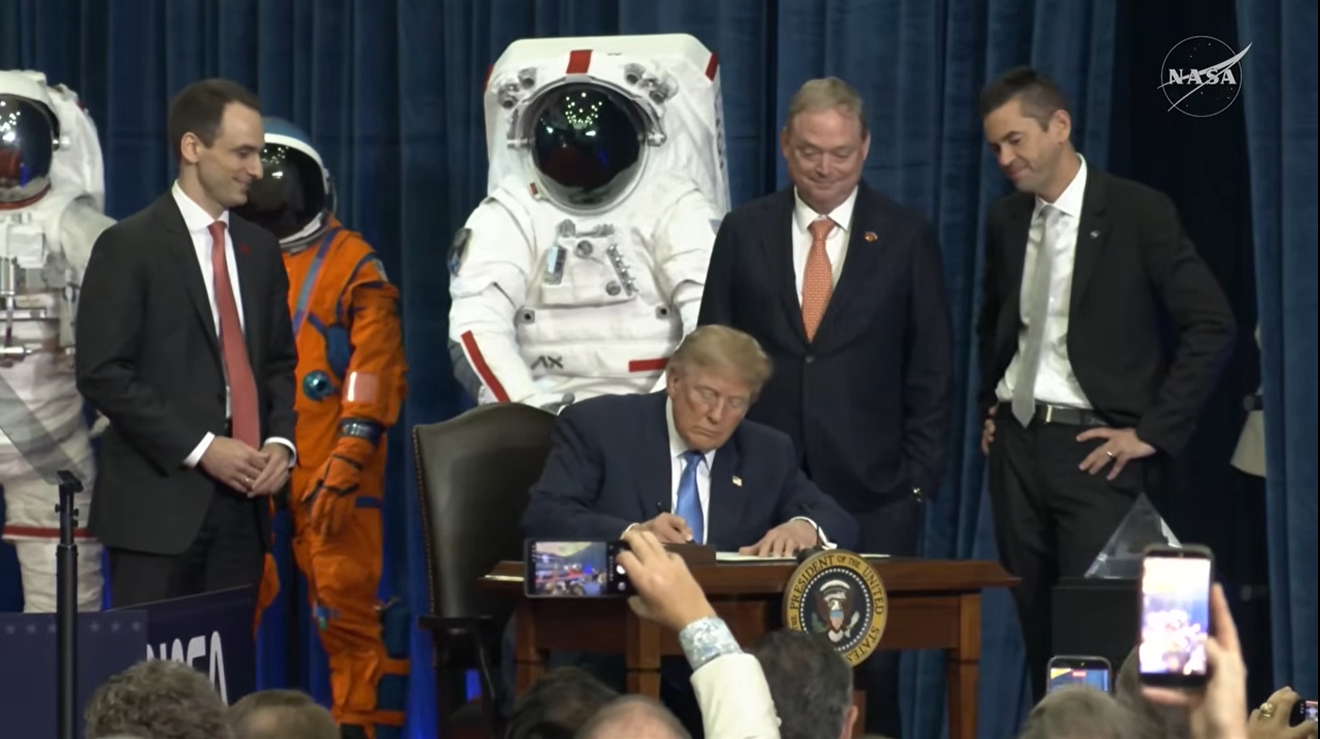
President Donald Trump signed an executive order on August 28, 2026, to begin creating a United States Space Academy during a ceremony at NASA’s Johnson Space Center in Houston, where he also awarded the Artemis II crew the Congressional Space Medal of Honor. Trump pitched the academy as a “big deal” that will train service members, engineers, and civilian operators needed for expanding Space Force missions and the booming commercial space industry.
The executive order establishes a Presidential Commission on the United States Space Academy, chaired by NASA Administrator Jared Isaacman and led day‑to‑day by Deputy Administrator Matt Anderson as executive director. According to the order, the commission will explore options for establishing the academy within NASA and make recommendations on its structure and potential locations before any campus is built. Trump and NASA officials describe the academy as serving both the military and civilian space sectors rather than functioning purely as a traditional officer‑training school.
The announcement continues Trump’s broader push to brand space as a core arena of U.S. national power that began with the creation of the U.S. Space Force as the sixth branch of the military in December 2019. Subsequent directives on ensuring American space superiority and boosting U.S. launch capacity positioned space as central to economic growth and security, setting the stage for a dedicated academy to feed that workforce. Internal NASA planning documents have even floated a “Starfleet Academy”-style institution for certifying hardware and training operators—ideas that the new Space Academy now pulls into official policy discussions.
Despite NASA’s news release describing the academy as being established at Johnson Space Center, Trump has emphasized that the final campus location has not yet been chosen and remains under study. He has repeatedly compared the planned school to West Point and other U.S. service academies, hinting at an immersive, service‑academy‑style program designed to cultivate future officers and mission leaders focused on space operations. Reuters and other outlets report that the academy is expected to serve the Space Force, NASA, and civilian spaceflight companies, giving graduates pathways into both government service and the private sector.
In his Houston remarks, Trump framed the Space Academy partly as a response to intensifying competition with China and other nations in orbit and beyond, arguing that “space is essential” to U.S. economic and security interests. The timing of the announcement—during a ceremony honoring the Artemis II crew that flew by the Moon in April—underscores how NASA’s Artemis program and long‑term lunar plans are driving demand for more specialized talent in areas such as mission operations and spacecraft engineering.
For space‑obsessed students raised on visions of Starfleet Academy, the proposed U.S. Space Academy reads like a real‑world analogue, aimed at providing a more centralized pipeline into astronaut corps, mission control, and space‑industry roles that previously required more ad‑hoc career paths. At the same time, early coverage notes that key details—from admissions standards and degree programs to how the academy will balance military training with NASA’s civilian mandate—are still vague in the executive order and will depend heavily on the commission’s recommendations over the coming year.


