
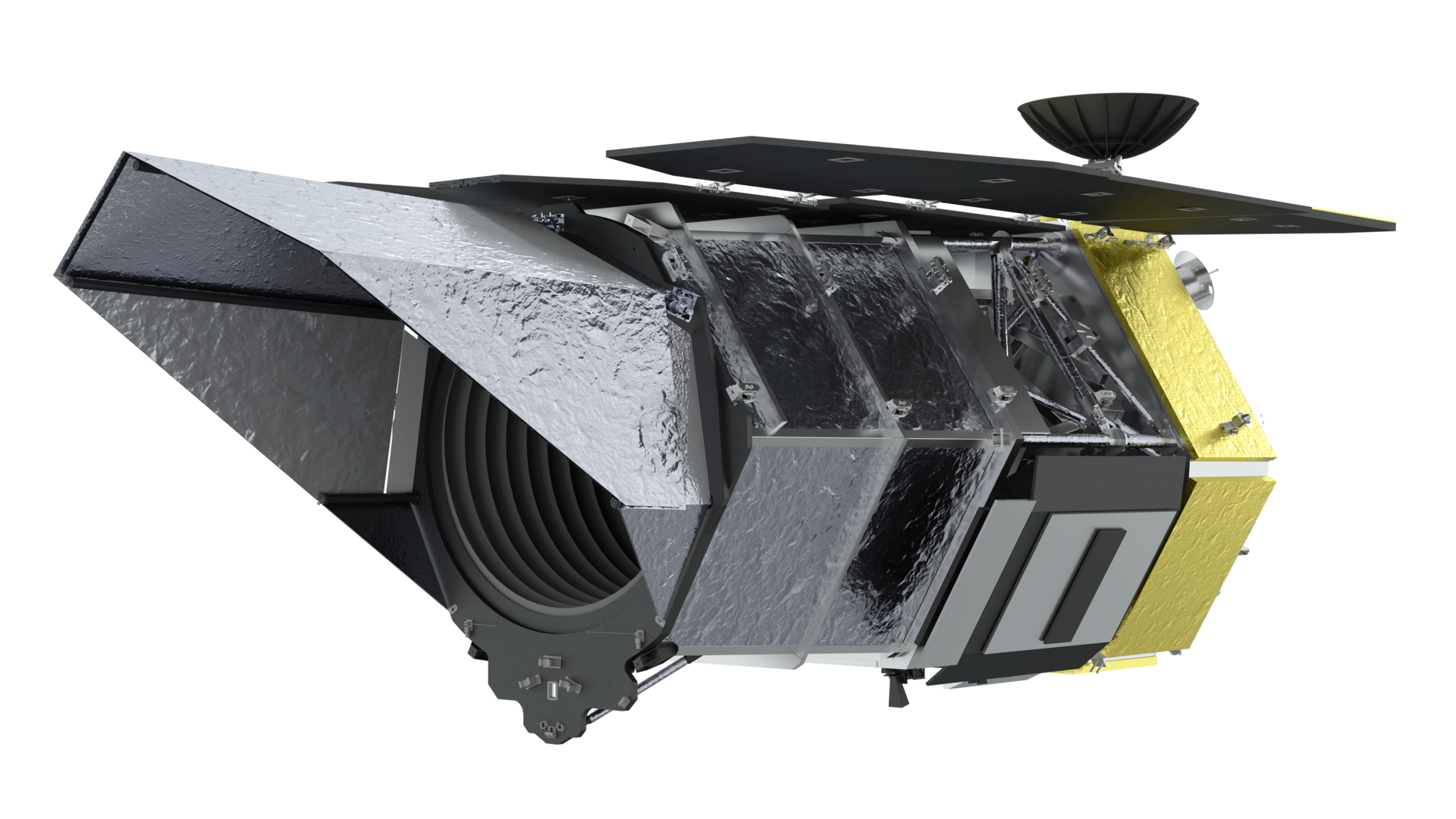
NASA’s $4.3 billion Nancy Grace Roman Space Telescope has officially joined Hubble and the James Webb Space Telescope in the agency’s flagship observatory lineup, lifting off from Kennedy Space Center aboard a SpaceX Falcon Heavy at 7:26 a.m. ET on August 30, 2026. The bus-sized spacecraft separated from its rocket minutes after launch and is now on a roughly million-mile journey toward the Sun–Earth L2 point, where it will begin a sweeping campaign to probe dark energy, dark matter, and distant exoplanets.
Roman is built to be NASA’s wide-angle cosmic surveyor, offering a field of view about 100 times larger than Hubble’s while operating in similar wavelengths of light. Whereas Hubble and Webb excel at zooming in on individual targets, Roman will tile enormous swaths of the sky, collecting data on billions of galaxies and hundreds of millions of stars to map the universe’s structure and expansion in unprecedented detail. It’s only the second NASA-led flagship astrophysics mission to reach space this century—following the 2021 launch of the James Webb Space Telescope—underscoring how rare and pivotal this new observatory is.
Under the hood, Roman is a gearhead’s dream. The telescope’s primary mirror is a 2.4-meter optic originally built for a classified National Reconnaissance Office spy satellite and later donated to NASA, giving Roman Hubble-class resolution with a very different mission profile. Its primary science instrument, the Wide Field Instrument, is a 300-megapixel visible-to-near-infrared camera and slitless spectrometer built from 18 Teledyne H4RG detectors, each with 4096 x 4096 pixels. Sensitive from roughly 0.5 to 2.3 microns, the WFI will capture patches of sky larger than the apparent size of a full Moon in a single shot, enabling Roman to cover more sky in five years than Hubble has managed in three decades and generate up to about 20 petabytes of data.
Science-wise, Roman is a dark energy and dark matter hunter first and foremost. By measuring the brightness and distances of countless Type Ia supernovae and mapping subtle distortions in galaxy shapes through weak gravitational lensing, the mission aims to pin down how fast the universe is expanding and whether dark energy’s influence has changed over cosmic time. Roman will also chart the large-scale distribution of galaxies to track baryon acoustic oscillations—ancient ripples in matter that act as “standard rulers” for cosmic distances. On the dark matter side, its ultra-precise lensing maps should reveal how invisible mass is threaded through galaxy clusters and filaments, offering new tests for models of cosmic structure formation.
For exoplanet geeks, Roman is quietly one of the most exciting missions of the decade. Using gravitational microlensing, it is expected to detect thousands of planets by watching for tiny, temporary brightening events as foreground stars and their planets warp the light of background stars. The mission also carries a cutting-edge coronagraph technology demonstration that will attempt to block out starlight so faint planetary companions can be seen directly, a crucial step toward future telescopes that could image Earth-like worlds in detail. Combined with discoveries from ground-based observatories and previous missions like Kepler and TESS, Roman’s census should dramatically sharpen the picture of how common different kinds of planetary systems are in the galaxy.
Roman’s road to the launch pad has been notably smoother than its older sibling Webb, which endured years of delays and cost growth before its 2021 liftoff. Originally conceived as the Wide Field Infrared Survey Telescope (WFIRST), the mission was renamed in 2019 to honor Nancy Grace Roman, NASA’s first chief of astronomy and a key architect of the Hubble program. NASA completed Roman’s telescope assembly and delivered it to Goddard Space Flight Center in 2025, announcing at the time that the mission remained on track for a launch no later than May 2027—a schedule Roman has now beaten with its August 2026 ascent. The reuse of a donated spy satellite mirror and a tightly managed design helped keep the observatory on budget relative to earlier flagship projects.
From here, Roman faces a multi-month cruise to L2, followed by an extended period of instrument checkouts and calibrations before science operations begin. Once fully online, its data will flow into public archives, giving professional astronomers and backyard data wranglers alike a firehose of high-resolution, wide-field imagery to mine for cosmic oddities, transient events, and new worlds. Paired with Webb’s zoomed-in spectroscopy and Hubble’s long legacy of optical imaging, Roman is poised to redefine the “big picture” of the universe—turning some of the most mind-bending questions in modern cosmology into fresh data sets waiting for the next generation of geeks to explore.


