
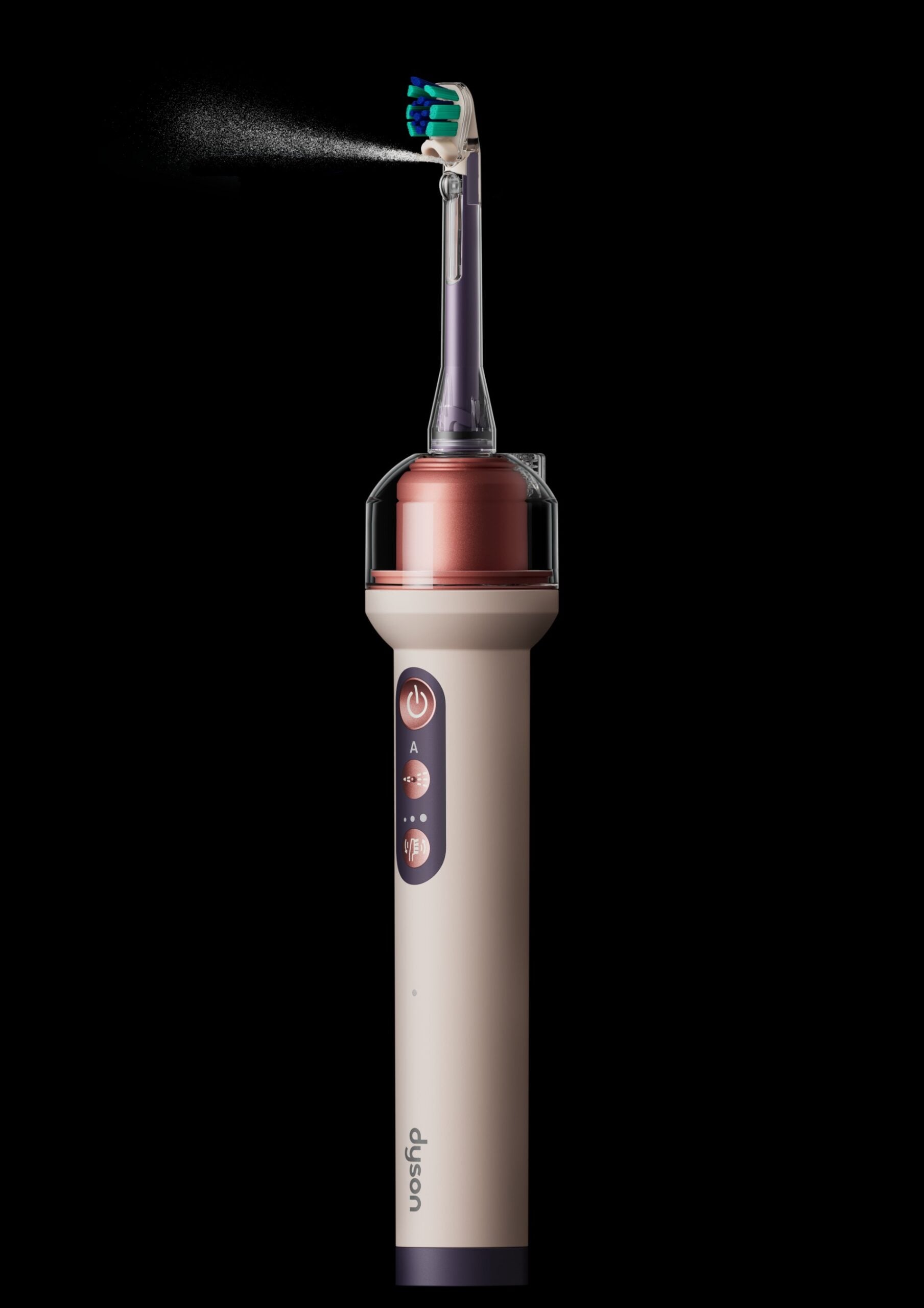
Dyson, the company that turned vacuums and hair dryers into status gadgets, is now pointing its engineering firepower at your teeth with the new CameraJet, a $499 electric toothbrush that builds a tiny camera and liquid “floss” system directly into the brush head. Launching on September 1, 2026, in Ceramic Ultra Blue and Ceramic Pink, the CameraJet is pitched as the first toothbrush that can both show you a live video feed of your mouth and automatically blast plaque from the gaps between your teeth while you brush.
At the heart of CameraJet is a 100,000‑pixel macro camera embedded in the brush head, effectively turning the toothbrush into a dental endoscope. Dyson’s “Gap Optical Targeting” system analyzes roughly 28 live images per second, using machine learning to identify interdental spaces where plaque tends to build up and triggering a conical jet of mouthrinse in about one‑hundredth of a second. The liquid floss comes from an internal reservoir that can be filled with mouthwash or water, letting the brush blast solution precisely between teeth rather than flooding your whole mouth. The camera feed links to Dyson’s companion MyDyson app, giving users a real‑time view inside their mouths and coaching them on brushing technique.
Under the hood, CameraJet still behaves like a high‑end sonic brush, with a motor operating at around 245 oscillations per second to scrub away surface plaque. A double‑bristle head is designed to handle both stain removal and everyday cleaning, while a membrane pump generates the high‑pressure micro‑jets needed for the liquid floss bursts. Dyson’s engineers also built the system around an “anti‑gravity” reservoir that maintains flow at almost any angle, so the jets can fire whether you’re attacking molars or front teeth. Out of the box, the CameraJet package includes a charging and refill dock, two brush heads, a charging cable, and a travel case, positioning it as a full dental gadget system rather than just another brush.
True to Dyson form, all this tech comes at a premium and rolls out with different bundle pricing across regions. In the US, the CameraJet toothbrush itself is priced at $499, while in markets like the UK Dyson is pairing it with a broader “Dyson Dental System” bundle that includes the dock for around £419.99. Early regional launches show steeper pricing in places like Singapore and Australia, where local sets land closer to the equivalent of $700–$800, underscoring that Dyson sees this as a flagship gadget rather than a mass‑market brush. It slots above most high‑end Oral‑B and Philips Sonicare models, leaning on the unique camera and AI flossing pitch to justify the jump.
Functionally, Dyson is trying to solve a very familiar problem: people either don’t floss, or don’t floss well, and their brushing technique is often sloppy. By tying precision liquid flossing to the act of brushing—and making the process visible on your phone—the company is betting that users will slow down, cover more of their mouths, and let the machine‑learning system pick up the slack in tricky interdental spots. Early hands‑on reports from beauty and tech outlets describe the experience as surprisingly clinical, with the live video revealing missed areas and the jets providing a noticeable “between‑teeth” clean that feels closer to a dedicated water flosser.
For gadget‑obsessed fans, the idea of a toothbrush that doubles as a mouth‑mounted camera is both irresistible and faintly dystopian, raising questions about how much intimate biometric data we’re comfortable streaming to companion apps. Dyson’s move into oral care also hints at a broader strategy: turn every boring hygiene chore into a premium, sensor‑packed device, from hair to skin to now teeth. Whether CameraJet becomes the new must‑have bathroom trophy or remains a niche toy for tech die‑hards with deep pockets, it marks one of the most aggressively sci‑fi takes on something most people still buy for under twenty bucks at the drugstore.


