
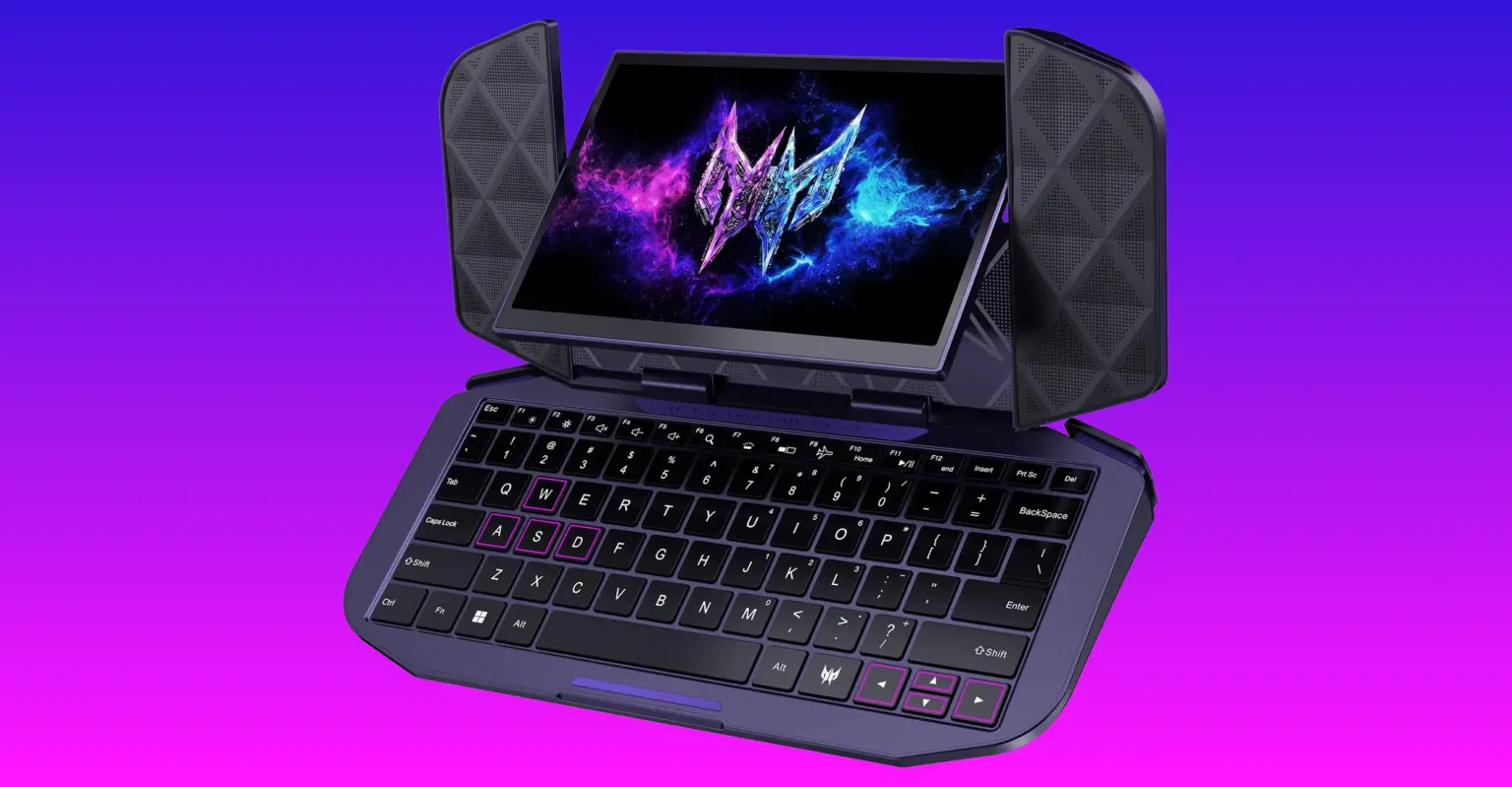
Acer is pushing the boundaries of what a PC handheld can look like with Project DualPlay Mini, an 8-inch gaming concept that morphs from a traditional controller-first device into a miniature laptop with a full keyboard. The company unveiled the prototype during its next@acer event at IFA 2026 in Berlin, showing it alongside new Predator Atlas handhelds as a glimpse at where portable gaming and ultra-mobile PCs might converge next. For now, Acer is positioning Project DualPlay Mini strictly as an experimental concept with no release date or retail plans.
At first glance, Project DualPlay Mini resembles a chunky Windows gaming handheld, complete with dual analog sticks, face buttons, and shoulder triggers flanking an 8-inch display. The magic trick happens when you open the clamshell: the screen flips up and swivels, revealing a compact, backlit physical keyboard underneath, effectively turning the device into a netbook-style mini laptop. Acer’s design tucks the grips and controls onto the back of the “lid” in laptop mode, so in handheld mode it feels like a conventional portable console, while in laptop mode it behaves more like an ultra-small notebook. The screen can also fold inward for a closed handheld configuration, reinforcing the Transformers-adjacent vibe that multiple outlets have noted.
Under the hood, Acer isn’t talking full specs yet, but the company and early hands-on reports agree that Project DualPlay Mini runs on an Intel processor and borrows cooling tech from the Predator Atlas 8 handheld. Coverage from Chinese tech press notes that DualPlay Mini uses a dual-fan setup similar to the Atlas 8, pairing one AeroBlade metal fan with a plastic counterpart to manage thermals in the cramped chassis. CNET reports that Acer plans to use Intel’s new Arc G3 handheld-focused chips—the same family powering the Predator Atlas 8—in this concept, suggesting the device is built to handle modern PC games despite its small footprint. Acer has not disclosed RAM, storage, or battery details, reinforcing that this is more a design exercise than a near-final product.
The DualPlay Mini’s whole pitch is “two devices in one”: a gaming handheld for couch sessions and a tiny productivity machine when you flip it into laptop mode. Acer describes the concept as a portable gaming system that can quickly pivot into a “mobile productivity station,” and media hands-ons echo that the keyboard feels aimed at typing documents, emails, and chat as much as it is at WASD gaming. Notebookcheck notes that Acer envisions slower, less twitchy titles for the handheld configuration, while the keyboard and track-style controls are intended for genres like shooters and MOBAs where mouse/keyboard-style inputs matter more. The device can also output to an external display, letting it serve as the brains of a tiny desktop setup when docked, a nod to the way players already treat the Steam Deck and other handheld PCs.
Despite its obvious appeal to handheld enthusiasts and modders, Acer and several outlets are clear that Project DualPlay Mini is not headed to store shelves in its current form. French coverage from IFA 2026 describes the device as a concept-only showpiece with no price or launch window, explicitly stating that Acer does not plan to commercialize it. Instead, the company appears to be using DualPlay Mini as a testbed for ideas—like the flip-and-swivel hinge, integrated keyboard, and hybrid cooling—that could trickle into future Predator or Swift systems. In a playful flourish, a Chinese report points out Morse code on the chassis spelling “Acer 50 since 1976,” tying the concept to the company’s 50th anniversary celebration and underscoring its role as a statement piece as much as a gadget.
Project DualPlay Mini also fits into a broader pattern for Acer, which previously experimented with the original Project DualPlay gaming laptop concept that used a detachable touchpad doubling as a wireless controller. That history suggests Acer is serious about blurring the line between gaming devices and productivity machines, even if most of these experiments stay in the prototype stage. In a handheld market now crowded with devices like the Steam Deck, ROG Ally, and Legion Go, DualPlay Mini’s clamshell design and focus on keyboard-centric play stand out as genuinely different, even as a concept. If nothing else, it signals that the next wave of portable gaming PCs may look less like oversized controllers and more like shape-shifting mini laptops built to multitask between work and play.


