
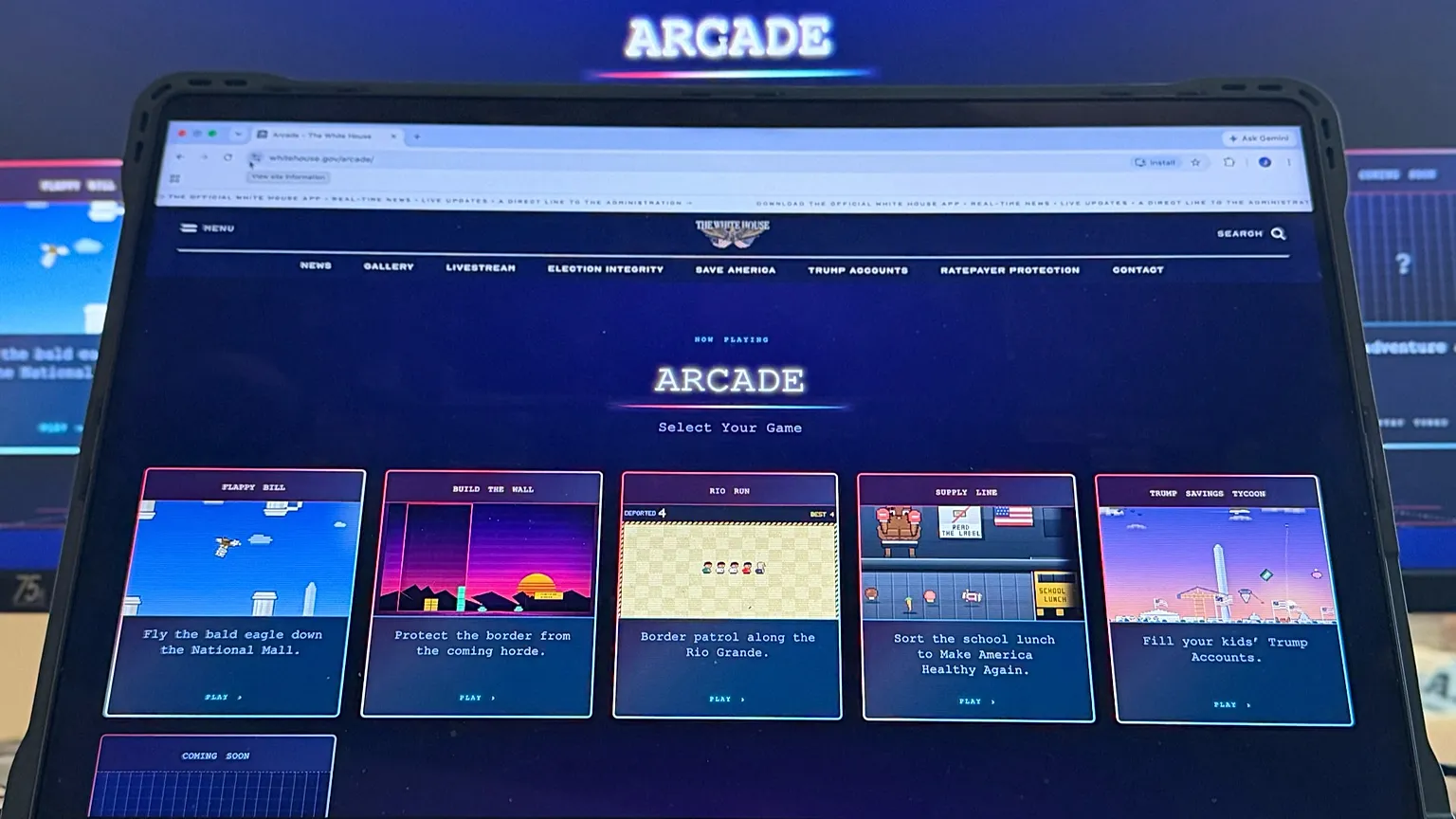
The Trump administration has turned its official web presence into a retro game portal dubbed Arcade, launching five browser titles that wrap key policy planks in pixel-art campaign messaging. The arcade went live on September 3, 2026, framed as a playful way to showcase Trump priorities in the run-up to the midterm elections. Early reactions from gamers, civil-rights groups and political observers describe the project as a bleak fusion of nostalgia aesthetics and hardline propaganda.
At launch, the site features five simple, low-resolution games modeled on classics like Tetris, Snake, Flappy Bird and Tapper, each re-skinned to promote a different Trump agenda item. Build the Wall turns Tetris into a border-defense puzzle where players stack wall segments to “protect the border from the coming horde” of migrants trying to cross into the United States. In Rio Run, a riff on Snake, an avatar resembling Trump patrols along the Rio Grande, scooping up pixelated figures that represent border crossers while avoiding collisions with his own path. Supply Line borrows from Tapper-style conveyor-belt gameplay, asking players to sort school-lunch items and reject anything that fails “Make America Healthy Again” standards. Flappy Bill mimics mobile hit Flappy Bird, tasking players with steering a bald eagle carrying legislation through a gauntlet of monuments in Washington, D.C. Rounding out the set, Trump Savings Tycoon is a simple money-catching game in which players fill children’s Trump Accounts, a branded savings plan that promises $1,000 for every child born during Trump’s term.
Thematically, the arcade leans hardest into immigration and border enforcement, with two of the five titles casting migrants as an oncoming “horde” to be blocked or rounded up. Rights groups and immigrant advocates have condemned these mechanics and slogans as dehumanizing, arguing that they reduce real people to faceless sprites in a game about containment and deportation. Even the less incendiary concepts—like healthier school lunches or children’s savings accounts—are framed through overtly branded MAGA messaging, ensuring every score chase doubles as a miniature campaign ad. A sixth game is teased as “coming soon,” signaling that the administration sees the arcade as a living platform rather than a one-off stunt.
For longtime gamers, the most jarring aspect is how openly the White House is courting gamer culture as a political target demographic. As first noted by outlets like Boing Boing and echoed in a sharply critical column from The Guardian, the project reads less like outreach and more like a “propaganda arcade” that treats beloved game templates as vessels for culture-war talking points. Other coverage from mainstream news organizations has highlighted the tonal whiplash of wrapping harsh immigration rhetoric in cheerful 8-bit art, pointing out how the games trivialize complex policy debates by reducing them to twitchy reflex challenges. For younger players already skeptical of Trump, the attempt to win hearts through browser minigames may land closer to cringe than clever.
The arcade has also raised eyebrows in the game industry over potential copyright and trademark issues. A detailed analysis from Forbes notes that major publishers behind the inspirations—companies tied to franchises like Tetris, Snake, Flappy Bird, Tapper and even Duck Hunt-style shooting galleries—have largely stayed silent, likely to avoid inflaming a politically charged situation while they assess whether the clones cross legal lines. Because the titles closely mimic mechanics and visual language from well-known games, attorneys and developers quoted in that coverage suggest the administration may be walking a fine line between homage and infringement. For now, the big platforms and gaming giants appear content to ignore Arcade rather than be dragged into a partisan fight.
In a broader context, the Trump Arcade fits into a long history of governments using interactive media to sell policy, from military recruitment titles to educational civics sims, but its aesthetic and tone mark a new level of meme-ready provocation. Here, retro visuals and simple mechanics are not just teaching tools but vehicles for slogans like “Protect the border from the coming horde,” intentionally engineered to be screenshotted, shared and debated across social platforms frequented by younger voters. Whether players embrace the games, mock them, or ignore them entirely, the White House has made one thing clear: in 2026, even classic arcade-style gameplay is fair game in the battle to define Trump’s agenda.


