
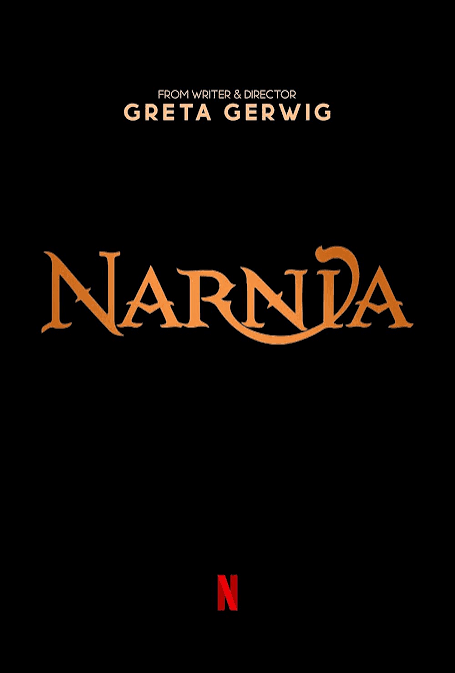
Netflix’s long-awaited return to The Chronicles of Narnia just took a tangible step forward: the streamer has unveiled the first official logo for its feature film reboot, Narnia: The Magician’s Nephew, as the movie locks in a 2027 rollout across theaters and streaming. The fresh branding arrives after years of development and schedule shuffling, signaling that Greta Gerwig’s trip to Aslan’s country is finally moving from rumor-bait to real, marketed blockbuster.
As first highlighted by fan site reports from the UK-based Cardington Studios shoot, the new logo leans into a cleaner, storybook aesthetic that departs sharply from the ornate, metallic title treatments used for the Walden Media films. Early set photography showed a stylized serif wordmark with gently curved letters, minimal embellishment, and a flatter overall look, suggesting Netflix wants this Narnia to feel less like a 2000s sword-and-sandals epic and more like a classic illustrated novel brought to life. That minimalist direction now appears to be codified in the official logo circulating with the film’s latest promotional materials, aligning the visual identity with the promise of a more faithful, literary-minded adaptation.
Narnia: The Magician’s Nephew adapts C.S. Lewis’ sixth-published but chronologically first Narnia novel, a prequel that explores the creation of Narnia, the origins of the White Witch, and the backstory of Professor Digory Kirke. The story follows children Digory and Polly as they stumble through enchanted worlds, unleash Queen Jadis into London, and ultimately witness Aslan sing Narnia into existence, making it an origin tale that could reset the cinematic franchise on a new narrative track. Unlike the previous film series, which opened with The Lion, the Witch and the Wardrobe, Netflix’s choice to start with The Magician’s Nephew positions this movie as a foundational chapter that can reintroduce Narnia’s mythology to a new generation before revisiting the more familiar wardrobe and lamppost.
The logo reveal dovetails with Netflix’s confirmation that Narnia: The Magician’s Nephew will receive a full theatrical push before landing on the platform, a major shift for a company built on day-and-date streaming drops. The film is slated for exclusive IMAX previews beginning February 10, 2027, followed by a global theatrical launch on February 12, 2027, and a Netflix streaming premiere on April 2, 2027. That roughly 45-day window mirrors traditional studio strategies and marks one of Netflix’s most aggressive “eventized” releases yet, elevating the project from just another content tile to a tentpole meant to compete head-on with studio fantasy franchises.
This milestone has been a long time coming. Netflix first secured rights to develop new film and TV projects based on The Chronicles of Narnia back in 2018, in a landmark deal with The C.S. Lewis Company that, for the first time, placed the entire book series under one studio’s control. After the Walden trilogy fizzled following The Voyage of the Dawn Treader, the franchise lay dormant until Netflix tapped Gerwig in 2023 to spearhead at least two Narnia features, with production listings later confirming Narnia: The Magician’s Nephew as the first out of the gate. Filming began in London in August 2025, anchoring the shoot at soundstages like Cardington as the adaptation moved from boardroom deal to on-set reality.
Industry watchers see this Narnia rollout as a bellwether for Netflix’s evolving identity, with commentators noting that the streamer’s willingness to hold back the film for a wide theatrical run may signal “the end of an era” for its all-in streaming-first model. For fantasy fans, the combination of a prestige filmmaker, a canonical origin story, and a newly minted logo finally gives shape to a project that has lived in the speculative realm for years, hinting at a Narnian revival that aims to balance nostalgia with a fresh visual and narrative approach. With the wardrobe doors creaking open once more, the new logo is more than just a title treatment—it is the first official sigil of Netflix’s bid to reclaim a cornerstone of 20th-century fantasy for the modern blockbuster age.


