
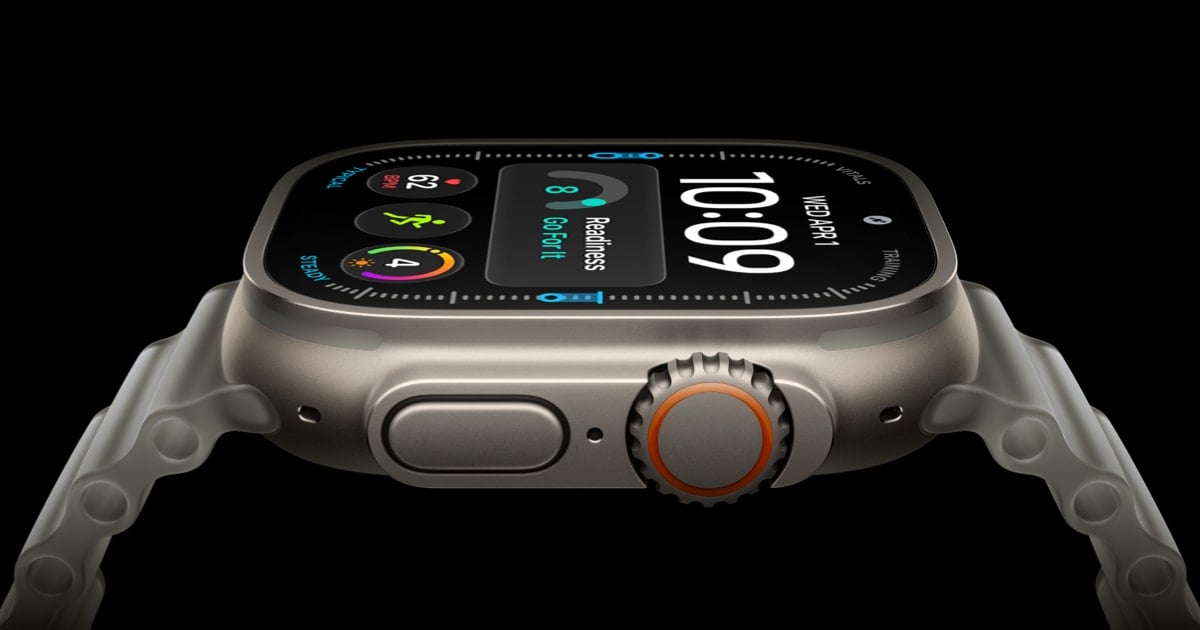
Apple and Samsung have both refreshed their “Ultra” lines for 2026, setting up a flagship smartwatch clash between the Apple Watch Ultra 4 and Samsung’s Galaxy Watch Ultra 2. As Engadget’s comparison highlights, these aren’t casual fitness bands but full-on adventure tools vying to be the default wrist computer for hikers, divers and endurance athletes.
On the wrist, the two watches broadcast very different design philosophies despite sharing titanium cases and a rugged aesthetic. Apple sticks with its signature rectangular case with rounded edges and a flat sapphire crystal, paired with the familiar Digital Crown and customizable Action button. Samsung counters with a “squircle” chassis — a rounded square body housing a fully round Super AMOLED screen — that looks more like a traditional sports watch at first glance. The Apple Watch Ultra 4 is slightly larger and heavier at around 49 x 44 x 12 mm and roughly 63 g, while the Galaxy Watch Ultra 2 trims that down to about 47.4 x 47.1 x 10.7 mm and 61.5 g, making Samsung’s watch just a bit slimmer and lighter for all-day wear.
The display specs show how each company prioritizes different aspects of outdoor readability. Apple’s Ultra 4 uses an always-on Retina LTPO OLED panel around 1.9 inches with a resolution of 422 x 514 pixels, topped by a flat sapphire crystal for extra impact protection. Samsung’s Galaxy Watch Ultra 2 goes smaller but sharper with a roughly 1.5-inch Super AMOLED screen at 498 x 498 pixels, also protected by sapphire. Raw brightness is where Samsung pulls ahead: the Ultra 2 can hit up to 5,000 nits, while Apple rates the Ultra 4 at up to 3,000 nits, a difference that should be noticeable when you’re trying to read maps or metrics in blazing sun or snow glare. In practice, Apple’s larger canvas favors complex data fields and big typography, while Samsung’s brighter circular display leans into watch-like aesthetics and extreme visibility.
Durability and water resistance are central to both devices’ pitch, and this is where the spec sheets start to diverge in interesting ways. The Apple Watch Ultra 4 carries 10 ATM water resistance, IP6X dust protection and MIL-STD-810H certification, and is rated for recreational scuba diving down to 40 meters. Samsung matches the 10 ATM rating and MIL-STD-810H but goes further with IP68 and IP69K certifications, meaning full dust protection and resilience against high-pressure, high-temperature water jets, plus EN13319 compliance associated with dive equipment. Both watches are built for tough environments, but on paper the Galaxy Watch Ultra 2 looks slightly more overbuilt for scenarios like canyoning or working around industrial washdowns, while Apple leans on dive-focused ratings and its established safety and emergency features to appeal to adventure travelers.
Under the hood, each watch runs on a next-gen platform tuned for fitness tracking and on-device intelligence. Apple’s Ultra 4 uses the new S11 chip, a 64‑bit dual‑core processor that continues the company’s push for tight integration with watchOS and iPhone health features, backed by generous 64 GB of storage for maps, music and apps. Samsung’s Galaxy Watch Ultra 2 relies on Qualcomm’s Snapdragon SW6100 (part of the latest Snapdragon Wear family), paired with 2 GB of RAM and the same 64 GB of storage, giving Wear OS plenty of room for offline playlists and downloaded routes. Battery life is one of the big deciding factors: Samsung’s 800 mAh cell is rated for up to about 60 hours with the always-on display enabled and up to 80 hours with it off, while Apple quotes up to 50 hours of typical use and a maximum of roughly 84 hours in its Low Power Mode, plus extended workout profiles for long races and expeditions. That leaves Apple promising more endurance when you lean on aggressive power-saving settings, and Samsung offering stronger “set it and forget it” longevity with bright visuals active.
Platform lock-in remains the most important non-hardware spec in this rivalry. The Apple Watch Ultra 4 is firmly tied to the iPhone ecosystem, with deep hooks into Apple’s Fitness+, Health and emergency features that simply won’t work without an iOS device. The Galaxy Watch Ultra 2, on the other hand, is built for Android users and particularly optimized around Samsung phones, leveraging Galaxy AI features and tight integration with Samsung Health. Pricing underscores the split: in multiple markets, the Apple Watch Ultra 4 lands as the premium option, starting around $799 in the US and roughly ₹109,900 in India and about 1.249 million won in South Korea, while Samsung’s Galaxy Watch Ultra 2 typically undercuts it at around $649–$699 in the US, roughly ₹64,999 in India and about 969,100 won in South Korea. For hardcore iPhone owners, Apple’s bigger screen, familiar interface and ecosystem hooks will be hard to pass up; for Android adventurers, Samsung’s brighter display, beefy battery and lower price make the Galaxy Watch Ultra 2 an especially compelling rugged companion.


