
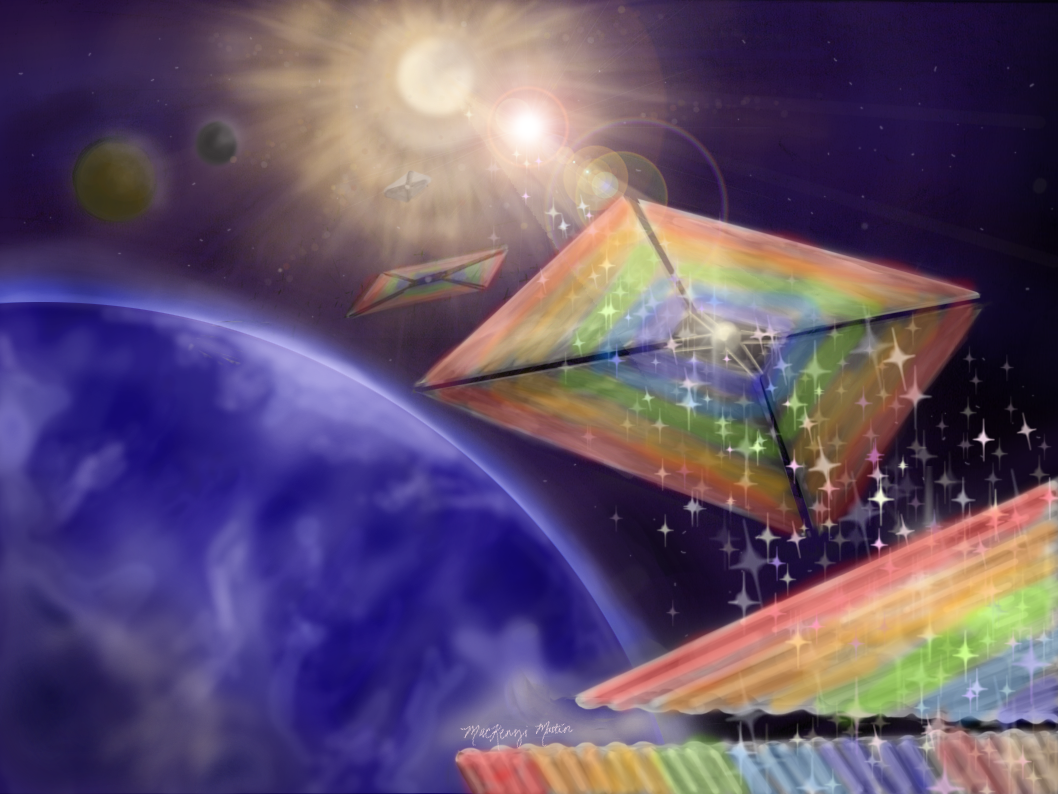
Diffractive solar sails are edging from far-future sci-fi into serious engineering proposals, with new research arguing they could drive a 100 km/s kinetic impactor into a hazardous asteroid on a collision course with Earth. Phys.org recently spotlighted a study from Beihang University that lays out how such a sail-propelled spacecraft could ram a dangerous object head-on instead of nudging it sideways, dramatically changing the playbook for planetary defense. Coverage by space-focused outlets has zeroed in on the same jaw-dropping number: a simulated impactor reaching its target at roughly 100 km/s after only a few hundred days of continuous solar sailing.
Solar sails work by harnessing radiation pressure from sunlight, exchanging momentum with photons instead of burning chemical propellant. Traditional reflective sails, like those flown by missions such as IKAROS and LightSail, tilt away from the Sun to steer, which reduces effective thrust and complicates attitude control. Diffractive sails swap metallic films for thin metamaterial sheets etched with microscopic gratings that diffract light sideways while the sail stays pointed straight at the Sun, maintaining full illumination yet producing a controllable transverse push. NASA’s Innovative Advanced Concepts (NIAC) program has funded multiple diffractive lightsail studies led by Grover Swartzlander at Rochester Institute of Technology and Amber Dubill at Johns Hopkins Applied Physics Laboratory, underscoring the agency’s interest in the technology’s promise for nimble deep-space missions.
The Beihang team’s asteroid-defense scenario leverages that sideways thrust to spiral a sailcraft inward toward the Sun, trading orbital energy for speed much like a gravity-assist maneuver, but powered purely by sunlight. In simulations discussed by Universe Today, both a reflective baseline and a diffractive sail configuration were capable of delivering an impactor to the near-Earth asteroid Apophis with a relative velocity near 100 km/s. Depending on exactly when the spacecraft launched, each concept reached the target in roughly 200–300 days, showing that even a single sail-driven probe could hit hard enough, and fast enough, to meaningfully alter an asteroid’s trajectory. Because diffractive sails can keep their faces sunward at perihelion, where temperatures and solar flux peak, they avoid some of the overheating and control issues that limit metallic reflective designs at close approach.
Planetary defense strategies have so far focused on relatively slow nudges—gravity tractors, nuclear standoff blasts, and kinetic impactors like NASA’s DART mission that strike at a few kilometers per second—so a 100 km/s hit represents a radically different regime of energy delivery. NASA is already testing conventional solar sails for small asteroid missions, including the NEA Scout cubesat that will use a reflective sail to visit near-Earth asteroid 2020 GE, demonstrating long-duration sailing in deep space. Diffractive lightsails build on that experience by offering more efficient use of photons, reduced thermal load thanks to transparent metamaterial films, and the ability to embed photovoltaic cells or electro-optic steering elements directly into the sail. For asteroid interception, those advantages translate into smaller sailcraft, simpler guidance and navigation, and the potential to launch swarms of impactors instead of a single large, expensive vehicle.
Despite the eye-catching numbers, diffractive solar sails remain in the early research and technology-demo phase rather than an operational planetary-defense system. Swartzlander’s team received NIAC Phase II support to prove out metamaterial sail films and electro-optic beam steering, with an eye toward a demonstration mission in the near future. Dubill’s Diffractive Solar Sailing concept has progressed to NIAC Phase III with roughly $2 million in funding over two years to optimize sail materials and conduct ground tests in preparation for a first spaceflight. NASA’s public materials emphasize nearer-term science applications—like probing the poles of the Sun or hovering above Earth’s poles for continuous monitoring—while acknowledging that the same maneuverability could eventually support ambitious targets such as fast interplanetary transfers or asteroid diversion.
For now, the killer-asteroid scenario lives on paper and in simulations, but it vividly illustrates how a technology born in optics labs could, in a few development cycles, become a literal sunlight-powered spear for protecting the planet. It also puts a firmly science-based spin on a familiar geek trope, echoing decades of anime, tabletop campaigns, and space opera novels that imagined civilization-saving megaweapons powered by nothing more exotic than the star they orbit. If diffractive sails deliver on NASA’s expectations and the Beihang concept holds up under further scrutiny, future planetary-defense planners may find themselves adding solar sail impactor alongside gravity tractors and nukes in their playbooks—a quiet revolution driven by clever optics rather than bigger rockets.
Image Credits
In-Article Image Credits
Concept art from NASA depicting a diffractive solar sail. Original title of "Diffractive lightsail concept". via Wikimedia Commons by NASA (MacKenzi Martin) with usage type - Public DomainFeatured Image Credit
Concept art from NASA depicting a diffractive solar sail. Original title of "Diffractive lightsail concept". via Wikimedia Commons by NASA (MacKenzi Martin) with usage type - Public Domain


