
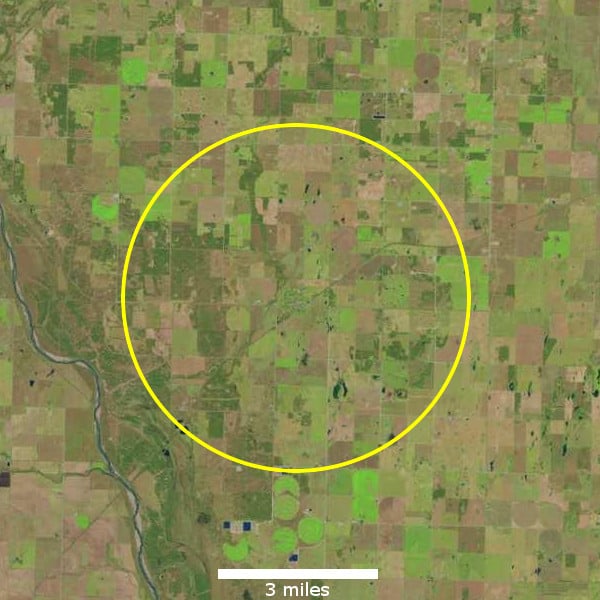
Deep beneath the quiet farm town of Ames, Oklahoma, a buried impact crater just had its cosmic birthday moved by roughly 100 million years—and that revision links the strike to one of Earth’s great mass extinctions instead of a much older meteor shower.
Researchers at The University of Texas at Austin’s Jackson School of Geosciences have re-dated the Ames impact structure and found that the meteorite hit around 370 million years ago in the Late Devonian, not ~470 million years ago in the Ordovician as long believed. The team used high-precision uranium–lead dating on zircon crystals locked inside shocked, impact-melted granites from the crater, pinning the event at 369.7 ± 5.9 million years ago—a result that matches independent crater-age estimates compiled by planetary scientists.
For decades, geologists placed the Ames crater firmly in the early to middle Ordovician based on the age of sedimentary rocks draped over the structure, including the Oil Creek Shale, and biostratigraphic fossils recovered from the region. Those estimates—typically in the 460–475 million-year range—made Ames part of the narrative around the Ordovician meteor event, a spike in L-chondrite asteroid fragments that peppered the planet and left a trail of craters across North America and Europe. The new zircon dates directly contradict that older picture, forcing scientists to decouple Ames from the Ordovician bombardment and instead slot it into the closing chapters of the Devonian.
That Late Devonian timing matters because it coincides almost exactly with the Frasnian–Famennian boundary, home to the “Upper Kellwasser Crisis”—one of the five biggest mass extinctions in Earth history, marked by catastrophic biodiversity loss in marine ecosystems. The new study notes that its crater age overlaps the best current constraints on this extinction interval, suggesting the Ames impact might be part of a still-emerging pattern of environmental stress, volcanism, and possible impact events that together reshaped life on the planet. While the paper stops short of claiming Ames caused the extinction, tying a buried Midwestern astrobleme to a global biological crisis gives researchers a fresh data point in longstanding debates about what actually killed off so many Devonian species.
Even before its age flip, Ames was a geological oddity: a complex hypervelocity impact crater roughly 14–16 kilometers across, with a central uplift ringed by faulted rims, all buried under nearly 3 kilometers of Ordovician through Permian sediment. Discovered only in 1991 during seismic surveys, the crater quickly became famous in petroleum circles for its prolific reservoirs in fractured Arbuckle dolomite and uplifted Precambrian basement rock—so much so that government reports have described Ames as possibly the largest known productive astrobleme on Earth, with some wells individually yielding millions of barrels of oil. Today, around a hundred wells tapping the structure and its surroundings produce a significant share of Oklahoma’s hydrocarbons, making the crater a literal engine of the state’s energy economy.
Recasting Ames as Devonian rather than Ordovician doesn’t change the physics of the impact or the shape of the crater, but it does challenge how geologists date buried structures using overlying rock layers and fossil assemblages—a method that has underpinned the age assignments of several subsurface craters worldwide. The new work argues that relying solely on biostratigraphy can mislead, especially in complex basins where impacts disrupt stratigraphy and later tectonics shuffle the deck, and it highlights high-precision zircon geochronology as a crucial reality check for other astroblemes whose ages remain tied to indirect evidence.


