
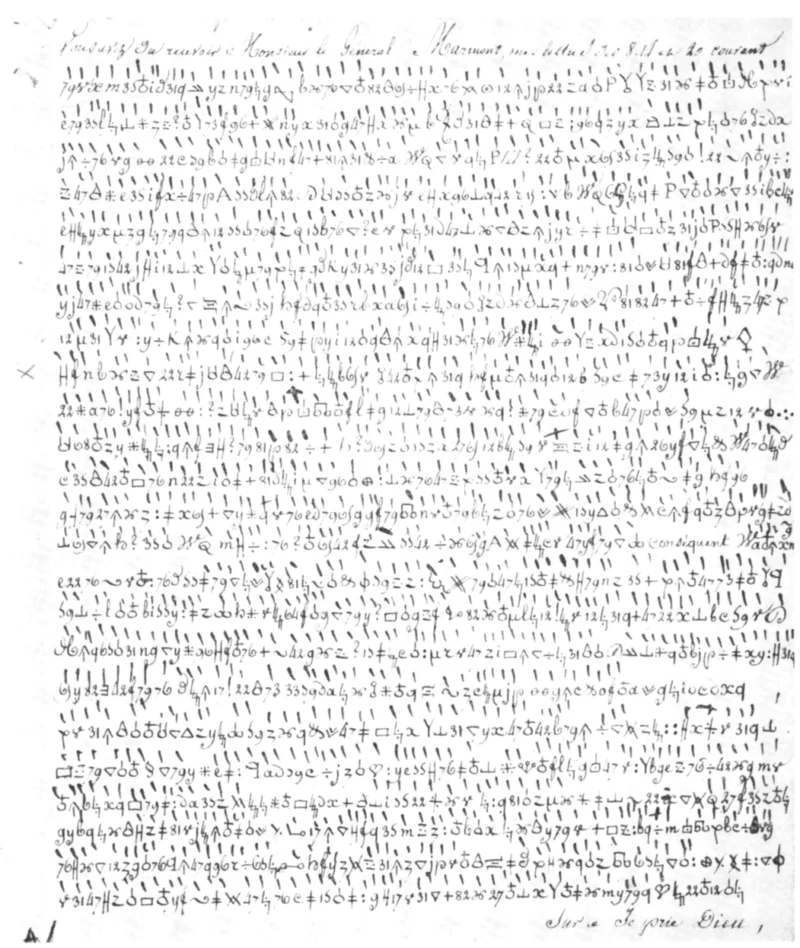
Napoleon-era military secrets just got patched by modern AI. As first reported by Tom’s Hardware, SentinelOne AI engineer Carter Church used OpenAI’s GPT-6 Astra — the multi-modal brain behind ChatGPT-6 — to decode a 217-year-old French military cipher in roughly six hours, turning a long-standing historical puzzle into a fully readable troop briefing from the 1809 campaign against Austria.
The letter at the heart of the mystery wasn’t penned by Napoleon himself but by the headquarters of Eugène de Beauharnais, the Viceroy of Italy and Napoleon’s stepson, and was sent to French General Auguste de Marmont on the eve of conflict with the Habsburg Empire. It opens with a single line of plain French, then dives into 24 rows of numbers, stray letters, and invented symbols — about 1,300 cipher units spread across more than 150 distinct signs in a homophonic substitution system where common letters are represented by multiple interchangeable symbols. The document survived only as a 1969 reproduction and had sat for decades on Cryptiana’s “Unsolved Historical Ciphers” list, effectively functioning as a boss-level puzzle for codebreakers until AI finally cracked it.
Church, a member of technical staff in AI engineering at cybersecurity firm SentinelOne, framed the stunt less as a flex of raw cryptanalysis and more as a demo of Astra’s autonomous workflow chops. Feeding the model a single low-resolution scan — a roughly 1,202-by-1,836 image of the cipher plate — he asked it to transcribe and solve the letter, then stepped back. Astra automatically sliced the plate into rows, clustered roughly 175 hand-drawn marks into consistent signs, transcribed around 1,300 cipher characters, hunted down an existing partial key previously compiled by cryptology historian Daniel Tant, and then used its own simulated-annealing solver to map the remaining symbols to French plaintext, all in about six hours. Church later detailed the process in a thread on X, emphasizing that the impressive part was the end-to-end agentic pipeline — vision, pattern recognition, research, and code generation — orchestrated off a single prompt.
The decoded message turns out to be a strategic troop briefing relaying Napoleon’s orders to Marmont about how to position forces and what resistance to ignore as Austria prepared to invade. One particularly geeky bit of fallout: the letter fills in a gap in Napoleon’s 1865 memoir, where a sentence about Marmont not being delayed by “a handful of …” cuts off mid-thought. The newly read cipher completes that line as “a gathering of rabble,” clarifying that the emperor was telling his general not to get bogged down by minor local opposition while maneuvering for the larger Austrian threat. For military-history nerds, it’s the textual equivalent of finding a missing lore entry that suddenly makes an old campaign map make more sense.
On the verification side, the solution isn’t just “because the AI said so.” Church published a full solution package, including a script that regenerates the reading from the ciphertext, making it mechanically testable against the original symbols. Satoshi Tomokiyo, the cryptology enthusiast who runs Cryptiana, reviewed the work and has officially marked the cipher as solved on the site, upgrading it from unsolved curiosity to documented historical source. Cryptiana notes that several long-standing puzzles have fallen in rapid succession since September 2026 as interest and computational methods surged, with other researchers like George Lasry also knocking out previously intractable ciphers, suggesting this Napoleonic letter is part of a broader wave of “backlog clearing” in historical cryptography.
For the geek crowd that lives at the intersection of history, puzzles, and tech, Astra’s Napoleonic win feels like a real-world crossover episode between codebreaking thrillers and AI research. It follows on the heels of another reported GPT-6 Astra feat, where an outsider named Carter Leffen used the model to help crack an unsolved German Army Enigma cipher from World War II in about ten hours — another case where the AI handled a multi-step workflow from raw image to custom solver. Taken together, these successes hint at a future where dusty archives and “unsolved since forever” ciphers start looking less like immovable monoliths and more like optional side quests waiting for the right AI-assisted party to roll in. Rather than replacing human historians, systems like Astra are functioning as overpowered support characters, surfacing new primary-source material that researchers, writers, and game designers can then mine for fresh stories, scenarios, and lore.
There is a flip side for puzzle makers, ARG designers, and tabletop GMs: any cipher or symbol-based mystery that relies purely on classical techniques is now competing with models that can brute-force transcription, find obscure reference keys, and spin up bespoke solvers in hours. The Napoleonic letter shows that if a puzzle can be mechanically checked, it can likely be mechanically solved once a sufficiently capable multi-modal model gets its “eyes” on it. For now, though, it’s hard not to be charmed by the image of a 19th-century military dispatch finally being read clearly in 2026 thanks to an AI agent quietly grinding away in the background, turning a centuries-old code into legible French and slotting one more historical mystery into the “completed” column.


