
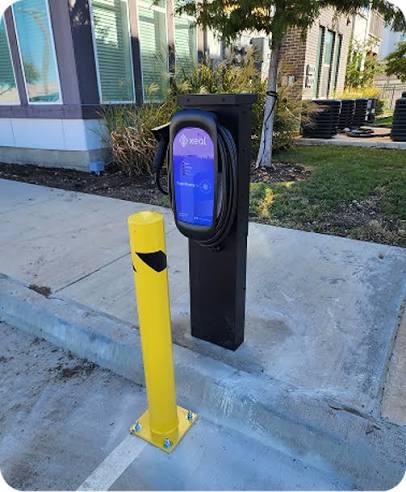
EV charging startup Xeal is about to turn a very unglamorous piece of infrastructure into something straight out of a cyberpunk novel: a nationwide edge AI network built into roadside EV charging lots and parking garages, powered by more than 100,000 Nvidia GPUs. The company has launched a platform called Laitent, which it bills as the world’s first edge inference compute network that runs on idle EV charging capacity, effectively converting underused electrical headroom into GPU horsepower.
Xeal’s pitch hinges on a quirk of how EV charging sites are permitted and built in the US. The company says it already operates more than 1,600 charging locations with over 200 megawatts of permitted, installed electrical infrastructure, but those sites typically draw less than 10% of their allowed capacity in day-to-day use. Rather than leaving the remaining 90% of potential power idle while chargers wait for cars, Xeal’s Laitent software dynamically routes that unused capacity into compute pods, allowing the same grid connection to support EVs and AI workloads without new interconnect approvals or water-intensive cooling systems. Co-founder and CEO Nikhil Bharadwaj frames Laitent as the fastest way to bring new compute online in dense metro areas, sidestepping one of the hardest parts of building new data centers: securing grid interconnects and utility upgrades.
The physical backbone of this scheme is the Laitent Pod, a cabinet roughly the size of a single parking space that hides a small data center behind a mundane street-furniture silhouette. Each pod can house up to 48 Nvidia GPUs from the Hopper or Blackwell Ultra families, putting tens of thousands of cores and multiple racks’ worth of inference performance into a footprint normally reserved for a compact car. Xeal says the pods use self-contained, independent cooling and do not require any water hookup, which lets them sit in locations where a traditional data center would be impractical or impossible. The enclosures are designed to withstand outdoor conditions and meet NEMA 4 standards, and the company claims they operate at under 65 decibels—roughly washing-machine levels—so they can coexist with nearby apartments and offices without sounding like a jet engine. According to Xeal, the units can be installed and brought online in hours, turning a regular parking lot into a slice of the cloud on extremely short notice.
While the hardware is eye-catching, the strategic play is what Xeal calls its “Metro Edge” footprint: seeding Laitent Pods across metropolitan areas instead of isolating compute in remote hyperscale campuses. By pushing inference GPUs close to users and devices, the company says it can deliver sub-20-millisecond latency for AI workloads, a marked improvement over round-trips to far-flung data centers. Xeal is a member of Nvidia Inception, and Nvidia representatives have publicly praised Laitent as an inventive way to bring low-latency inference closer to customers while reusing infrastructure that already exists. To pull this off, Xeal has lined up partners including Rafay Systems for infrastructure orchestration and Spectrum Business for connectivity, positioning Laitent as a full-stack platform rather than just a rack of GPUs in a parking lot.
This isn’t the first time someone has floated the idea of turning transportation assets into a distributed compute grid, but Xeal’s approach is one of the most concrete so far. Elon Musk previously talked about tapping idle Tesla vehicles for “100 gigawatts of inference” when they’re parked and “bored,” effectively turning millions of cars into a rolling data center. Other players, such as Forum Edge AI, are experimenting with placing inference hardware at existing powered sites and mobile towers to bring AI closer to end users. Xeal’s twist is to exploit the idle capacity in EV charging infrastructure—an asset class that is already dense in urban cores and commercial properties where latency-sensitive AI applications, from AR overlays to interactive assistants, are likely to live.
Of course, weaving valuable GPUs into public-facing roadside cabinets raises some distinctly non-virtual concerns. EV charging stations have already become targets for thieves looking to strip copper-rich charging cables for scrap, and stuffing a pod with up to 48 Nvidia Blackwell GPUs could put roughly $2 million worth of hardware in a single enclosure based on 2024-era pricing estimates. That mix of high-value silicon and everyday access means operators will need serious security: surveillance, hardened enclosures, possibly physical guards or tighter access controls, all layered on top of the usual challenges of keeping outdoor electronics reliable in punishing weather. Xeal’s materials emphasize that Laitent Pods are built for outdoor use and utility-like deployment, but the real test will come when the first production units roll out and face the dual realities of curious bystanders and determined thieves.
For AI developers, studios, and even game and app makers, Xeal’s plan hints at a future where GPU slices live not just in distant hyperscale farms but embedded in the urban fabric—next to apartment garages, mall parking lots, and office parks. If Laitent delivers on its sub-20-millisecond latency claims, it could give edge-heavy applications—think real-time NPC generation in AR games, responsive city-scale simulations, or low-lag AI assistants on personal devices—a new kind of infrastructure to target, one that scales city by city instead of region by region. Xeal says the first Laitent Pod will go live with real estate partner JVM Realty by the end of 2026, so the coming year will reveal whether turning EV chargers into AI mini–data centers is a clever reuse of idle power or just a very expensive science experiment hiding in plain sight.


