
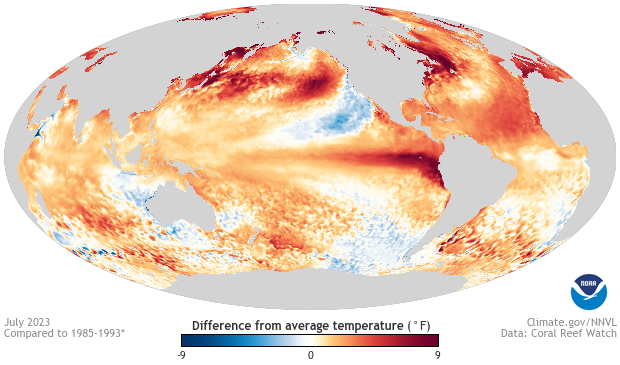
During the 2023–2024 El Niño, roughly three-quarters of the planet’s tropical forest belt spent at least half a year locked in an unprecedented combo of extreme heat and severe drought. That’s not just a freak event, according to a new study in the journal Earth’s Future—it’s a preview of the “new normal” scientists say we’re likely to face over the next two decades if greenhouse gas emissions don’t drop fast. As first reported by Phys.org, those forests weren’t just hotter or drier than usual; they were pushed into compound stress levels the historical record has never seen before.
To understand why this matters, you have to zoom out to what made the 2023–24 El Niño so intense. In the equatorial Pacific, sea surface temperatures during the event climbed to around 2 °C above average, a spike that helped drive global temperatures to new records and reorganized rainfall patterns across the tropics. That warming typically dries out Indonesia, Southeast Asia, and northern Australia, turning normally wet forests into tinderboxes and fueling fire seasons that can run out of control. NASA’s Earth Observatory has already flagged the 2023–24 episode for its role in severe Amazon drought, record-high ocean temperatures, and precipitation extremes elsewhere in the tropics.
The new “hot drought” study slots into a growing body of work showing that recent El Niño events have become brutal stress tests for tropical forests. Research published in Nature describes back-to-back hot droughts in the Amazon as a window into a future “hypertropical” climate, where longer dry seasons and higher temperatures hammer trees’ ability to move water and carbon. Another analysis of understory conditions in the eastern Amazon found a sudden jump of roughly 0.7–1.6 °C in forest-floor air temperatures during the 2023–24 event, along with anomalously low soil moisture lasting more than a year—clear evidence of a sharp, sustained thermal shock to ecosystems that evolved in much cooler, wetter conditions.
On the ground, that shock showed up in stark, physical ways. A detailed study of the 2023–24 Amazon drought reports delayed onset of the rainy season, record-low river levels, and widespread heat waves that stretched from mid-2023 into 2024, disrupting transport routes, fisheries, and local communities. Separate modeling work on intact Amazon forests shows that between July 2023 and April 2024, average air temperatures over these forests were about 1.4 °C above the previous 30-year mean, and that gross primary productivity—the rate at which plants convert sunlight into biomass—fell more sharply than in any other major drought of recent decades. Layered on top of that, new research finds that wildfire-driven ozone pollution during the 2023–24 drought almost doubled relative to the previous decade, further weakening surviving trees’ ability to pull carbon out of the atmosphere.
What makes the latest Earth’s Future study so alarming is its global reach. Instead of focusing on one basin like the Amazon, it tracks compound hot-and-dry extremes across tropical forests worldwide during the 2023–24 El Niño, then asks how often similar conditions show up in climate model projections for the next 20 years. The answer: if emissions continue roughly on their current path, the kind of six-month-plus, record-breaking heat-and-drought combo just witnessed will cease to be “rare” and instead become a recurring feature of life in the tropics. That matches broader humanitarian assessments warning that this El Niño has already driven droughts, wildfires, floods, and heatwaves in vulnerable regions from Central and northern South America to Southeast Asia and the Pacific, with more impacts expected as background warming ratchets up.
There is a sliver of hopeful news buried in the data. Another Earth’s Future study finds that El Niño and warming in parts of the tropical Atlantic can provide an early warning signal for extreme Amazon heat as much as seven months in advance, using a combination of historical climate records and machine learning to flag upcoming compound hot-dry events. Better forecasting won’t stop droughts, but it can give governments, Indigenous communities, and land managers more lead time to prepare—whether that means closing fire-prone areas, shoring up water supplies, or adjusting logging and agriculture plans. Still, the core message of the new tropical forest analysis is blunt: without aggressive cuts to greenhouse gas emissions, the “once-in-a-generation” hot drought that hit during the 2023–24 El Niño is likely to feel less like a disaster movie and more like the standard climate backdrop for the world’s rainforests—and everything that depends on them.
Image Credits
In-Article Image Credits
Sea Surface anomalies across the Earth in July 2023 during the 2023-2024 El Niño event via Wikimedia Commons by NOAA with usage type - Public DomainFeatured Image Credit
Sea Surface anomalies across the Earth in July 2023 during the 2023-2024 El Niño event via Wikimedia Commons by NOAA with usage type - Public Domain


