
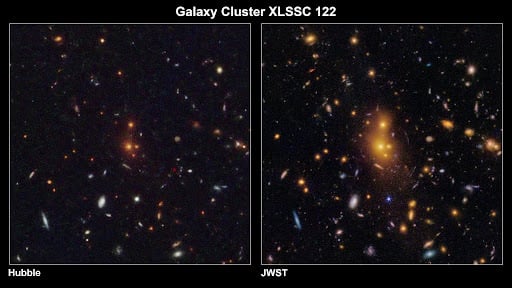
NASA’s James Webb Space Telescope has uncovered a galaxy cluster that appears to have grown up far earlier than cosmological models expected. Known as XLSSC 122, the structure existed roughly 10.4 billion years ago, when the universe was only a few billion years old, yet its dark matter is already packed into a remarkably organized central core. ScienceDaily reports that the result comes from three related studies examining the cluster’s lensing, merger activity, and faint diffuse starlight.
XLSSC 122 was first identified in 2014 through an X-ray survey conducted by the European Space Agency’s XMM-Newton spacecraft. Earlier Hubble observations established its distance and hinted that the cluster looked unusually developed for its era. Webb supplied the decisive upgrade: its infrared imaging revealed enormous curved arcs around the cluster’s center, the telltale signature of strong gravitational lensing. The cluster’s gravity bends light from galaxies behind it, allowing astronomers to reconstruct the otherwise invisible mass responsible for the distortion.
That mass map is especially important because ordinary matter accounts for only a small portion of a galaxy cluster’s gravitational influence. By combining strong lensing near the core with weaker lensing farther out, plus X-ray and radio observations, researchers found that XLSSC 122 is not a finished, static object. It is still merging and assembling, even as much of its dark matter has settled into a concentrated central region. The tension between those two traits—dynamic growth and unexpectedly mature structure—is what makes the cluster a challenge for standard models of cosmic evolution.
The observations also provide an unusually direct look at the cluster’s intracluster light, the dim glow of stars that have been stripped from individual galaxies and now drift through the space between them. A study led by Hyungjin Joo describes this as the earliest known detection of intracluster light, at a redshift of about 2. The team detected diffuse emission extending hundreds of kiloparsecs from the brightest cluster galaxy, with the intracluster-light distribution and the central dark-matter map showing a striking morphological match.
That correspondence could give astronomers a new, visible way to estimate where dark matter is concentrated. Dark matter does not emit or reflect light, so researchers normally infer its presence through gravitational effects on galaxies, gas, or background light. If the relationship between intracluster light and dark matter holds across more ancient clusters, faint starlight could become a useful complement to lensing—particularly in systems too distant or complicated for a clean mass reconstruction.
XLSSC 122 is not being presented as proof that cosmology is broken. One unusually advanced cluster could still be an outlier, and the researchers say a much larger sample is needed to determine whether this early maturity is rare or part of a broader pattern. The next step is to locate dozens, potentially hundreds, of comparable clusters using wide-area X-ray and radio surveys, including searches based on the Sunyaev–Zel’dovich effect. Webb’s narrow field of view makes it better suited to studying promising targets than sweeping the sky, so those surveys will help astronomers decide which cosmic time capsules deserve a closer look.


