
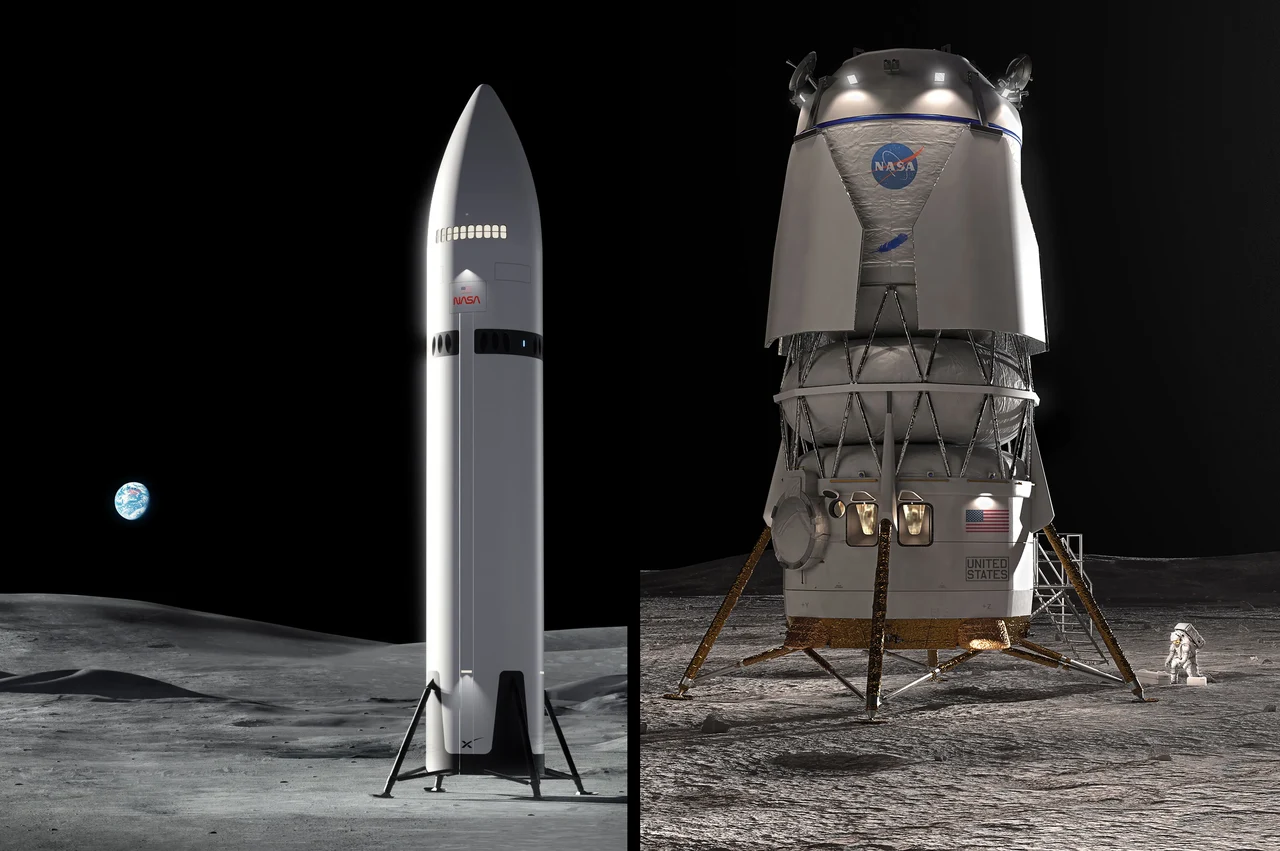
NASA’s Artemis III mission is taking a surprising detour: instead of carrying astronauts around the Moon and down to its surface, the 2027 flight will remain in low Earth orbit and rehearse the technology needed for a later landing. The revised plan may sound less dramatic than the original mission profile, but it turns Artemis III into a critical test of whether NASA’s spacecraft and commercial landers can work together before astronauts attempt the far more dangerous journey to the lunar surface.
As Wired reported, planetary scientist Barbara Cohen described Artemis III as an Earth-orbiting mission carrying astronauts aboard Orion. NASA’s own mission outline says the four-person crew will demonstrate rendezvous and docking operations between Orion and one or both commercial human landing systems developed by SpaceX and Blue Origin. The agency says those tests are intended to reduce risk ahead of future lunar surface missions.
The architecture is essentially a full-scale systems rehearsal. The crew will launch from Kennedy Space Center aboard NASA’s Space Launch System rocket and Orion spacecraft, then practice meeting and connecting with test versions of the landers in orbit. NASA’s human-landing-system program says both SpaceX and Blue Origin are expected to fly test articles for the demonstration, giving flight controllers and astronauts a chance to validate procedures before attempting the same kind of transfer around the Moon. NASA explains the test plan here.
The change also reshuffles the headline moment of the Artemis campaign. Artemis IV is now the mission NASA identifies for the first crewed Artemis landing, with launch targeted for early 2028. Its crew is expected to travel to lunar orbit, transfer to a commercial lander, and send two astronauts to the Moon’s south-polar region for roughly a week of exploration and science. NASA’s Artemis IV profile says the selected lander provider will depend on readiness, keeping the schedule tied to progress by SpaceX and Blue Origin.
NASA has already named Artemis III’s crew: Commander Randy Bresnik, European Space Agency pilot Luca Parmitano, and mission specialists Andre Douglas and Frank Rubio. Bob Hines is the backup astronaut. The crew’s work will be less about collecting lunar rocks than proving that the Orion vehicle, commercial landers, docking systems, spacesuits, communications, and mission operations can function as one integrated stack. NASA’s crew announcement frames the flight as a way to prepare for the first Artemis lunar landing.
For space fans, Artemis III is therefore best understood as the mission that makes the landing possible rather than the mission that delivers it. A successful orbital demonstration could expose software, navigation, docking, or crew-transfer problems while the vehicles are still close to Earth—exactly the kind of failure NASA wants to find before committing astronauts to lunar orbit. The Moon landing remains the more cinematic milestone, but Artemis III’s quieter engineering test may determine whether Artemis IV can safely make it happen.
Image Credits
In-Article Image Credits
NASA's HLS (Human Landing System) fact sheet showing a SpaceX HLS on the moon with the Earth in the background (left) and a Blue Origin Blue Moon HLS (right) with an astronaut working next to it. via Wikimedia Commons by NASA with usage type - Public DomainFeatured Image Credit
NASA's HLS (Human Landing System) fact sheet showing a SpaceX HLS on the moon with the Earth in the background (left) and a Blue Origin Blue Moon HLS (right) with an astronaut working next to it. via Wikimedia Commons by NASA with usage type - Public Domain


