
America’s next major power source may already be spinning inside its factories, office buildings, and warehouses. Variable frequency drives, or VFDs, can slow electric motors when fans, pumps, and compressors do not need to run at full speed—a relatively modest retrofit that could return gigawatts of capacity to an increasingly crowded U.S. grid.
As IEEE Spectrum and Canary Media report, roughly 50 million motors power essential equipment across American buildings and industry. Collectively, those motors consume close to a third of the nation’s electricity. The opportunity is not to shut them off, but to stop wasting energy by operating them at maximum speed when demand is lower.
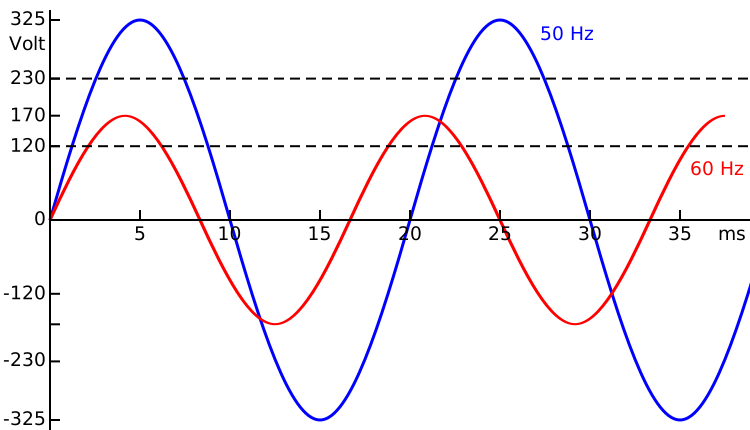
A VFD is an electronic controller that adjusts the frequency and voltage supplied to an alternating-current motor. Sensors and control software can then match motor speed to real-time requirements: an HVAC fan can ease back after an office empties, while a pump or compressor can respond to changing production needs. Energy experts cited by Canary Media estimate that the technology can reduce a motor’s electricity use by roughly 40% to 60% in suitable applications. The U.S. Department of Energy describes variable-speed drives as one of the most established and cost-effective ways to reduce equipment energy consumption. DOE guidance also notes that VFDs are especially common because they work with widely used AC induction motors.
The untapped potential is substantial because adoption remains surprisingly low. A Lawrence Berkeley National Laboratory assessment found that VFDs were used by about 16% of industrial motor-system capacity and just 4% of commercial motor-system capacity. Berkeley Lab’s motor-systems research estimates that right-sizing motors and adding speed controls could save approximately $13.2 billion in electricity costs each year. Those savings would arrive without waiting years for a new gas plant, transmission line, or geothermal project to be permitted and built.
Toyota offers a useful real-world example. In 2015, the automaker installed VFDs on more than 200 motors serving the HVAC system at its manufacturing plant in Georgetown, Kentucky. The approximately $1.25 million project reportedly cut annual electricity costs by more than $700,000, showing why industrial operators facing higher power prices may view the equipment as an operating investment rather than merely a climate initiative. Early coverage also reported that the project reduced the plant’s total electricity consumption by about 2.6%.
Modern drives are also more capable than the basic controllers many facility managers may remember. Danfoss says its iC7 series can optimize motor speed around actual demand while typically reducing energy consumption by about 40%, and its HVACR line adds sensors, monitoring, cybersecurity features, and power-quality options. The technology is not a universal fix: retrofits require engineering, compatible motors, maintenance planning, and attention to issues such as harmonics. But with data centers, electric vehicles, and industrial electrification all competing for new electricity, utilities and policymakers have a strong reason to make VFD upgrades easier to finance. Incentives, efficiency standards, and utility programs could turn millions of overlooked motors into one of the grid’s fastest efficiency wins.
Image Credits
In-Article Image Credits
Electric frequency of power utility via Wikimedia Commons by Pieter Kuiper with usage type - Creative Commons License. By Pieter Kuiper; modified by PMarksDotNet - Own work, CC BY-SA 2.5, https://commons.wikimedia.org/w/index.php?curid=2217525Featured Image Credit
Electric frequency of power utility via Wikimedia Commons by Pieter Kuiper with usage type - Creative Commons License. By Pieter Kuiper; modified by PMarksDotNet - Own work, CC BY-SA 2.5, https://commons.wikimedia.org/w/index.php?curid=2217525


