
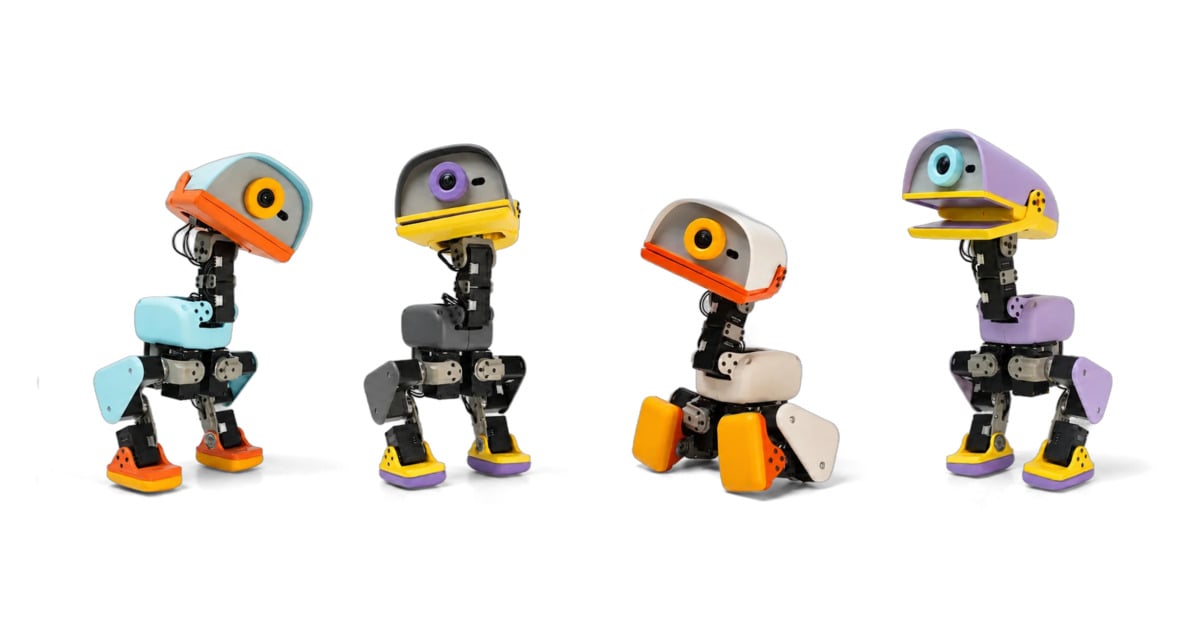
A flock of tiny duck-shaped robots has waddled from an Nvidia keynote into the holiday shopping conversation. Microducks reportedly passed 20,000 preorders after Nvidia CEO Jensen Huang demonstrated the machines at GTC Berlin, where they responded to voice commands with charmingly imperfect tricks including sitting, collapsing for a nap, and attempting somersaults. The viral Microduck demonstration and preorder surge turned an educational robotics platform into one of the season’s most unexpected technology hits.
The October 21 presentation featured four robots walking onto the stage and gathering around Huang. Their performance was not perfectly synchronized: one reportedly kept moving after being told to nap, while only some of the group completed the requested roll. That unpredictability may have made the demonstration more compelling than a flawless product video, giving audiences a glimpse of both the promise and present-day limitations of physical AI.
Microduck is a roughly 25-centimeter-tall, under-800-gram biped made by French robotics company Pollen Robotics. Its compact body contains 15 motors, along with a camera, microphone, speaker, wireless connectivity, and a beak that can function as a simple gripper. The robot launched at $399 before taxes and shipping, with deliveries planned before Christmas for customers in North America and Europe.
The important distinction is that Microduck is not being pitched merely as a preprogrammed novelty. It is an open-source development platform intended for students, researchers, and hobbyists who want to teach machines new physical behaviors and share the results. Out of the box, it can perform basic movements such as walking, sitting, crouching, standing, and recovering after a fall; optional activities include picking up objects and skating with rollers.
Nvidia used the keynote to highlight the training pipeline behind those behaviors. An AI agent helped create a course and prepare the robot in simulation, with Nvidia Isaac Sim and Isaac Lab used to train movements before policies were evaluated on RTX hardware and transferred to the physical machine. The company’s larger argument is that simulation and cloud computing can make physical-AI development more accessible, while Microduck provides a small, relatively affordable body on which developers can test the results.
Pollen Robotics became part of Hugging Face after the latter acquired the French startup in 2025, making Microduck part of Hugging Face’s expanding hardware effort alongside Reachy Mini. The preorder rush shows how quickly a developer-focused product can cross into mainstream gadget culture when a charismatic tech executive, a playful demo, and a highly shareable design collide.
Whether Microduck becomes the must-have toy of Christmas remains uncertain—20,000 preorders are not the same as completed deliveries—but its early momentum already gives open-source robotics a notable showcase. The next test will come when customers begin teaching their own ducks new tricks and discover whether the tiny robots are as entertaining away from the keynote stage as they were under the spotlight.


