
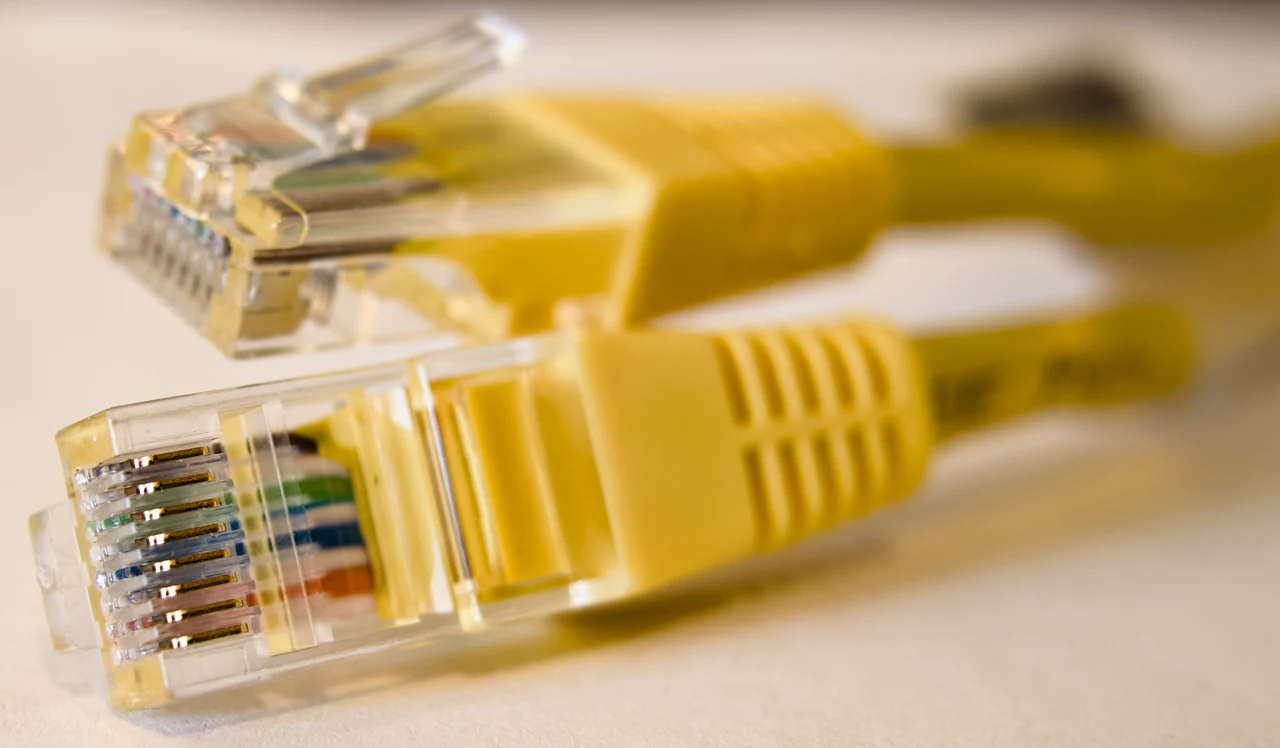
Those seemingly chaotic spirals inside an Ethernet cable are doing far more than keeping the copper conductors organized. The wires are twisted to protect the data signal from the electromagnetic noise created by the cable itself, nearby electronics, and other cables running alongside it.
Most familiar Ethernet cables contain four pairs of insulated copper wires. Each pair carries a balanced, or differential, signal: one conductor carries a voltage pattern while the other carries the corresponding inverse. At the receiving end, the network hardware compares the two signals rather than simply measuring one wire against ground. Noise that reaches both conductors in roughly equal amounts can therefore be rejected.
The twists make that rejection work better. A current moving through a conductor creates an electromagnetic field, which can leak into a neighboring pair as crosstalk. If two wires ran parallel for the entire length of a cable, one conductor could remain consistently closer to the source of interference than the other. Twisting continually swaps their positions, helping unwanted fields affect both wires more evenly. Fluke Networks describes this as a way to reduce near-end crosstalk, particularly as signal frequencies rise. The geometry of twisted-pair cabling also helps opposing magnetic fields cancel.
There is another detail hidden in the jacket: the four pairs generally do not use identical twist rates. If every pair followed the same spiral, sections of the cable could repeatedly line up in the same pattern, allowing interference to build over distance. Varying the twist rate changes those relationships and reduces persistent coupling between pairs. That is why installers are warned not to untwist the conductors farther than necessary when attaching an RJ45 plug or terminating a wall jack.
Twisting is not the only defense. Some Ethernet cables add a foil or braided shield, producing shielded variants designed for electrically noisy environments such as factories, server rooms, and areas near motors or power equipment. Unshielded twisted pair remains popular because it is inexpensive, flexible, and effective in ordinary homes and offices, while higher cable categories refine the materials, construction, and performance requirements for faster signaling.
The same principle also explains why an Ethernet cable can carry data reliably beside a surprising amount of everyday electronics without requiring a separate wire for every bit of protection. The cable’s physical layout, combined with differential signaling and error handling in the network hardware, turns a bundle of copper into a controlled communications channel. What looks like decorative coiling is actually one of the simplest and most important pieces of Ethernet engineering.


