
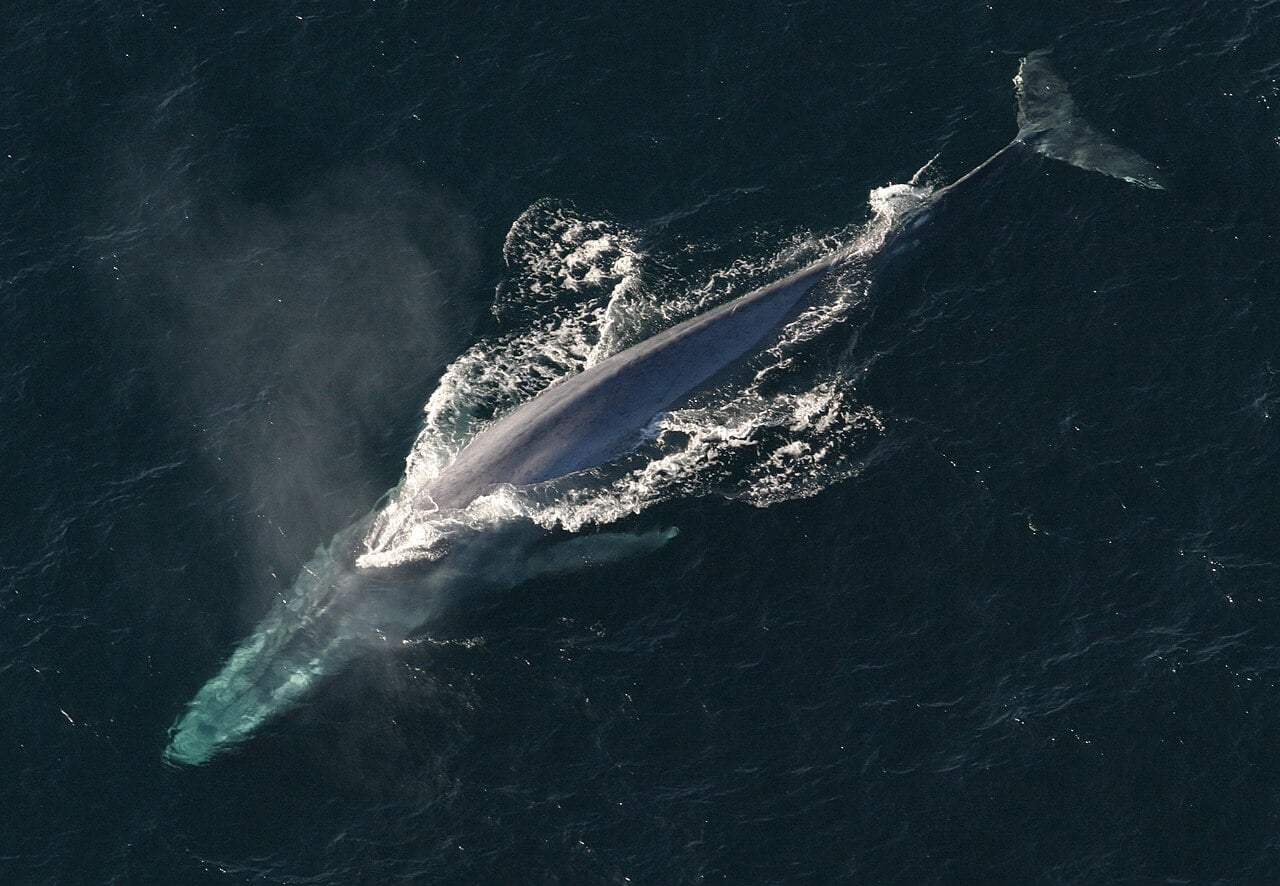
Blue whales have temporarily disappeared from waters around the Galápagos Islands, and an unusually warm Pacific may have changed the feeding map for the largest animals on Earth. A scientific expedition searched the archipelago from October 2025 through July 2026, covering historically important areas around San Cristóbal, Isabela, Fernandina and Santiago, but failed to locate a single whale for satellite tagging. The nine-month search produced no confirmed blue whale encounters, despite the animals being regularly recorded in the region.
The work was led by Daniela Alarcón and Juan Pablo Muñoz of Universidad San Francisco de Quito and the Galápagos Science Center, with the Galápagos National Park Directorate, WWF Ecuador, Oregon State University and the University of Wisconsin involved in the broader effort. The team hoped to attach satellite transmitters and learn how blue whales move between feeding areas, but oceanographic measurements became an important result in their own right. Surface temperatures reached roughly 82 degrees Fahrenheit (27.56 degrees Celsius), while water 100 meters down approached 19.7 degrees Celsius—far warmer than expected for the season. The Galápagos Science Center details the expedition’s routes, partners and temperature readings.
The suspected problem is not simply that the whales dislike warm water. Blue whales must track dense concentrations of krill, which can depend on the location of phytoplankton and the ocean conditions that support it. During this expedition, the water layer associated with the whales’ usual feeding temperatures was found considerably deeper than normal, while the strongest chlorophyll readings—an indirect clue to phytoplankton abundance—were higher in the water column. That mismatch may have made the Galápagos a poor dining stop, effectively forming a warm-water barrier between the whales and their prey.
El Niño is characterized by unusually warm equatorial Pacific waters, and its effects can rearrange currents, nutrients and biological productivity across a much larger region. The researchers therefore suspect that some whales may have remained farther south, perhaps in waters off Peru or in offshore areas that are much harder to survey. Earlier tracking research supports the idea that Galápagos blue whales are not confined to the islands: documented individuals have traveled through Ecuadorian waters, with at least one reaching Peru.
Still, the evidence does not establish a permanent migration shift—or even prove that El Niño alone caused the empty survey. The region recorded 45 blue whale sightings under standardized monitoring in 2025, and a citizen-science network reported an adult and calf near Punta Pitt on San Cristóbal in early September 2026, after the expedition ended. That late sighting suggests the whales may have changed their timing or moved among less-observed parts of the archipelago rather than abandoned it.
The next step is to connect whale sightings with temperature, plankton and krill measurements over multiple seasons. That matters well beyond a single island chain: blue whales can travel thousands of kilometers between feeding and breeding grounds, crossing waters exposed to ship traffic, fishing gear, pollution and underwater noise. WWF’s Eastern Pacific Blue Corridor initiative argues that protecting only the places where whales are easiest to see is not enough; conservation has to follow the animals’ entire migratory network. For now, the Galápagos mystery is best understood as a warning that a changing ocean can move a whale population out of sight before scientists know exactly where it went.
Image Credits
In-Article Image Credits
A blue whale (Balaenoptera musculus) via Wikimedia Commons by NOAA Photo Library with usage type - Public Domain. By NOAA Photo Library - anim1754, Public Domain, https://commons.wikimedia.org/w/index.php?curid=17942391Featured Image Credit
A blue whale (Balaenoptera musculus) via Wikimedia Commons by NOAA Photo Library with usage type - Public Domain. By NOAA Photo Library - anim1754, Public Domain, https://commons.wikimedia.org/w/index.php?curid=17942391


