
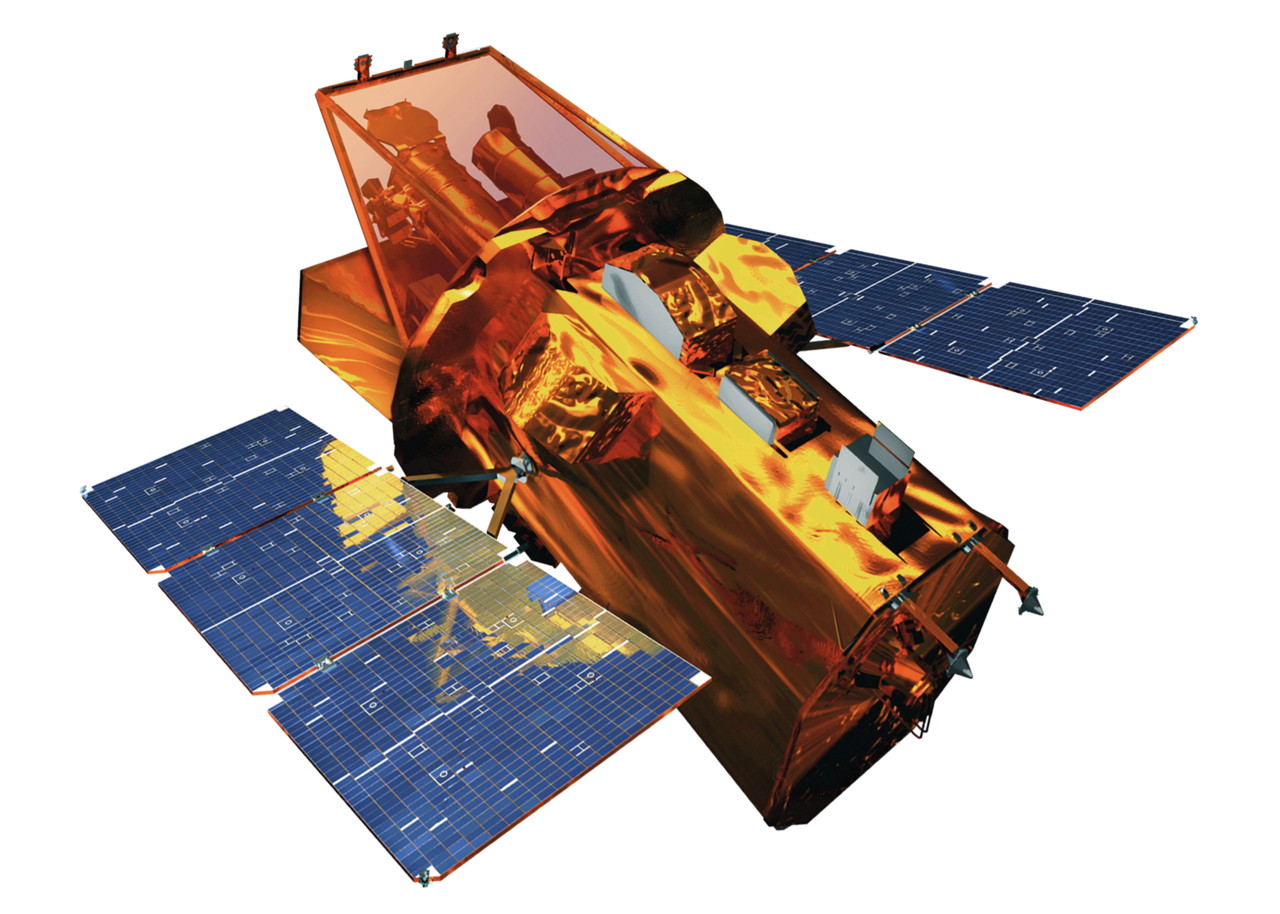
NASA’s Neil Gehrels Swift Observatory is nearing the end of its long mission with an uncontrolled plunge back through Earth’s atmosphere. The truck-sized space telescope is expected to reenter on Wednesday, November 4, nearly 22 years after launch, in a fiery return that should destroy most of the spacecraft.
The U.S. Space Force’s latest prediction places reentry at approximately 3:30 a.m. Eastern time, but the forecast carries an uncertainty of roughly 11 hours. Swift weighs about 3,200 pounds and measures approximately 5.6 meters high and 5.4 meters across, including its deployable solar arrays. NASA expects some denser components to survive the descent, although the agency estimates the chance of someone on Earth being harmed at about one in 2,100. Any surviving debris would be confined to a broad band between 20.6 degrees north and 20.6 degrees south latitude because of Swift’s low-inclination orbit. NASA says it and the Space Force will continue refining the prediction as reentry approaches.
Swift was launched on November 20, 2004, aboard a Delta 7320 rocket from Cape Canaveral. The mission was designed to last only two years, but it became one of NASA’s most productive long-lived astrophysics observatories. Its three instruments could detect gamma rays, X-rays, ultraviolet light, and visible light, allowing the spacecraft to identify violent flashes and rapidly redirect itself to study their afterglows. NASA describes Swift as a first-of-its-kind multiwavelength observatory when it launched.
The telescope’s primary quarry was the gamma-ray burst, an extremely powerful cosmic explosion that can briefly outshine entire galaxies. Swift also expanded its work to active galaxies driven by supermassive black holes, stellar X-ray flares, novae, supernovae, comets, and asteroids. Its ability to send rapid alerts to observatories around the world made it less like a traditional one-purpose telescope and more like a space-based emergency-response system for transient events. NASA credits the mission with helping coordinate fast follow-up observations across multiple wavelengths.
The descent follows an unsuccessful effort to preserve the observatory in a higher orbit. Swift’s altitude had fallen low enough that NASA ended its science mission after the spacecraft dropped below roughly 171 miles, or 275 kilometers, above Earth. A commercial robotic servicing concept was intended to raise the telescope before atmospheric drag made recovery impossible, but the rescue attempt did not succeed. Swift completed its final observation on October 20, closing out more than two decades of discoveries before its orbit became unrecoverable.
For skywatchers, this is not expected to produce a spectacular, predictable light show: the reentry is uncontrolled, the timing remains uncertain, and any visible debris would depend on location and weather. The more important legacy is already secure. A mission built for a brief two-year experiment spent over 20 years turning fleeting explosions into some of the best-observed events in the universe—leaving behind a scientific archive far more durable than the hardware now falling home.
Image Credits
In-Article Image Credits
NASA Swift Observatory via NASA with usage type - Public Domain. By NASA E/PO, Sonoma State University/Aurore Simonnet - http://swift.sonoma.edu/resources/multimedia/images/ (TIFF source file), Public Domain, https://commons.wikimedia.org/w/index.php?curid=34690615Featured Image Credit
NASA Swift Observatory via NASA with usage type - Public Domain. By NASA E/PO, Sonoma State University/Aurore Simonnet - http://swift.sonoma.edu/resources/multimedia/images/ (TIFF source file), Public Domain, https://commons.wikimedia.org/w/index.php?curid=34690615


