
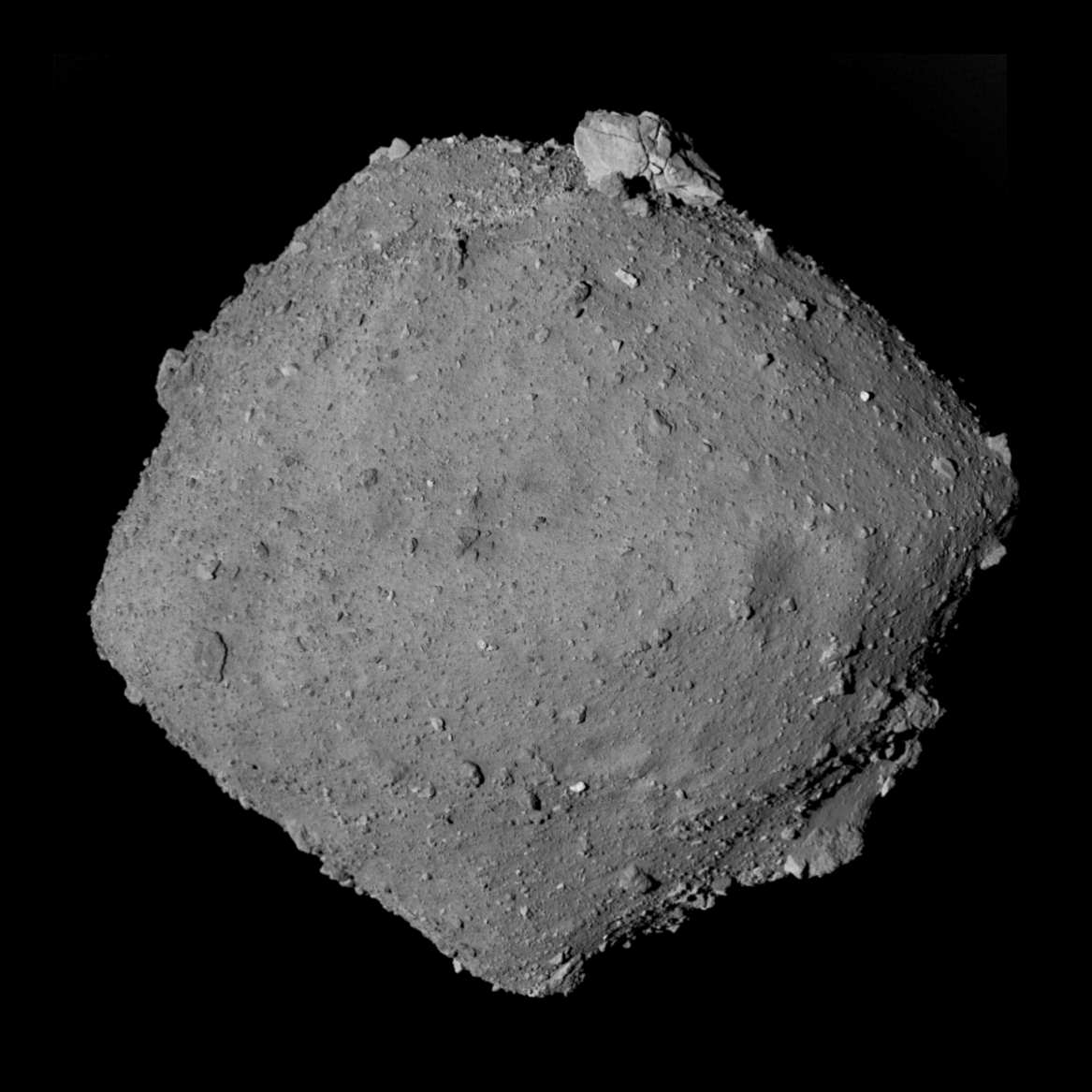
Asteroid Ryugu has yielded a complete set of the chemical “letters” used by life on Earth. In two pristine samples returned by Japan’s Hayabusa2 mission, researchers identified adenine, guanine, cytosine, thymine, and uracil—the five canonical nucleobases associated with DNA and RNA. The discovery in 4.5-billion-year-old asteroid material adds a striking new chapter to the search for life’s origins.
The finding comes from a study published in Nature Astronomy by a Japanese-led research team headed by Toshiki Koga. The scientists examined Ryugu samples designated A0480 and C0370, using high-performance liquid chromatography and high-resolution mass spectrometry to distinguish the compounds from other organic material. Both samples contained all five bases, with the detected molecules appearing in broadly similar amounts. Nature Astronomy’s research summary identifies the compounds as adenine, guanine, cytosine, thymine, and uracil.
That distinction matters because nucleobases are not life by themselves. They become part of genetic material only after joining sugars and phosphate groups to form nucleotides, which can then assemble into DNA or RNA. Still, finding the full set in untouched extraterrestrial material suggests that the raw molecular inventory needed for prebiotic chemistry was not unique to Earth.
Ryugu is a carbon-rich, primitive asteroid whose material has avoided many of the chemical changes caused by Earth’s atmosphere and biology. Hayabusa2 collected the samples in 2019 and delivered them to Earth in 2020, giving researchers unusually uncontaminated material from the early Solar System. Earlier analyses found thousands of organic molecules in the returned grains, while a 2023 assessment had not yet detected nucleobases—possibly because the available sample mass and concentrations were too limited. JAXA’s earlier analysis reported approximately 20,000 carbon-based organic molecules in Ryugu extracts.
The result also strengthens comparisons with asteroid Bennu, whose returned material has likewise produced evidence of all five canonical nucleobases. Together, Ryugu and Bennu suggest that these compounds may have formed widely in carbonaceous bodies rather than appearing through a rare local accident. The Ryugu team additionally reports a relationship between the balance of purine and pyrimidine bases and ammonia abundance, a possible chemical clue to how non-biological nucleobases evolved.
None of this demonstrates that life arrived from space, and it does not show that Ryugu ever hosted organisms. Its significance is more fundamental: impacts by asteroids could have supplied early Earth with a diverse assortment of prebiotic ingredients before biology emerged. As Hayabusa2 samples continue to be divided among laboratories, the next questions will involve how these molecules formed, whether they can link with sugars and phosphates under plausible planetary conditions, and how much of Earth’s first chemical toolkit was delivered from beyond the planet.
Image Credits
In-Article Image Credits
Black-and-white photograph of near-Earth asteroid 162173 Ryugu, taken by the Hayabusa2 spacecraft on 11 September 2018 via Wikimedia Commons by Original image taken by JAXA/ISAS with usage type - Creative Commons License. By ISAS/JAXA, CC BY 4.0, https://commons.wikimedia.org/w/index.php?curid=195893287Featured Image Credit
Black-and-white photograph of near-Earth asteroid 162173 Ryugu, taken by the Hayabusa2 spacecraft on 11 September 2018 via Wikimedia Commons by Original image taken by JAXA/ISAS with usage type - Creative Commons License. By ISAS/JAXA, CC BY 4.0, https://commons.wikimedia.org/w/index.php?curid=195893287


