
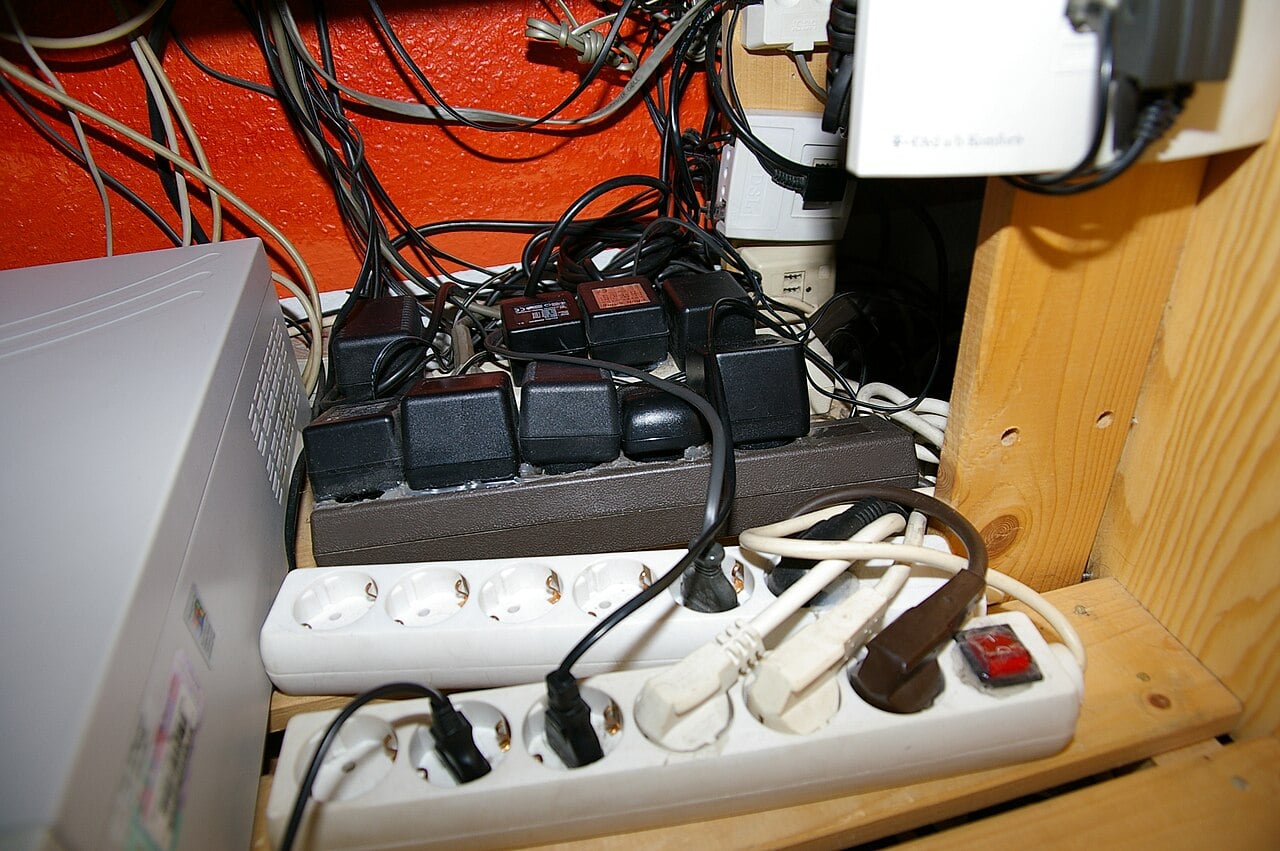
Power strips are an easy fix for a desk crowded with consoles, monitors, chargers, and smart-home gear—but plugging one strip into another is not a harmless way to create more outlets. The practice, commonly called “daisy chaining,” can overload the first strip, the wall outlet, or the building circuit and potentially turn a convenient setup into a fire hazard. The basic warning about interconnected power strips is simple: one strip should plug directly into a properly installed wall receptacle, not into another strip.
The danger is less about the number of visible sockets than the amount of current flowing through the chain. The strip nearest the wall may end up supplying every device connected farther down the line, even though its cord and internal components were not designed for that combined load. The resulting overload can trip a breaker, interrupt equipment, heat the wiring, or damage a component. Guidance from the Office of the Chief Workplace Responsibility specifically warns that interconnected strips can cause power failure and fire.
Surge protection does not change that equation. A surge protector can help protect connected electronics from certain voltage spikes, but it does not increase the capacity of the wall outlet or branch circuit. Connecting a surge protector to another surge protector also does not create a stronger protective system; it simply adds another link, plug, and point of potential failure.
Fire-safety guidance treats the arrangement as a code problem as well as a practical one. The National Fire Protection Association says relocatable power taps should be connected directly to permanently installed receptacles, and that power strips should not be connected to extension cords to extend their reach. The University of Illinois’ electrical-safety guide also notes that each additional connection introduces resistance and can contribute to overheating, while citing UL guidance that a cord-connected power strip is not intended to connect to another one.
For a gaming battlestation or home office, the safer solution is to spread high-draw equipment across separate wall outlets rather than stacking strips. Avoid using a power strip for appliances that generate substantial heat, such as space heaters, and replace units with damaged cords, cracked housings, scorch marks, or loose sockets. If a room consistently lacks enough receptacles, a qualified electrician can install additional permanent outlets—an appropriate long-term fix that extension cords and chained strips were never designed to provide.
The rule is therefore straightforward: use one appropriately rated, undamaged power strip per wall outlet, keep its total load within the manufacturer’s limits, and never use another strip as an improvised extension. A few extra sockets may be convenient, but they are not worth hiding an overloaded electrical connection behind a desk or entertainment center.
Image Credits
In-Article Image Credits
Multiple power strips from Germany with electrical cords via Wikimedia Commons by Johann H. Addicks with usage type - GNU Free. By Johann H. Addicks - addicks@gmx.net - Self-photographed, GFDL 1.2, https://commons.wikimedia.org/w/index.php?curid=5527127Featured Image Credit
Multiple power strips from Germany with electrical cords via Wikimedia Commons by Johann H. Addicks with usage type - GNU Free. By Johann H. Addicks - addicks@gmx.net - Self-photographed, GFDL 1.2, https://commons.wikimedia.org/w/index.php?curid=5527127


