
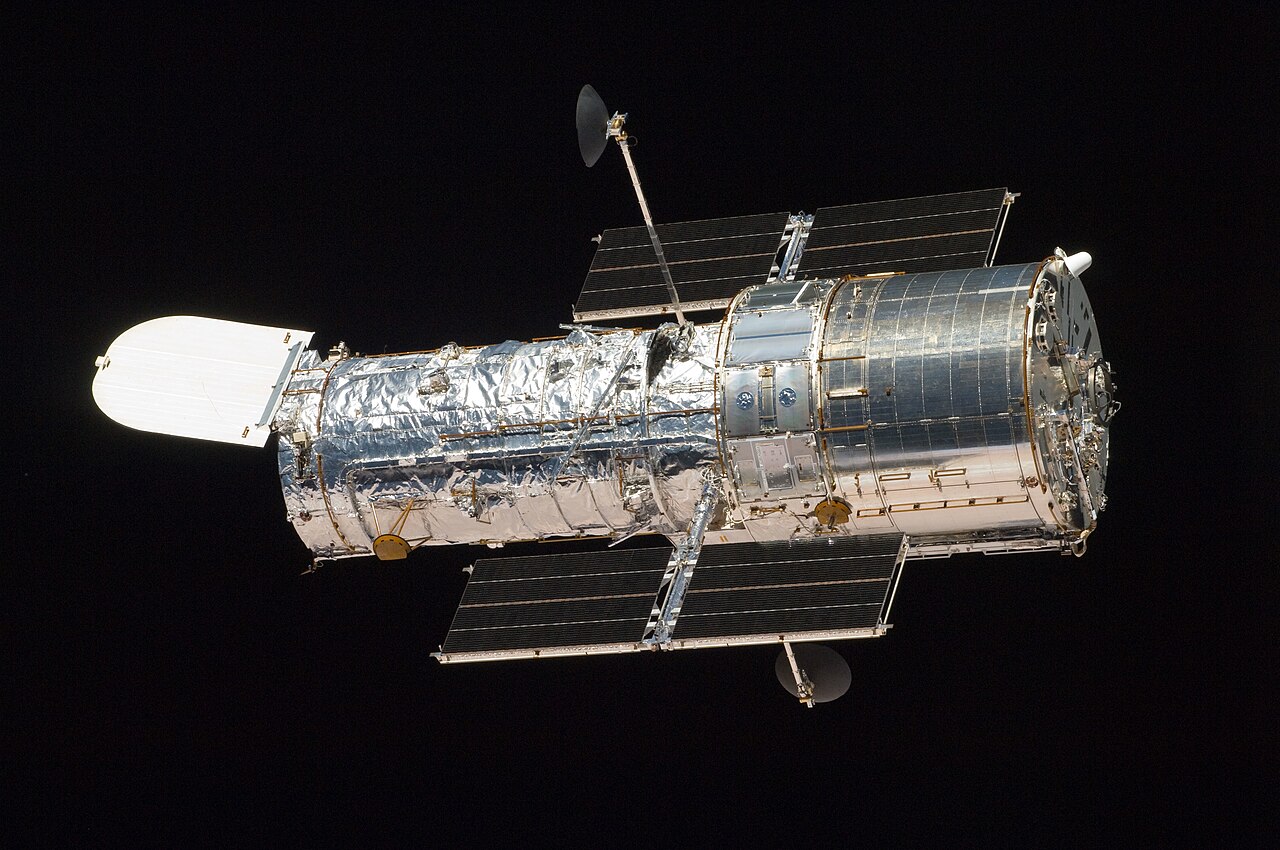
NASA is looking for a commercial rescue plan for the Hubble Space Telescope before orbital decay forces the legendary observatory back into Earth’s atmosphere. The agency is considering a mission that could raise Hubble’s orbit, improve its aging systems, or carefully retire it—and the clock is already ticking. NASA’s latest Hubble plans put a likely uncontrolled reentry in 2033 or 2034, with any intervention expected to happen by 2032.
The request for information issued by NASA’s Goddard Space Flight Center is aimed at private companies with spacecraft capable of rendezvousing with the telescope. One option would move Hubble into a higher orbit of at least 600 kilometers, or roughly 373 miles, extending the time available for scientific observations. A second would combine an orbit boost with in-space servicing, potentially improving the observatory’s performance and resilience. The final option is less glamorous but essential: a controlled atmospheric reentry or another form of safe orbital disposal.
Hubble currently circles Earth at approximately 483 kilometers, or 300 miles, where the thin upper atmosphere creates enough drag to gradually lower its orbit. Unlike newer spacecraft designed with propulsion systems for routine station-keeping, Hubble has no onboard system to counter that decay. NASA’s market research notice is not yet a contract solicitation, so it does not guarantee that a rescue mission will fly—but it gives commercial providers an opportunity to outline what they can do and how soon they can do it.
The telescope has earned the chance to become a difficult customer. Launched aboard the space shuttle Discovery in April 1990, Hubble has spent more than three decades producing observations that shaped modern astronomy. Astronauts visited it on five servicing missions between 1993 and 2009, replacing batteries, gyroscopes, computers, solar equipment, cameras, and other instruments. Those missions transformed Hubble from a troubled observatory with a flawed primary mirror into one of the most productive scientific platforms ever placed in orbit. NASA’s anniversary history documents that long maintenance legacy.
A future servicing mission would also revive a familiar idea in a very different spaceflight era. NASA and SpaceX previously studied whether a crewed Dragon spacecraft could boost Hubble, but NASA ultimately chose not to proceed at the time because of the risks involved in approaching and handling the aging telescope. A commercial mission would need to protect delicate solar arrays, instruments, communications hardware, and the telescope’s optical system while operating around a spacecraft never designed for routine autonomous capture.
For astronomers, the most exciting outcome would be more years of Hubble science rather than a ceremonial final image. The observatory remains especially valuable for ultraviolet and visible-light observations, areas where newer infrared-focused telescopes such as James Webb do not simply provide a replacement. NASA now has to determine whether industry can offer a safe, affordable way to preserve that capability—or whether the responsible end to Hubble’s extraordinary career will be a controlled descent planned years in advance.
Image Credits
In-Article Image Credits
An STS-125 crewmember aboard the Space Shuttle Atlantis captured this still image of the Hubble Space Telescope as the two spacecraft continue their relative separation on May 19 via Wikimedia Commons by NASA with usage type - Public Domain. By NASA - http://spaceflight.nasa.gov/gallery/images/shuttle/sts-125/html/s125e012050.html, Public Domain, https://commons.wikimedia.org/w/index.php?curid=6833760Featured Image Credit
An STS-125 crewmember aboard the Space Shuttle Atlantis captured this still image of the Hubble Space Telescope as the two spacecraft continue their relative separation on May 19 via Wikimedia Commons by NASA with usage type - Public Domain. By NASA - http://spaceflight.nasa.gov/gallery/images/shuttle/sts-125/html/s125e012050.html, Public Domain, https://commons.wikimedia.org/w/index.php?curid=6833760


