
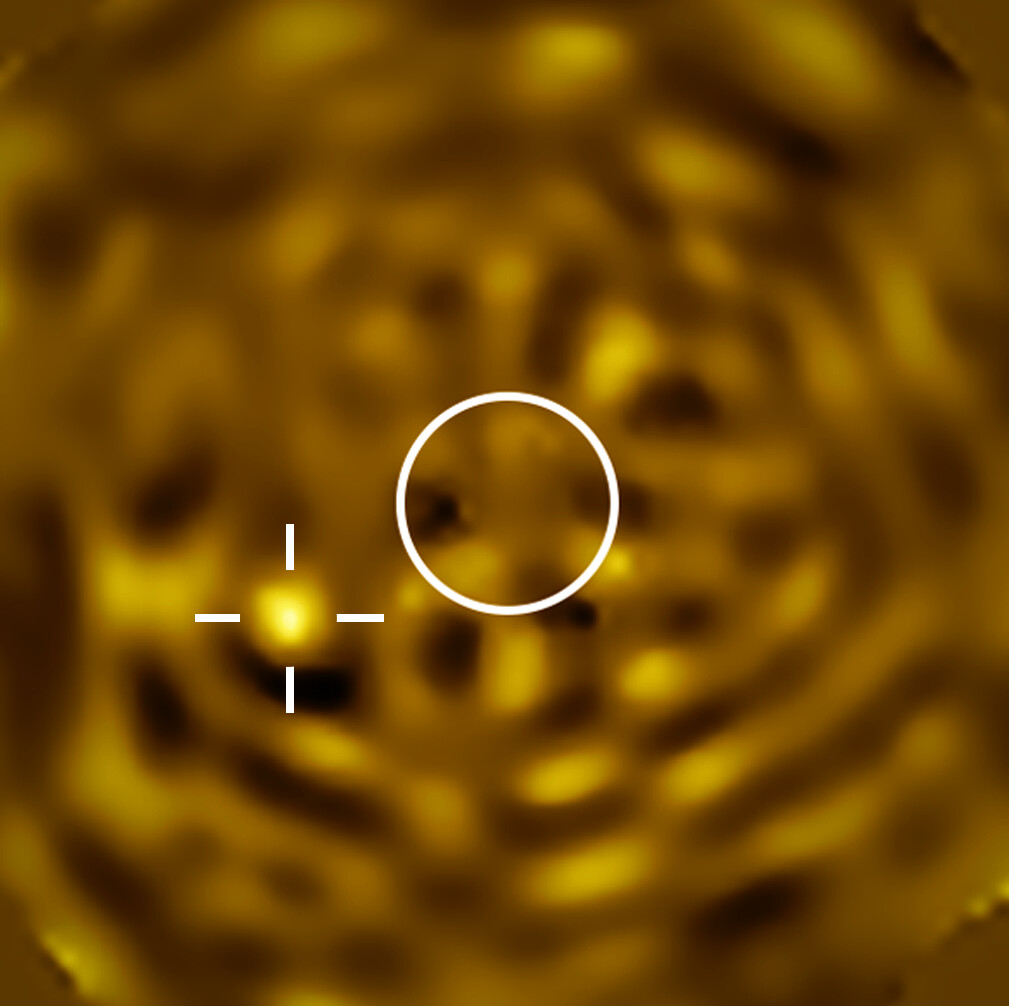
Betelgeuse may not be evolving alone. New observations suggest that a faint companion star named Siwarha is orbiting so close to the red supergiant that it physically passes through the giant star’s extended atmosphere, leaving measurable disturbances in the surrounding gas. The new evidence for Betelgeuse’s hidden companion comes from radio observations that track subtle changes in the star’s enormous outer layers.
The research team, led by Lynn D. Matthews of MIT Haystack Observatory, combined data gathered from 2021 through 2026 by the National Science Foundation’s Karl G. Jansky Very Large Array and the Atacama Large Millimeter/submillimeter Array. Seven frequencies, spanning 22 to 485 gigahertz, allowed astronomers to examine different depths of Betelgeuse’s atmosphere rather than treating it as a single uniform shell. The observatories’ announcement says those measurements reveal both atmospheric changes and evidence consistent with a close companion disturbing the star.
Siwarha has not been directly seen in the radio data. Instead, its presence is inferred from Betelgeuse’s changing outline. The atmosphere appears more stretched when the companion should be farther from the star in Earth’s view, then more nearly round when Siwarha passes in front of or behind Betelgeuse. That relationship matches the behavior expected if the smaller object is plowing through the supergiant’s outer gas, although additional observations covering more of the orbit will be needed to establish the case.
The proposed orbit is extraordinarily tight by stellar standards. A preprint describing the observations places Siwarha’s semimajor axis at roughly 2.3 times Betelgeuse’s radius, meaning the companion’s path would lie within the red supergiant’s radio-emitting atmosphere. The companion is expected to be tens to hundreds of times too faint to appear directly in these measurements, making the distortions it produces more useful than any attempted radio image of the star itself. The study’s preprint describes the connection between atmospheric ellipticity and the companion’s orbital phase.
The same observations also offer a new look at Betelgeuse’s recovery from its famous Great Dimming in late 2019 and early 2020. At the highest ALMA frequency, which probes relatively close to the visible surface, the team measured a brightness temperature of about 2,200 kelvin. Farther out, around 2.7 stellar radii, the temperature reached approximately 3,500 kelvin, while the outer atmosphere’s unusually low radio temperatures had risen from the levels recorded during the dimming.
Siwarha’s suspected wake gives astronomers a possible explanation for why Betelgeuse’s long-term brightness behavior has been so difficult to interpret using the star’s internal pulsations and convection alone. Earlier Hubble and ground-based observations also identified a dense trail of gas moving through Betelgeuse’s outer atmosphere, strengthening the case that the companion is leaving physical fingerprints even though it remains hidden. NASA’s account of the Hubble observations describes the wake as evidence of Siwarha’s influence on gas around the giant star.
For now, Siwarha remains a compelling hypothesis rather than a directly photographed stellar partner. Continued radio monitoring should show whether Betelgeuse’s shape keeps changing in step with the proposed orbit. If that pattern holds across additional cycles, astronomers may have found a rare opportunity to watch a companion star interact with—and possibly help shape—the atmosphere of a red supergiant from the inside.
Image Credits
In-Article Image Credits
Betelgeuse B (aka Siwarha), a star orbiting Betelgeuse via Wikimedia Commons by European Southern Observator (ESO) with usage type - Creative Commons License. By ESO/M. Montargès et al., CC BY 4.0, https://commons.wikimedia.org/w/index.php?curid=196361687Featured Image Credit
Betelgeuse B (aka Siwarha), a star orbiting Betelgeuse via Wikimedia Commons by European Southern Observator (ESO) with usage type - Creative Commons License. By ESO/M. Montargès et al., CC BY 4.0, https://commons.wikimedia.org/w/index.php?curid=196361687


