
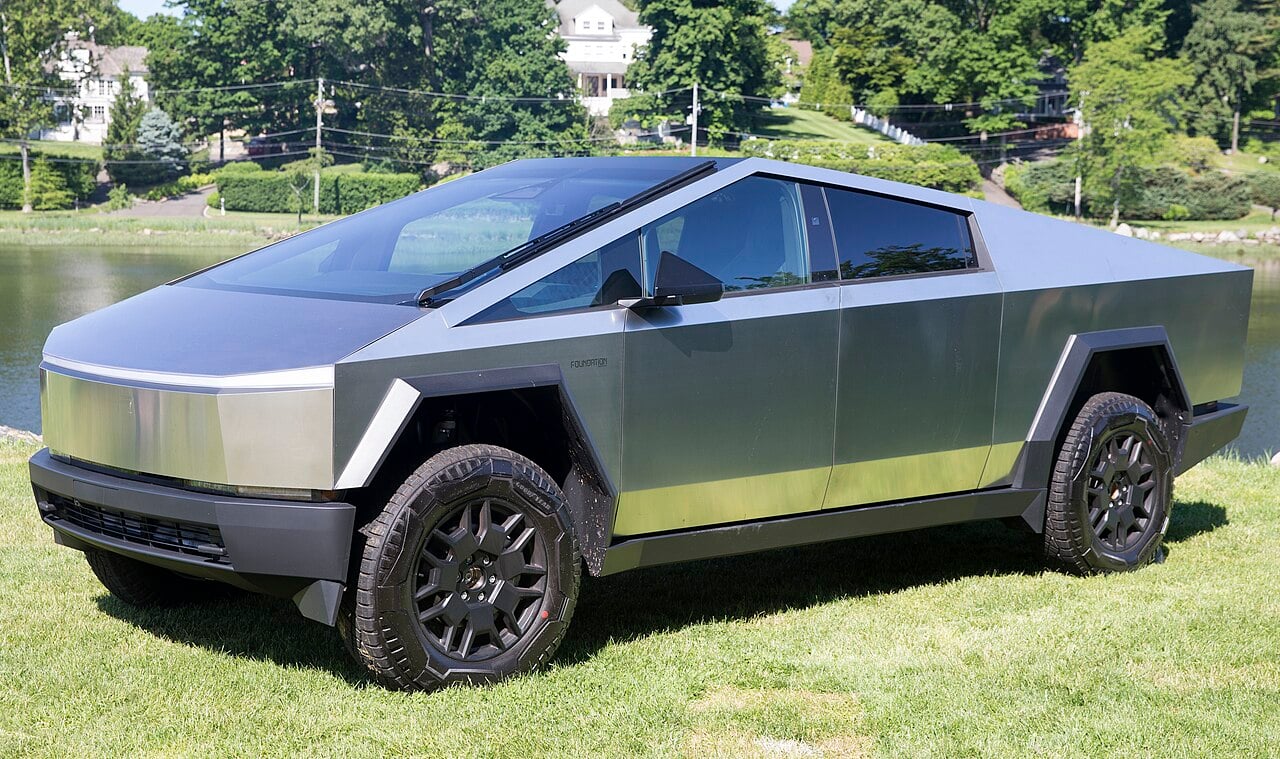
Tesla is preparing to move on from the Cybertruck. Elon Musk said the electric pickup’s production at Gigafactory Texas will wind down around the middle of 2027, freeing factory capacity for the company’s two-seat Cybercab robotaxi. The planned Cybertruck production shutdown marks a dramatic retreat from Tesla’s original ambition to make the stainless-steel vehicle a mainstream American pickup.
The wording leaves one important detail unresolved: Musk has not explicitly said whether the Cybertruck will disappear completely or whether Tesla could shift some assembly to another plant. That possibility appears remote, however. Gigafactory Texas is currently the only known Tesla facility equipped to build the pickup’s specialized components, and multiple outlets describe the mid-2027 change as a practical end to the model rather than a routine factory transfer.
The Cybertruck arrived with enormous expectations. When Musk unveiled the angular truck in November 2019, Tesla advertised a starting price of $39,900 and projected annual demand as high as 250,000 vehicles. The production model took years to arrive and launched at a much higher price, with the least expensive version initially listed above $60,000 and higher-end configurations approaching six figures.
Demand never matched the spectacle surrounding the reveal. Cox Automotive estimated that Tesla sold 38,965 Cybertrucks in the United States during 2024, followed by 20,237 in 2025—a drop of roughly 48 percent. Through the first three quarters of 2026, the estimate stood at 11,586 vehicles. Tesla does not publish a separate Cybertruck sales total, making outside industry estimates the clearest measure of the pickup’s performance.
Quality problems added to the truck’s uphill battle. Cybertruck owners have faced a series of recalls, including a 2025 campaign affecting more than 46,000 vehicles over concerns that an exterior stainless-steel panel could detach while driving. The model’s unusual construction and sharp-edged design gave it instant recognition, but those same choices also made the vehicle expensive and complicated to manufacture.
Cybercab represents a far more consequential bet for Tesla. The vehicle is designed around autonomous transportation rather than private ownership and has only two seats; Tesla’s own rider guide confirms that it lacks a steering wheel, accelerator pedal, and brake pedal. Redirecting Cybertruck capacity toward Cybercab production suggests Musk now sees robotaxis—and the software, hardware, and fleet network supporting them—as a more promising future than competing directly with conventional pickups from Ford, Chevrolet, and Rivian.
For Cybertruck owners and fans, the announcement could eventually make the pickup a short-lived Tesla oddity: a divisive vehicle remembered as much for its delayed launch, futuristic styling, and ambitious promises as for its time on the road. For Tesla, the change is a reminder that even its most heavily promoted products can be displaced when the company’s strategy pivots toward the next grand Musk project.
Image Credits
In-Article Image Credits
A 2024 Tesla Cybertruck Foundation Series at the 2024 Greenwich Concours d'Elegance via Wikimedia Commons by Mr.choppers with usage type - Creative Commons License. By Mr.choppers - Own work, CC BY-SA 3.0, https://commons.wikimedia.org/w/index.php?curid=152037030Featured Image Credit
A 2024 Tesla Cybertruck Foundation Series at the 2024 Greenwich Concours d'Elegance via Wikimedia Commons by Mr.choppers with usage type - Creative Commons License. By Mr.choppers - Own work, CC BY-SA 3.0, https://commons.wikimedia.org/w/index.php?curid=152037030


