
Iran-linked vessels have been making suspicious movements above some of the Gulf’s most important undersea internet routes, raising fears that a future confrontation with the United States and Israel could extend into the infrastructure carrying the region’s digital traffic. Between October 5 and 28, three U.S.-sanctioned tankers and an Iran-flagged fishing-support vessel slowed, looped, turned around, or disappeared from tracking systems near cable corridors off Oman and Iran. The unusual activity near the cables coincided with increasingly explicit warnings from Iranian officials about possible retaliation against Gulf communications infrastructure.
Maritime intelligence company Windward documented the vessel movements, including a tanker identified as CELESTIAL SEA that went dark for 86 hours inside the 2Africa and Bay of Bengal Gateway cable corridors. Another sanctioned gas carrier slowed inside the 2Africa corridor before turning away from its declared destination, while an Iran-flagged crude carrier spent roughly 10 days moving at less than one knot near four cable routes. A smaller fishing-support vessel also drifted along the Europe India Gateway and Transworld routes before vanishing from automatic tracking.
Those movements do not prove that any cable was damaged or that an attack was carried out. They do, however, look difficult to explain as ordinary commercial navigation. Windward said the tankers were tied to networks involved in moving Iranian oil, including Iran’s state tanker company, and noted that the fishing-support vessel entered waters outside its recent operating history before lingering close to cable paths. Turning off or manipulating automatic identification signals would also make it harder for authorities to reconstruct a ship’s precise movements.
The timing matters because Iranian security and military figures have threatened the cables in recent weeks. Windward said officials warned that Gulf communications links could become targets if the United States and Israel renewed attacks on Iran, with some statements reportedly suggesting that Tehran could obstruct repairs to prolong an outage. The maritime firm assessed the vessel activity as potentially consistent with surveying cable routes or positioning equipment while operating dark, but presented that as a possibility rather than established fact.
The potential impact would reach far beyond Iran. Windward identified seven cable systems in the waters off Oman’s Batinah coast, including 2Africa, Bay of Bengal Gateway, Asia Africa Europe-1, Oman Australia Cable, Europe India Gateway, Transworld, and SeaMeWe-4. Together, those systems connect Gulf states with India, Pakistan, Sri Lanka, Africa, Europe, and Australia. Six active cables cross the Strait of Hormuz, while additional regional capacity is under construction, leaving Iraq, Kuwait, Bahrain, and Qatar especially dependent on routes passing through the narrow maritime chokepoint.
That concentration makes the Gulf a tempting pressure point in any escalation—and a difficult one to defend. Cable cuts can be accidental, but deliberate damage would require specialized planning and could disrupt financial services, cloud access, government communications, and ordinary consumer internet traffic across multiple countries. The next important clues will be whether the vessels reappear, repeat their loitering patterns, or are joined by additional Iran-linked ships near the same corridors. For now, the evidence points to a serious warning sign, not a confirmed act of sabotage.
Image Credits
In-Article Image Credits
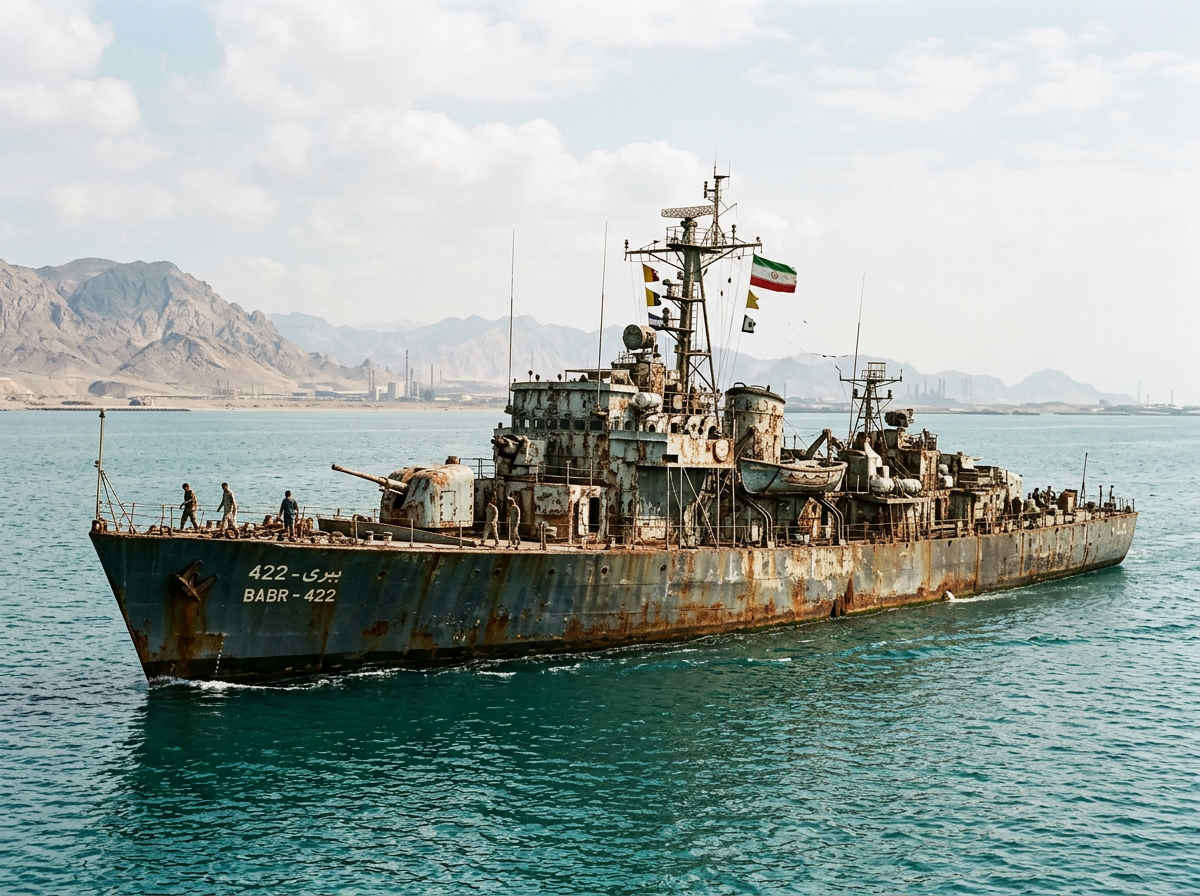
An old rusty dilapidated iran iranian warship via OpenArt AIFeatured Image Credit
An old rusty dilapidated iran iranian warship via OpenArt AI


