
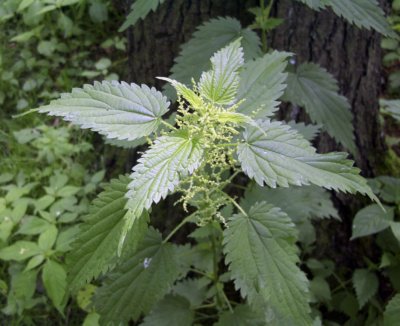
Nettle plants can grow several feet high and sometimes grow as shrubs. The leaves and stalks are arranged across opposite sides of the stem.
Nettle plants can grow several feet high and sometimes grow as shrubs. The leaves and stalks are arranged across opposite sides of the stem.

The Mulberry tree has alternate, simple, often lobed leaves with rough surfaces. The tree rarely grows over 33-49 feet tall.
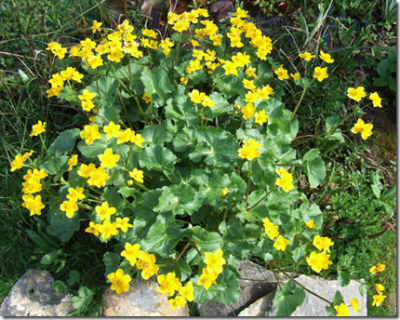
The Marsh Marigold (also known as Kingcup, Mayflower, May Blobs, Mollyblobs, Pollyblobs, Horse Bob, Water Blobs, Water Bubbles, Gollins, and Cowslip) plant has rounded, dark green leaves arising from a short stem.

Manioc, also called Cassava, Yuca, Mandioca, and Kamoting Kaoy, is a perennial woody shrubby plant, 1 to 3 meters (3 to 9 feet) tall, with jointed stems and deep green, fingerlike leaves.

he Mango tree may reach 34-40 meters (115-130 feet) in height with a crown radius of 10 meters (33 feet). It has alternate, simple, shiny, dark green leaves.

About the Malanga plant The Malanga (Xanthosoma) plant, also known as Melanga, Otoy, Otoe, New Cocoyam, Tannia, Tannier, Yautia, Macabo, Taioba, Dasheen, Quequisque, or Singapore Taro, is a popular cuisine in many countries around the world. This plant has soft, arrow-shaped leaves up to 60 centimeters (24 inches) long. The large leaves sprout from an…

The Lotus is an edible aquatic plant . There are two species of lotus: one has yellow flowers (known as American Lotus, Yellow Lotus, Water Chinquapin, or Volee) and the other pink flowers (known as Indian Lotus, Sacred Lotus, Bean of India, or simply Lotus).
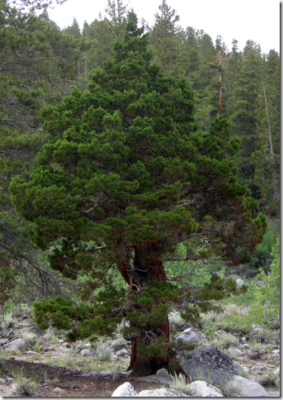
Junipers, sometimes called cedars, are trees or shrubs that vary in size and shape from columnar trees to low spreading shrubs with long trailing branches.
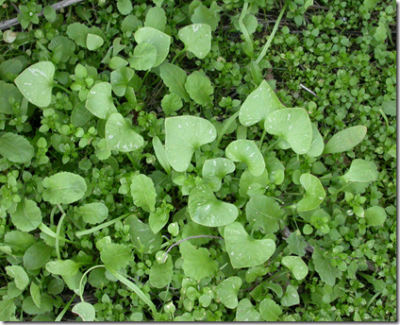
Known as Miner’s Lettuce, Winter Purslane, or Indian Lettuce, is usually bright green (but sometimes purplish or brownish green), long and narrow.
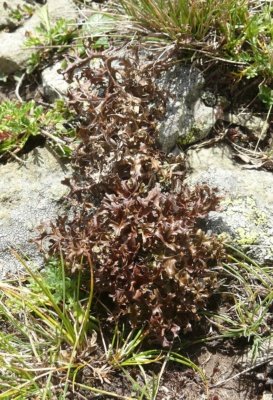
The edible Iceland moss grows only a few inches high. Its color may be gray, white, pale chestnut, or even reddish. It grows to a height of 3 to 4 inches with branches rolled into tubes which terminate in flattened lobes with fringed edges.
SparTech Software Cybersecurity
Check out the latest cybersecurity and dark web news. From rapid, high-level cybersecurity analysis reports to in-depth penetration testing (pentesting) of your network and systems, SparTech Software offers a comprehensive suite of cybersecurity services designed to protect your organization from evolving digital threats.

Geeky mathematical minds make money with horse race handicapping! Visit pickpony.com for horse racing past performance sheets, race charts and heatmaps, data summaries, AI analysis, and more. Pick Pony - your best bet in horse racing!
Books from Geek Slop Publishing
Living Truth Bible Study Guides
Despite its beautiful prose, you can’t just read Revelation; it requires diligent study. However, ineffective study techniques can lead to misunderstandings. Rather than imposing strict interpretations on the described events, use the concepts we present as a framework for understanding its intricate code. The Book of Revelation indeed provides more than just a foretelling of the tumultuous end of days. It reassures Christians that divine justice will ultimately triumph over evil and promises Jesus' eventual return as the rightful king of the world.
Chronicles of Enigma
While science and reason often seek to illuminate the unknown, there remains a certain allure in the unexplained—a realm where imagination and reality blur, creating a tapestry rich with wonder and possibility. Stories from the Chronicles of Enigma series endure not just as relics of the past, but as gateways to exploring the depths of our curiosity and the infinite potential of our world. Let us be the light that guides you through the darkness.
This Month’s Charity
Geek Slop believes everyone should be a good corporate citizen. Thus, each month, Geek Slop gives a portion of our online store profits to deserving charity. This month’s charity is:
Child Fund of America
Charity Watch Grade: A+
Program percentage: 92%
©Geek Slop – Many images, trademarks, logos, video, brands and images used on this website are registered trademarks of their respective companies and owners. They want us to remind you that “All Rights are Reserved”. Geek Slop never shares its data with third parties. However, 3rd party apps used on this site (we’re talking about you, Google!) may share your data in a non-identifying manner for reasons we do not know (probably to take over the world). Some content is sourced by fans, online websites, and or other fan community sources. Geek Slop is not responsible for reporting errors, inaccuracies, omissions, and or other liabilities related to news shared here. Entertainment is afast-movingg industry but we do our best to keep tabs on infringements. If some of your content was shared by accident, contact us about any infringements right away.


