

When vinegar is mixed with baking soda, a double replacement reaction takes place. The end result is carbon dioxide but behind the scenes, there is more than one reaction taking place.
As science enthusiasts ourselves, we understand the importance of staying up-to-date with the latest developments in science. That’s why we bring you the latest discoveries, innovations, and advancements in the world of science, keeping you informed and up-to-date on the latest trends and breakthroughs.
When vinegar is mixed with baking soda, a double replacement reaction takes place. The end result is carbon dioxide but behind the scenes, there is more than one reaction taking place.

Why do people pour salt on icy sidewalks to melt the snow? Usually, the result is a big pile of slush made of melted snow and ice crystals. And why do the lakes and streams freeze over solid while the ocean always remains flowing? Is there something magical about salt? Let’s find out!

In this experiment, we will load a balloon with electrons and see how it interacts with a soda can (which is full of protons).

We love things that go boom. Throw in some flames and you’ve got one of the most popular experiments on Geek Slop.

Ever heard of a Leyden jar? It’s been around for over 200 years and is the forerunner of the modern day capacitor. The guy who invented it tested it on himself and stated that ‘my whole body was shaken as though by a thunderbolt’. And no, his name wasn’t Leyden – Leyden was the town…

In this experiment we’ll create an object called a electrophorus. Using the materials listed above, we’ll charge the object and then discharge it creating a snap, a little electrical shock, and a bright spark. If you’re afraid of a little electrical shock then get Dad to discharge the object for you. And for grins, don’t…
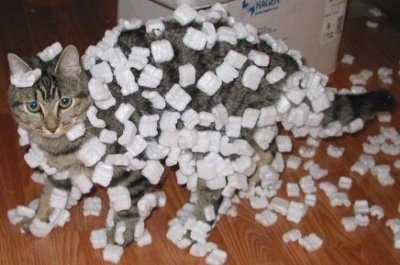
In this experiment, we will magically force electrons from Scotch Tape to pass to and from a table. Of course, you won’t be able to see the electrons transfer, but you will definitely see the effects of the hopping electrons.

Science can often seem like magic. In this mind-bending experiment, we’ll demonstrate a fundamental scientific principle with an experiment that will astonish your friends – and all you’ll need is a PVC pipe, Christmas tinsel, and a head of clean, dry hair to create a “magic wand” that will float a colorful orb.

A DC microammeter is an instrument that measures the electric current in a circuitIn a nutshell, a battery uses a chemical reaction to produce an electrical current. In this experiment, we will create an electric current using nothing more than our own bodies (Geek Slop promises this won’t hurt…. much).

Batteries store chemical energy that can be transmitted as electrical energy through various components in a circuit. You can think of the circuit as the path the electrons (electricity) take. The path has to have no breaks in it and it much be a path made of a material that will allow the electrons to…
SparTech Software Cybersecurity
Check out the latest cybersecurity and dark web news. From rapid, high-level cybersecurity analysis reports to in-depth penetration testing (pentesting) of your network and systems, SparTech Software offers a comprehensive suite of cybersecurity services designed to protect your organization from evolving digital threats.

Geeky mathematical minds make money with horse race handicapping! Visit pickpony.com for horse racing past performance sheets, race charts and heatmaps, data summaries, AI analysis, and more. Pick Pony - your best bet in horse racing!
Books from Geek Slop Publishing
Living Truth Bible Study Guides
Despite its beautiful prose, you can’t just read Revelation; it requires diligent study. However, ineffective study techniques can lead to misunderstandings. Rather than imposing strict interpretations on the described events, use the concepts we present as a framework for understanding its intricate code. The Book of Revelation indeed provides more than just a foretelling of the tumultuous end of days. It reassures Christians that divine justice will ultimately triumph over evil and promises Jesus' eventual return as the rightful king of the world.
Chronicles of Enigma
While science and reason often seek to illuminate the unknown, there remains a certain allure in the unexplained—a realm where imagination and reality blur, creating a tapestry rich with wonder and possibility. Stories from the Chronicles of Enigma series endure not just as relics of the past, but as gateways to exploring the depths of our curiosity and the infinite potential of our world. Let us be the light that guides you through the darkness.
This Month’s Charity
Geek Slop believes everyone should be a good corporate citizen. Thus, each month, Geek Slop gives a portion of our online store profits to deserving charity. This month’s charity is:
Child Fund of America
Charity Watch Grade: A+
Program percentage: 92%
©Geek Slop – Many images, trademarks, logos, video, brands and images used on this website are registered trademarks of their respective companies and owners. They want us to remind you that “All Rights are Reserved”. Geek Slop never shares its data with third parties. However, 3rd party apps used on this site (we’re talking about you, Google!) may share your data in a non-identifying manner for reasons we do not know (probably to take over the world). Some content is sourced by fans, online websites, and or other fan community sources. Geek Slop is not responsible for reporting errors, inaccuracies, omissions, and or other liabilities related to news shared here. Entertainment is afast-movingg industry but we do our best to keep tabs on infringements. If some of your content was shared by accident, contact us about any infringements right away.


