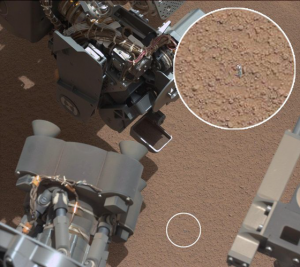
This past weekend, on route to Glenelg, the Curiosity Rover’s first target on Mars, Curiosity arrived at the “Jake Matijevic” rock where it stopped and probed the rock with its huge robotic arm to determine its chemical composition. Curiosity also blasted the specimen with its Alpha Particle X-Ray Spectrometer. Then Curiosity shot laser pulses at…
Category: Science
As science enthusiasts ourselves, we understand the importance of staying up-to-date with the latest developments in science. That’s why we bring you the latest discoveries, innovations, and advancements in the world of science, keeping you informed and up-to-date on the latest trends and breakthroughs.
Please, reclassify Fox News as a “fictional reality-based TV show” – new report shows their climate change reporting is 93% wrong
Wanna know how to buy a moon rock? Hint: black market
Moon rocks are rarely offered for sale. Sample moon rocks collected by NASA’s Apollo astronauts are considered National Treasures, property of the United States government, and would never be sold to the public. They have been however, given away. Here are funny stories about lost moon rocks and tips on how you can come into…
What causes that unique rainy smell after it rains?
It’s that distinctive earthy, musky scent that occurs after a good rain, and it has a name unbefitting its pleasant smell – “petrichor”. The petrichor odor is distinctive (and difficult to duplicate) because there are several sources/causes for the smell, including the force of the rain striking the soil and storm winds stirring everything up.…
Did you Know (DYK)–there are really six degrees of burns
Photo Montage: Space Shuttle Endeavour’s Final Flight
See why Junk DNA might not be as worthless as they thought
40 years ago, scientists coined the term “Junk DNA” to describe the part of the genome that does not contain any genes. Given that genes represent the body’s instructions for how to make vital proteins, egotistical scientists figured Mother Nature must have screwed up in the 98% of the genome without any genes. Or so…
Life may be able to survive on more planets that we originally thought
Astronomers are changing their tune and now think extraterrestrial life may be able to survive on more planets than they originally thought. In fact, there may be seven times more life bearing planets than they originally estimate. Earth differs from most planets in that it orbits the Sun on a fairly circular orbit. Most other…
Scientists create super hi-res holographic images using nanotubes
Scientists say they have found a way to use carbon nanotubes to create super hi-resolution holographic images in a process that could pave the way for 3D holographic video. Carbon nanotubes, are exceptionally small manmade materials that are several times thinner than a wavelength of visible light. They are essentially long, thin hollow pipes only…