
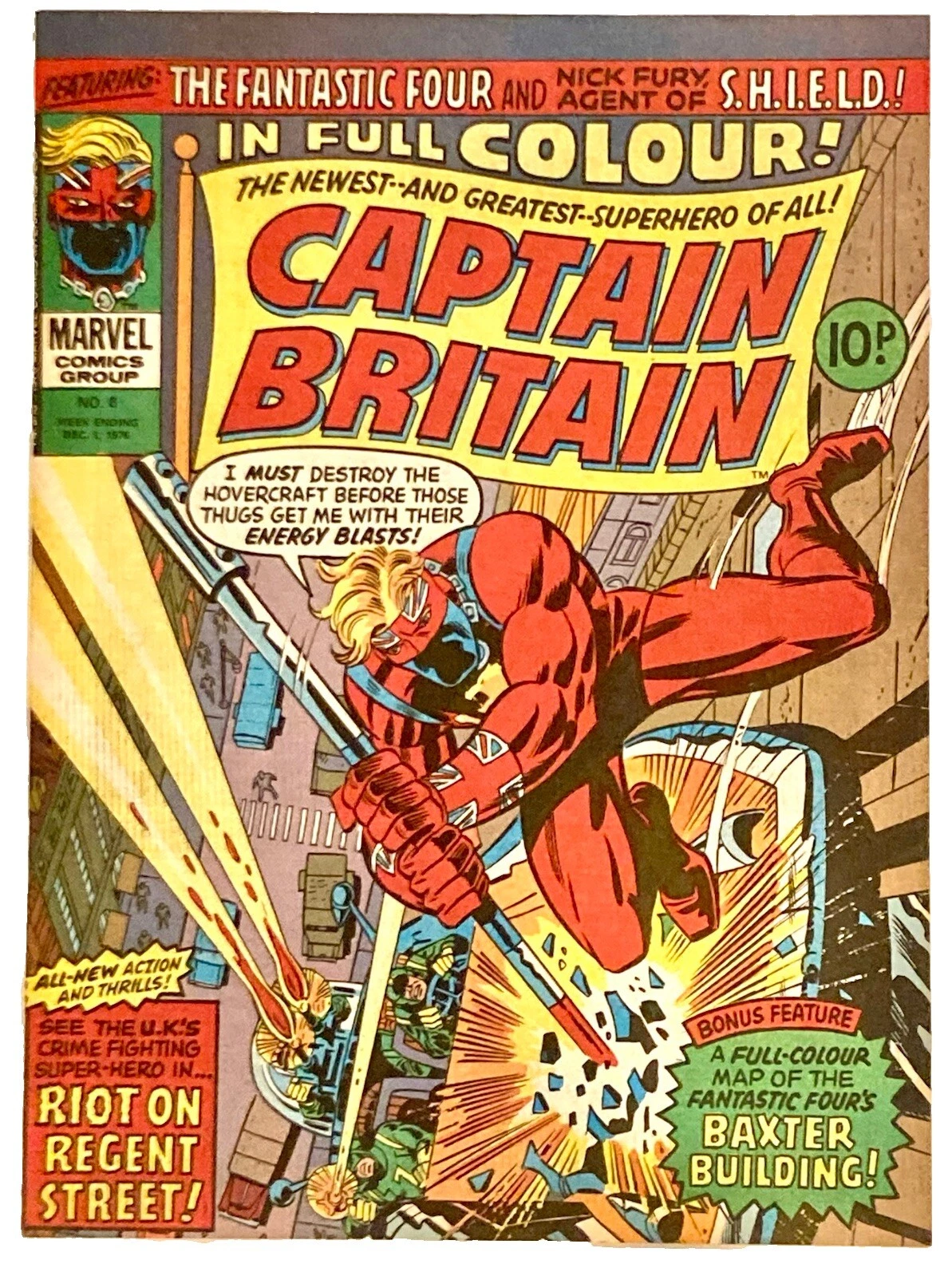
Long before Betsy Braddock became the psychic ninja Psylocke on X-Men posters and trading cards, her first step into the Marvel Universe happened in an easily overlooked British weekly: Captain Britain #8. That 1976 chapter not only introduced a future cornerstone of the X-books, it also showed how a young Chris Claremont was already weaving the kind of character-driven, interconnected mythology that would redefine superhero comics in the decades to come.
Captain Britain himself was born out of Marvel’s push to capitalize on the growing appetite for American superhero fare in the UK, where reprints of Spider-Man, the Fantastic Four, and other titles had been booming since the early 1970s. Marvel commissioned London-born writer Chris Claremont and Hulk veteran Herb Trimpe to create a homegrown champion for Marvel UK, resulting in Brian Braddock, a physics student chosen by the wizard Merlyn and empowered by the mystical Amulet of Right rather than the more aggressive Sword of Might. Launched in Captain Britain Weekly #1 in October 1976, the strip blended Arthurian myth with soap-opera family drama, positioning Brian as a distinctly British counterpart to Captain America’s idealized patriotism.
Issue #8, published in late 1976 with Claremont writing and Trimpe on pencils, quietly expanded that family drama by introducing Brian’s twin sister, Elizabeth “Betsy” Braddock. In the story, Betsy appears as a glamorous fashion model whose poised exterior masks latent psychic abilities, a setup that immediately marks her as more than just background support in the Braddock household. Contemporary summaries of the issue note that her telepathy is hinted at rather than fully weaponized, but the seeds of her future as a major telepathic force in the Marvel Universe are unmistakable even in this early UK-only appearance.
Because Captain Britain Weekly was distributed primarily in the United Kingdom and featured original material mixed with black-and-white reprints, the comic flew under the radar of many American readers, which helps explain why Betsy’s true debut remained obscure for years. Modern collecting data underscores just how hidden this origin is: grading records show only a few hundred slabbed copies of Captain Britain #8, with fewer than a hundred in top near-mint condition, making it one of the more elusive key issues for X-Men-focused collectors. That rarity puts a premium on a story that, for decades, was essentially a missing puzzle piece in Psylocke’s canon for anyone who only followed the US-published X-books.
Claremont’s handling of Betsy in Captain Britain prefigures the kind of complex, evolving identity shifts that would come to define the character once she crossed into the core X-Men line. Later stories would see her leave Britain behind, join the X-Men, and undergo radical transformations—from a refined telepath to the more aggressive, ninja-coded Psylocke persona that became a 1990s staple—yet the constant throughline is the tension between power, duty, and self-determination first sketched out in her family’s magical bargain with Merlyn. For readers charting Claremont’s growth, Captain Britain offers a bridge between his early work on titles like Iron Fist and Ms. Marvel and the intricate long-game storytelling that would make his Uncanny X-Men run legendary.
Captain Britain’s world would be dramatically reshaped in the 1980s, when Alan Moore and Alan Davis leaned hard into multiverse concepts, reinventing Brian as a protector of a web of parallel Britains and establishing the Captain Britain Corps. Those changes echoed back on Betsy as well, setting the stage for her eventual role in Excalibur, the UK-based mutant team Claremont and Davis launched in 1988 with Brian and Betsy tied tightly into X-Men continuity. By the time many ’90s readers met Captain Britain and Psylocke, their connections to British folklore, Marvel UK’s publishing experiment, and a quietly pivotal issue #8 were buried history—yet that forgotten chapter is where the Braddock twins’ shared destiny, and a significant part of the X-Men’s future, truly began.


