
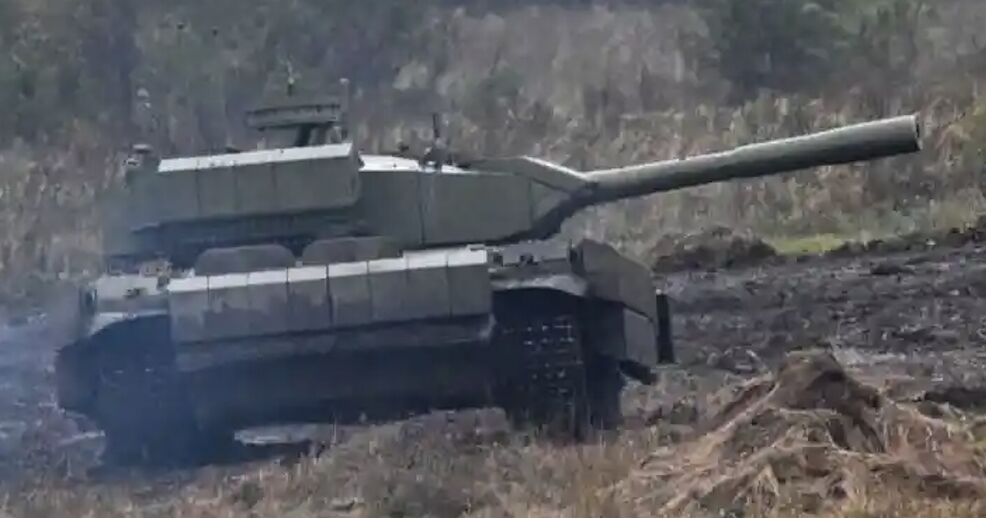
Russia’s much-hyped Shturm robotic assault tank just had the kind of debut every defense contractor dreads: a highly public, highly muddy faceplant in front of President Vladimir Putin during the Tsentr-2026 strategic exercises. The uncrewed vehicle reportedly suffered repeated command-and-control link failures before organizers gave up on remote operation, put a human driver inside, and still watched the tank nose-dive into a ditch and bog down in the soil.
The Shturm system is Russia’s latest attempt to turn a classic main battle tank chassis into a heavy robotic spearhead for frontline assaults. Developed by Uralvagonzavod, the country’s flagship tank manufacturer, Shturm is built on modified T-72B3M and related T-72/T-90 platforms, trading a crewed turret for remote-operation hardware and beefed-up frontal armor. Depending on configuration, it can carry a shortened 125 mm D-414 main gun or packages like twin 30 mm 2A42 autocannons paired with thermobaric rocket launchers, pushing it toward a hybrid of tank, infantry fighting vehicle, and close-support rocket platform. Recent Russian coverage has highlighted a multi-camera sensor block mounted on the roof that feeds panoramic imagery back to operators in the separate control vehicle, underscoring how dependent the system is on its remote vision and datalink. All of that combat power hinges on a radio-control loop with a typical range of roughly 3–4 km between Shturm and its dedicated crewed command tank, which has to stay close enough and in line of sight to maintain the link.
Tsentr-2026, held from September 28 to October 3 at sites including the Chebarkul training range in Russia’s Chelyabinsk region, was meant to be Shturm’s big coming-out party. Russia’s Ministry of Defense pushed out messaging on October 2 claiming that Putin had been shown new uncrewed combat vehicles based on the T-72B3M chassis and that they provided fire support to assault units during the main stage of the drills. But subsequent reporting painted a far less triumphant picture: according to Defence Blog and other outlets, the Shturm vehicles repeatedly lost radio contact with their control platforms during exercises, forcing commanders to abandon remote operation for the high-profile demo in front of Putin. Even under manual control, one Shturm reportedly slid off the dirt track into a muddy ditch, its tracks and forward hull sinking into the earth in a scene that spread quickly through Ukrainian, European, and Russian-language coverage.
The system’s rocky debut has amplified criticism from armor specialists who argue that Shturm’s design leaves it dangerously exposed in the types of drone-saturated battlespace it’s supposed to survive. A Russian armor expert cited by Defence Blog pointed to the tank’s engine compartment and turret roof as “almost unprotected,” exactly the surfaces Ukrainian FPV and loitering munitions have been hammering in the war. That same analyst questioned the entire concept of tying an uncrewed assault vehicle to a single nearby command post via short-range radio, noting that without stable, resilient communications akin to Starlink or a similar satellite backbone, there is “no point in such a vehicle.” The comments land harder given reports that commercial satellite internet providers have moved to prevent Russian military systems, including drones, from piggybacking on their networks in the ongoing conflict, underscoring how dependent next-gen hardware is on contested spectrum and orbital infrastructure.
For Russia’s wider “robot tank” ambitions, the Shturm flop is less an isolated meme moment and more a symptom of a long-running struggle to make unmanned ground combat vehicles work outside a parade ground. Back in 2018, the Uran-9 and Uran-6 robotic platforms were rolled through Moscow’s Victory Day parade as proof that Russian forces were embracing remote-controlled armor and demining vehicles. Subsequent exercises and trials revealed persistent problems with line-of-sight control, sensor fidelity, and survivability in complex terrain, issues that Shturm was supposed to address by pairing a heavier protected chassis with more integrated remote optics and weapons. Meta-Defense and other analysts note that Shturm is conceptually designed to rush ahead of manned formations, soak up enemy anti-tank fire, and smash hardened positions so infantry and conventional tanks can follow, but that mission only works if the robot tank can actually be steered reliably under fire.
Watching a “next-gen” robot tank lose signal and bury itself in mud feels uncomfortably familiar to fans raised on sci-fi war machines from Ghost in the Shell to Metal Gear, where reality always lags the sleek concept art. On paper, Shturm hints at a future where expendable armored hulks take the first hit instead of human crews, yet its debut shows how fragile that vision is when comms, sensors, and armor geometry haven’t caught up with cheap quadcopters and precision artillery. For now, human drivers remain very much in the loop, and Russia’s latest “robot tank” is closer to a remote-controlled cosplay of autonomy than the fully self-directed war machines that haunt video games and anime. Whether Uralvagonzavod and the Russian military can iterate past this embarrassing launch—upgrading communications, hardening vulnerable surfaces, and proving Shturm in more realistic combat conditions—will determine if this heavy robotic system becomes a fixture on future battlefields or just another cautionary tale about overpromising the tech of tomorrow.


