
Physicists have just added a new twist to the future of computing: experimental evidence of altermagnetism in an ultra-thin, highly tunable crystal that could let chips use electron spin without the noisy magnetic fields that usually come with magnets. The work nudges spintronics—electronics that treat electrons like tiny, controllable arrows instead of mere charge carriers—closer to practical, faster and more energy-efficient devices.
The new result centers on a layered material called Co1/4TaSe2, a sandwich-like crystal built by inserting magnetic cobalt atoms into a host lattice of tantalum and selenium. A team led by University of Central Florida physicist Madhab Neupane probed the material’s electronic structure and found clear signatures of altermagnetism, an unusual spin pattern that had only recently moved from theory to confirmed reality. Because Co1/4TaSe2 can be made as very thin, tunable films, it offers a playground where engineers can dial in magnetic behavior for future devices rather than being stuck with whatever nature normally provides.
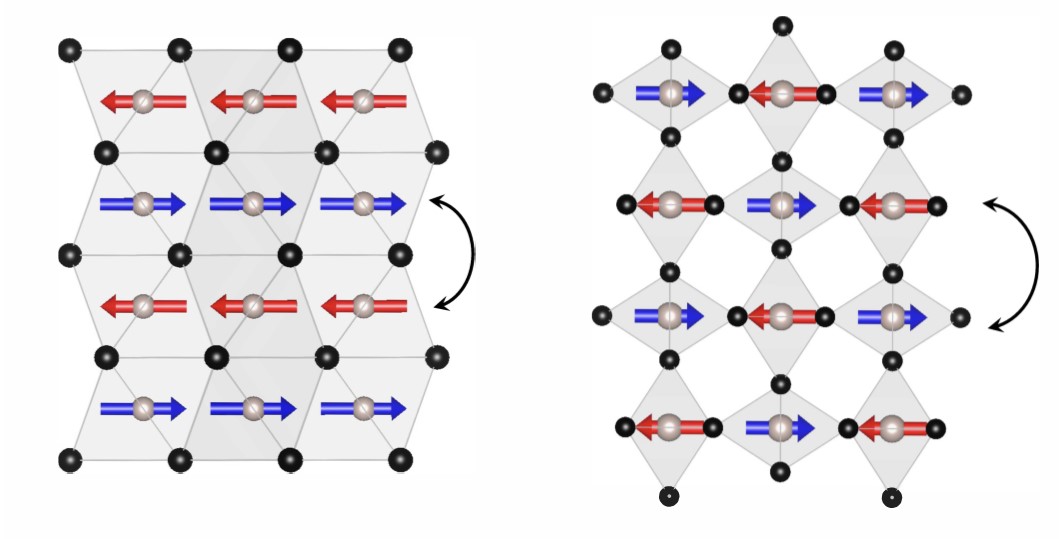
Altermagnets sit in a strange middle ground between the two classic magnetic archetypes that most tech and physics classes talk about: ferromagnets, which have spins aligned and produce strong stray fields, and antiferromagnets, whose spins cancel out so there’s no net magnetization. The altermagnetic trick is that spin directions alternate, like in antiferromagnets, but the underlying crystal symmetries still generate spin-polarized electronic bands reminiscent of ferromagnets. That means an altermagnet can look magnetically “quiet” from the outside—no big field to scramble nearby circuits—while inside it still offers the spin-selective behavior that spintronic hardware craves.
This third branch of magnetism was only formally recognized in the last few years, with theoretical work by Libor Šmejkal, Jairo Sinova and Tomas Jungwirth mapping out the concept and earning them the 2026 Europhysics Prize for reshaping the magnetic family tree. Experiments at the Swiss Light Source in Switzerland then nailed down altermagnetism in crystals of manganese telluride, providing a clean, textbook example of the phase. Since then, groups around the world have been racing to spot altermagnetism in more “real-world” materials, including ultra-thin films of ruthenium dioxide and even the common iron ore mineral hematite, all of which show altermagnetic order at or above room temperature.
For hardware geeks, the draw is straightforward: if you can build logic, memory or interconnects that use spin rather than charge, you can slash energy use and heat while potentially boosting speed. Conventional ferromagnets, however, act like tiny villains in a motherboard, emitting stray magnetic fields that can interfere with neighboring components, especially at nanometer scales. The Co1/4TaSe2 result suggests a route to spin-based elements that behave like antiferromagnets on the outside but still let engineers generate and detect spin currents inside—imagine SSD controllers, AI accelerators or quantum-inspired coprocessors that run cooler and cleaner without magnetic cross-talk.
The broader hunt for altermagnets is already being boosted by machine learning, with researchers training graph neural networks to scan crystal databases for structures likely to host this exotic spin pattern before confirming candidates with detailed electronic calculations. As more altermagnetic materials are identified—especially those compatible with existing chip fabrication processes—the discovery in Co1/4TaSe2 looks less like a one-off curiosity and more like a preview of a new design toolkit for future computers. It will take years of materials engineering and device prototyping to turn these crystals into commercial hardware, but the message for anyone tracking next-gen PCs and consoles is clear: the magnetic rules that governed old-school hard drives and fridge magnets are no longer the whole story.
Image Credits
In-Article Image Credits
Alternating magnetic and crystal pattern in altermagnetic Manganese Telluride (left) and Ruthenium Dioxide (right) via Wikimedia Commons by Libor Šmejkal with usage type - Creative Commons LicenseFeatured Image Credit
Alternating magnetic and crystal pattern in altermagnetic Manganese Telluride (left) and Ruthenium Dioxide (right) via Wikimedia Commons by Libor Šmejkal with usage type - Creative Commons License


