
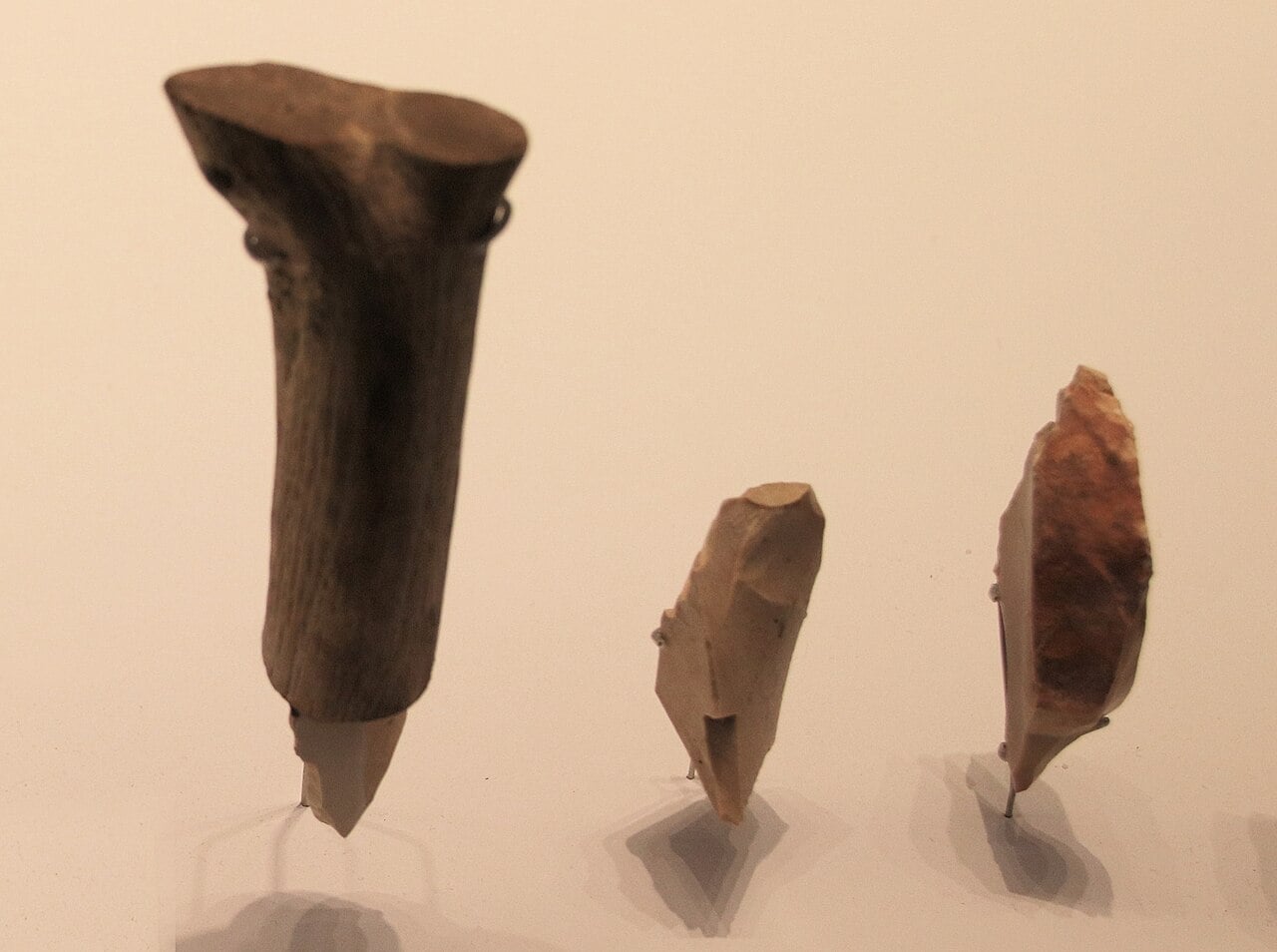
Forget the image of Neanderthals as clumsy cave brutes swinging crude clubs—new evidence from a rock shelter near Barcelona shows they were more like master carpenters living in a long-lost Wooden Age.
The find comes from Abric Romaní, a cliffside rock shelter in Capellades about 50 kilometers west of Barcelona, where Neanderthals lived between roughly 62,000 and 40,000 years ago. Researchers led by Palmira Saladié at the Catalan Institute of Human Paleoecology and Social Evolution (IPHES-CERCA) systematically documented 597 wooden remains and imprints preserved across 16 archaeological layers, capturing around 20,000 years of occupation. As first reported in a detailed study in Science Advances, this is the largest and most comprehensive sample of Neanderthal wooden technology ever analyzed.
Wood almost never survives in Paleolithic sites, but Abric Romaní is a rare exception thanks to travertine incrustations—calcium carbonate deposits that formed around wooden objects and kept their microscopic outlines even after the wood decayed. By peeling back these mineral shells, the team could reconstruct tool shapes down to cellular-level details, revealing deliberate scraping, shaping, and repair marks in the ancient carpentry. The result is a snapshot of Neanderthal tool culture that usually vanishes from the archaeological record, leaving stone artifacts to tell an incomplete story.
Out of the 597 pieces, the researchers flagged 13 as clear worked objects, and the lineup reads like a survival-crafting inventory: bark trays and containers, structural poles, digging tools, spears, and a compact club-like artifact with a distinct handle and head. Some wooden spears stretch up to about 2.45 meters and were likely designed for close-range thrusting rather than long-distance throwing, hinting at risky, up-close hunting tactics. Near hearths and refuse pits, the team found meter-long digging sticks and tripod-like supports that may have helped organize cooking spaces and waste disposal. The bark trays and containers suggest food handling and storage, while structural elements point to screens, windbreaks, or lightweight frameworks shaping how Neanderthals organized their living spaces.
Taken together, the assemblage shows woodworking wasn’t some occasional hack but a core part of Neanderthal technology, running alongside the stone tool tradition that usually gets all the attention. The careful selection of suitable wood, intentional shaping, and maintenance of tools indicates planning and an intimate knowledge of their environment. As coverage in outlets like New Scientist has put it, Neanderthal Europe now looks as much like a Wooden Age as a Stone Age, with wood providing weapons, utensils, and architectural components that rarely fossilize. This meshes with other rare finds of ancient wooden tools—such as much older artifacts from European coal mines possibly made by early Neanderthals or Homo heidelbergensis—but Abric Romaní stands out for its sheer scale and clear link to Neanderthal life.
For anyone steeped in sci-fi, fantasy, and tabletop worlds, these results practically beg for a rewrite of how Neanderthals show up in our media. They weren’t just background brutes with stone axes—they were people who engineered their shelters, managed firewood, built containers, and crafted specialized hunting gear, all with an organic material that usually disappears from the fossil record. The Abric Romaní tools give creators a data-backed excuse to depict Neanderthals more like meticulous survival crafters—closer to the resource-savvy NPCs in your favorite open-world game or a well-prepared D&D party than the caricatured cave-dweller stereotype.
Image Credits
In-Article Image Credits
Mousterian & Aurignacian Cultures, Stone Burins used for incising stone and wood, Qafzeh, Hayonim, el-Wad Cave, 250,000-22,000 BP Israel via Wikimedia Commons by Gary Todd with usage type - Creative Commons License. This image has been extracted from another file: Mousterian & Aurignacian Cultures, Stone Burins used for incising stone and wood, Qafzeh, Hayonim, el-Wad Cave, 250,000-22,000 BP Israel.jpgFeatured Image Credit
Mousterian & Aurignacian Cultures, Stone Burins used for incising stone and wood, Qafzeh, Hayonim, el-Wad Cave, 250,000-22,000 BP Israel via Wikimedia Commons by Gary Todd with usage type - Creative Commons License. This image has been extracted from another file: Mousterian & Aurignacian Cultures, Stone Burins used for incising stone and wood, Qafzeh, Hayonim, el-Wad Cave, 250,000-22,000 BP Israel.jpg


