
Finland has ordered Google to slam the brakes on two massive AI data center projects after authorities said the company’s local subsidiary cleared forest without completing mandatory environmental impact assessments, putting one of Europe’s flagship cloud expansions under intense scrutiny.
The Finnish Licensing and Supervision Agency (LVV) issued a notice to Tuike Finland Oy, Google’s subsidiary handling the projects, demanding an immediate halt to any work that significantly alters the environment at sites in Muhos and Kajaani in northern Finland. The suspension covers tree felling, stripping of topsoil, excavation, blasting, quarrying, crushing, major earthmoving, drainage work, and the construction of site roads and storage areas. LVV’s order sets a hard deadline: all such work must stop at once and no later than October 23, 2026, and remain paused until the environmental impact assessment (EIA) procedures for both projects are completed. Tuike Finland has also been told to explain how it intends to proceed by mid-October, while police have opened a probe into suspected illegal logging connected to the projects.
Finnish environmental groups say the scale of the land clearing already carried out is far from trivial: the Finnish Association for Nature Conservation reported that more than 300 hectares of forest had been felled or prepared at the Leppiniemi area in Muhos while the EIA process was still incomplete. Google confirmed to local media that roughly 330 hectares had been cleared or prepared in Muhos and nearly 200 hectares in Kajaani, equating to hundreds of acres of boreal forest converted into future server-farm real estate. In a statement, the company acknowledged that it had “fallen short of our own high standards in this instance,” saying it believed it had acted in good faith under Finland’s Forestry Act and had conducted nature surveys and measures to protect high-value areas, while now promising landscaping and biodiversity work including tree planting across about 130 hectares at Muhos.
These sites are part of a much larger play: Google recently unveiled plans to invest around €13 billion in Finland as a major hub for its European data center footprint, leveraging the country’s cool climate, stable power grid, and ample land to host energy-hungry AI infrastructure. Finland has been dubbed the “Texas of Europe” for its data center ambitions, even as the global AI buildout is largely anchored in the United States and China. European governments and tech giants are racing to catch up with what has been described as a roughly $30 billion push into AI infrastructure, with some mega-sites reportedly targeting around 100,000 AI GPUs per location. SoftBank, for example, has signaled plans to pour tens of billions of dollars—about $87 billion—into data center projects in France, banking on the country’s extensive nuclear-powered electricity grid to feed future AI workloads.
Europe’s rapid AI expansion is already straining power systems and permitting regimes elsewhere on the continent. Denmark has paused new data center connection requests after demand hit around 60 GW—more than eight times the country’s peak power consumption of roughly 7 GW—highlighting how AI-scale facilities can overwhelm national grids. Amazon’s data center projects in parts of Europe are reportedly facing delays of up to seven years as they queue for new grid connections, in stark contrast to the fast-track buildouts often seen in U.S. tech hubs. In Finland, however, the Google halt is not about electricity supply at all; LVV’s order is explicitly tied to environmental procedure, arguing that the measures already underway would significantly change the landscape and water balance in a way that must first be fully identified and evaluated through the EIA process.
Finland’s stance reflects a broader European approach where environmental review is meant to happen before massive projects reshape local ecosystems, rather than after communities complain about a finished “cloud” complex suddenly humming in their backyard. LVV has emphasized that while heavy land-altering work must stop, Tuike Finland can continue low-impact activities such as planning, measurements, and soil surveys that do not materially change the environment, signaling that the projects are paused rather than formally cancelled. Environmental assessments for Muhos and Kajaani are expected to conclude later this year, after which regulators will decide whether construction can resume as planned, be modified with stricter mitigation, or face more permanent limitations. For now, Finland’s forests have won a temporary reprieve from the bulldozers, and Google’s Nordic AI ambitions are on hold until it can convince regulators—and increasingly vocal conservationists—that its “green” data centers are not built on a clear-cut.
The clash also underlines a growing tension in global geek-tech infrastructure: the same AI boom that excites gamers, coders, and sci-fi fans with promises of ever-smarter models requires vast physical footprints, often in rural or forested regions that have long been treated as expendable. In the United States, resistance is already more visible, with dozens of data center projects worth around $68 billion reportedly blocked by residents and communities in just the second quarter of 2026. Europe, by contrast, tends to push conflicts into permitting and environmental review rather than street-level protests, which may explain why there have been fewer headline-grabbing clashes around European data centers even as regulatory brakes quietly slow megaprojects. The Finnish halt now becomes a key test case: if one of the world’s largest tech companies can be forced to stop mid-clear-cut in a country that actively courts data centers, it sends a message that environmental law will be a hard constraint on the AI arms race, not just another box to tick after the forests are gone.
Image Credits
In-Article Image Credits
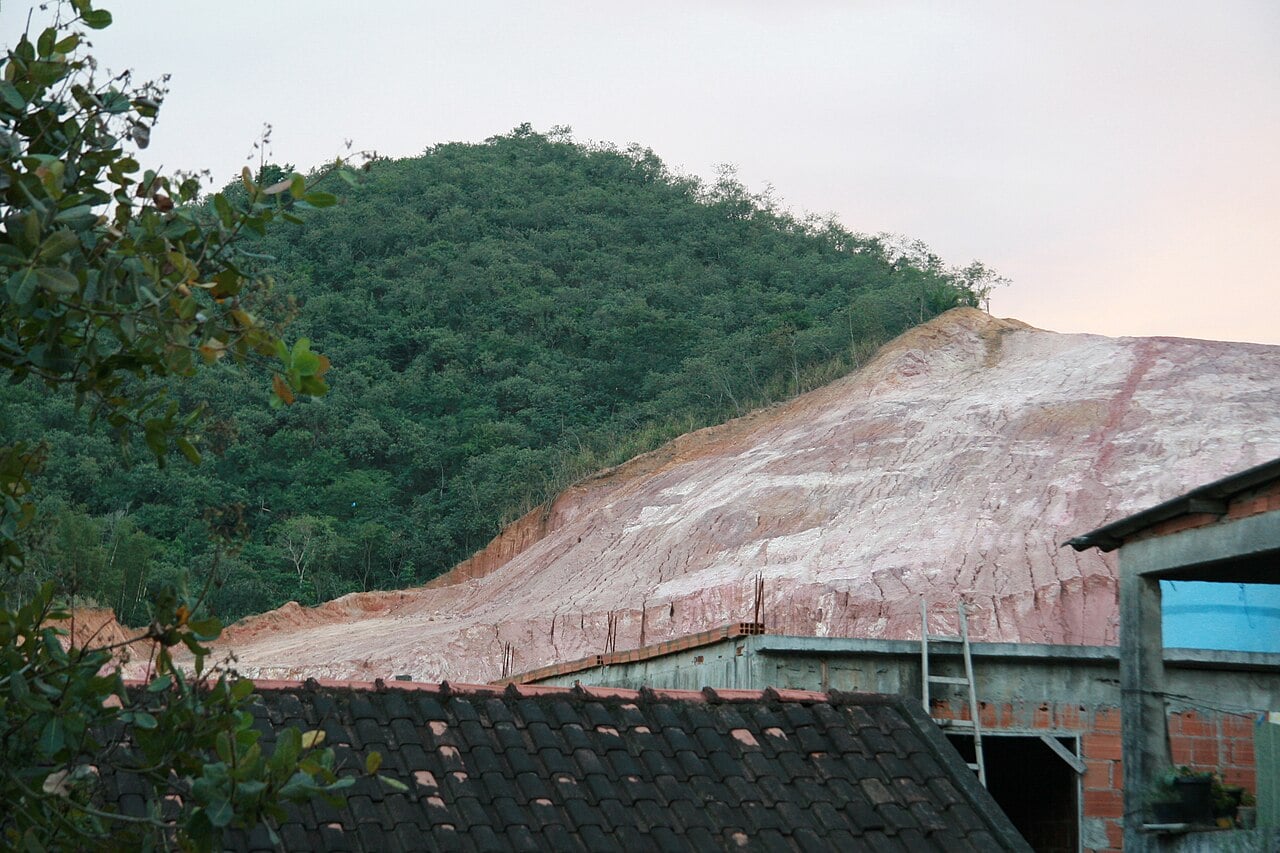
Deforestation in Atlantic Forest Rio de Janeiro - Brazil. This hill was deforestated in order to use its clay in civil construction in Barra da Tijuca. Many trucks with the city public service logo worked on the hill destruction. via Wikimedia Commons by Alex Rio Brazil with usage type - Public DomainFeatured Image Credit
Deforestation in Atlantic Forest Rio de Janeiro - Brazil. This hill was deforestated in order to use its clay in civil construction in Barra da Tijuca. Many trucks with the city public service logo worked on the hill destruction. via Wikimedia Commons by Alex Rio Brazil with usage type - Public Domain


