
Amazon’s long‑gestating satellite network has just crossed a major threshold: Project Kuiper has now produced its 1,000th broadband satellite, and the company is signaling that its space‑based internet service is only weeks away from an end‑of‑year rollout, as first reported by Ars Technica. With that milestone, the world’s biggest retailer is positioning itself as the first serious challenger to SpaceX’s Starlink, promising another way to get high‑speed internet beamed down from low‑Earth orbit instead of the usual fiber and cable.
Project Kuiper is Amazon’s plan to build a constellation of low‑Earth orbit satellites that can deliver low‑latency, high‑speed broadband to homes, businesses, and governments around the world, particularly in regions that traditional infrastructure has failed to reach. The company holds authorization to deploy a network of 3,236 satellites, and its regulatory commitments require launching at least half the constellation by mid‑2026, underscoring why the production ramp to 1,000 satellites matters. Earlier briefings described a strategy where Kuiper would begin offering service once “a few hundred” operational satellites are on‑orbit, rather than waiting for the full network to be built out, suggesting that commercial service could come online relatively quickly once launch cadence picks up.
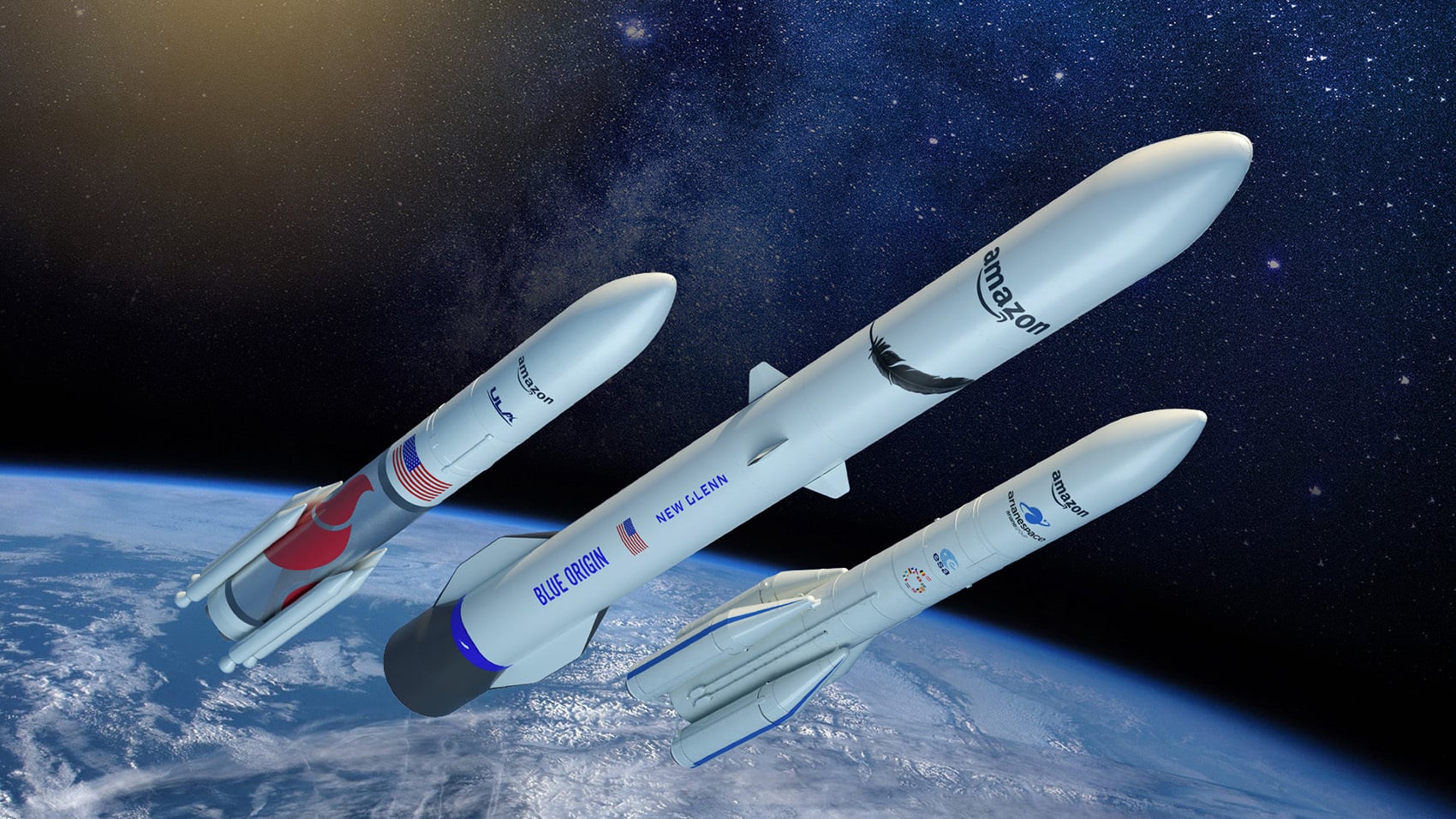
SpaceX’s Starlink has had the orbital broadband field largely to itself for the past several years, signing deals with airlines, maritime operators, and defense customers while rolling out consumer terminals in dozens of countries. OneWeb and a handful of regional systems offer more limited coverage, leaving Amazon as the only player with the scale, cash, and infrastructure to mount a global challenge. To get Kuiper into orbit, Amazon has locked in a slate of launch contracts with United Launch Alliance, European provider Arianespace, and Jeff Bezos’s own Blue Origin, with at least 77 launches planned over roughly five years to deploy the bulk of the constellation. That multi‑rocket approach is designed to avoid bottlenecks and keep Kuiper’s deployment on pace with its regulatory deadlines.
Guiding that effort is Rajeev Badyal, Amazon’s vice president of technology and head of Project Kuiper. Before joining Amazon, Badyal was a key figure at SpaceX, serving as vice president of satellites and leading the early Starlink program, including its first prototype spacecraft. His tenure at SpaceX ended when Elon Musk removed him from the role following disagreements over the pace of development, a shake‑up that cleared the way for Musk’s more aggressive deployment strategy and ultimately opened the door for Amazon to hire Badyal and several members of his team to spearhead Kuiper. That pedigree means Kuiper’s leadership has already lived through one full satellite‑internet buildout, and Amazon is leaning heavily on that experience as it scales from prototypes to mass‑manufactured hardware.
Amazon has already flown prototype Kuiper satellites to validate its hardware and communications architecture, including a successful pair of test spacecraft launched on a United Launch Alliance Atlas V that achieved contact and began experiments with ground antennas. The company has also shown off a family of user terminals, ranging from compact, lower‑cost dishes for residential customers to larger, higher‑throughput antennas aimed at enterprise and government buyers. The goal is to deliver fiber‑like speeds with much lower latency than traditional geostationary satellite internet, making Kuiper viable not just for streaming and remote work, but potentially for competitive online gaming and other latency‑sensitive applications that geeks care about.
Pricing, exact service tiers, and specific launch dates are still under wraps, and recent coverage notes that Amazon has yet to name a firm “day one” for Kuiper’s commercial debut even as it touts the 1,000‑satellite production milestone. Still, with hardware rolling off the line, launch contracts locked in, and regulatory clocks ticking, Kuiper is moving from the PowerPoint phase into the era of actual spacecraft and real customers. For Starlink users, that could soon mean a world where multiple competing orbital ISPs fight on price, performance, and coverage. For everyone still stuck on DSL or spotty rural LTE, Amazon’s sprint to orbit might finally make “internet from space” feel less like sci‑fi and more like a practical alternative by the end of the year.
Image Credits
In-Article Image Credits
Amazon Project Kuiper rockest taking satellites to space via Amazon News Release with usage type - News Release MediaFeatured Image Credit
Amazon Project Kuiper rockest taking satellites to space via Amazon News Release with usage type - News Release Media


