
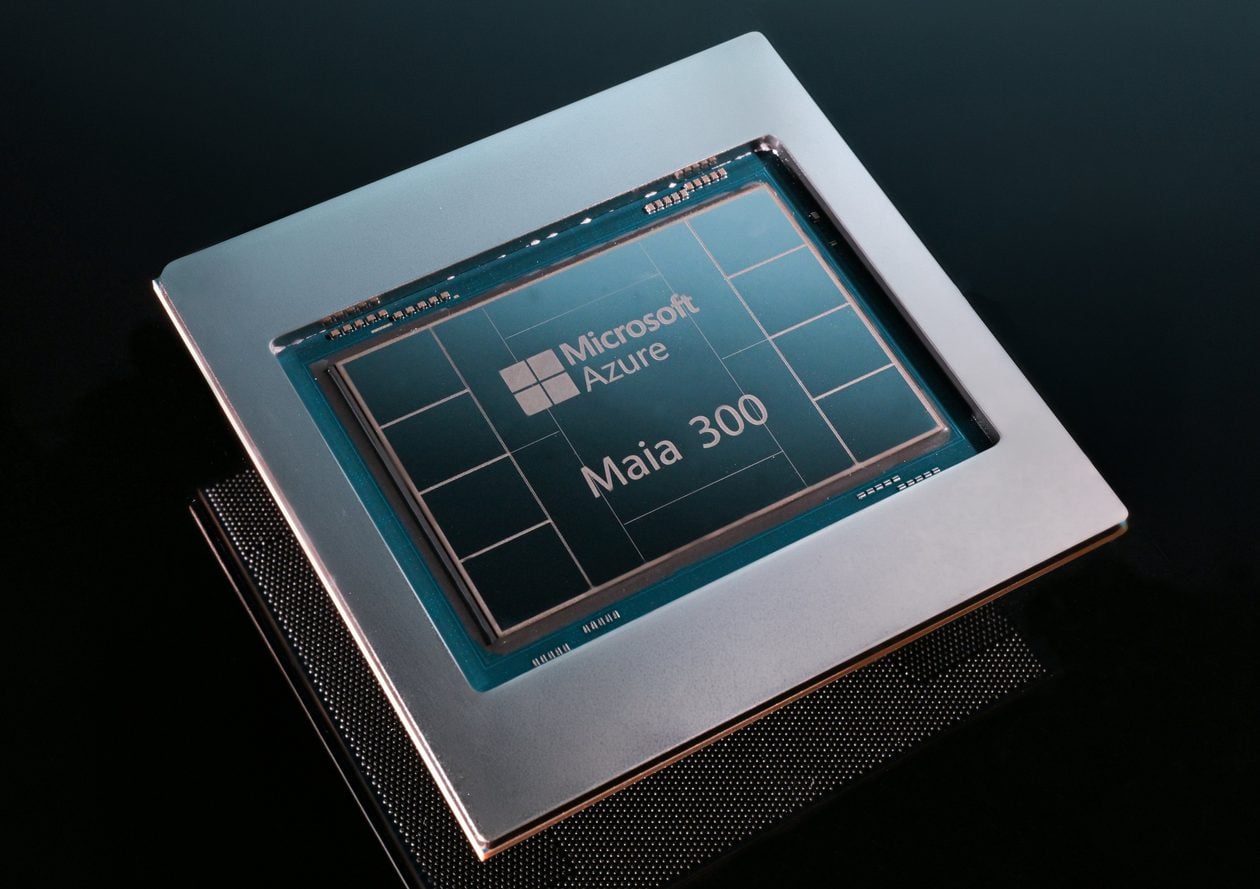
Microsoft is doubling down on homegrown AI silicon with Maia 300, a third-generation in-house accelerator that it plans to make the primary engine for running AI inference across its products and cloud services, with production rollout targeted for 2027. The chip is designed to squeeze more useful work out of each megawatt of power, giving Microsoft a path to cheaper AI features and a future less dependent on Nvidia’s dominant GPU lineup.
Reports ahead of the official reveal say Microsoft is preparing to show off Maia 300 this fall, potentially as soon as September 2026. Behind the scenes, the company has been negotiating with Taiwan Semiconductor Manufacturing Co. to secure capacity for more than 300,000 chips, with deliveries aimed at 2027 and long-term ambitions that could eventually top one million units. That scale underscores just how central Microsoft expects this accelerator to be in its datacenters, where AI inference workloads are measured not in servers but in gigawatts of power.
Maia 300 follows the pattern of its predecessors as a custom AI application-specific integrated circuit built specifically for Azure’s cloud infrastructure rather than consumer devices. Microsoft is targeting large language models, advanced reasoning systems, and agentic AI tasks, with a focus on optimizing how many tokens the chip can process per unit of energy consumed. Executives have teased efficiency gains over leading GPU systems, describing Maia 300 as capable of delivering substantially more tokens per megawatt than current alternatives, which translates directly to lower inference costs at cloud scale.
Maia 300 is the latest move in a multi-year strategy to bring more of Microsoft’s AI stack under its own roof rather than relying solely on third-party hardware. Back in 2023, the company unveiled its first Azure Maia 100 accelerator alongside the Arm-based Azure Cobalt CPU, framing them as part of a “silicon to service” approach that tailored everything from chips to software for AI demand. Maia 100, built on TSMC’s 5-nanometer process, packed roughly 105 billion transistors and was tuned for both training and inference, while a follow-up Maia 200 design saw its mass production window pushed out to 2026. Microsoft’s chief technology officer Kevin Scott has since suggested that the long-term goal is to run most of its AI workloads on its own silicon, indicating that these chips are meant to gradually take over from external suppliers.
The push toward Maia 300 also reflects a broader power play in the AI hardware market, where Nvidia’s GPUs still dominate both performance charts and the advanced packaging capacity at foundries like TSMC. Analysts note that Nvidia controls a large share of TSMC’s cutting-edge packaging queue, and that hyperscalers such as Microsoft must lock in massive chip orders years in advance if they want guaranteed access to next-generation manufacturing nodes. By betting on its own accelerator and reserving hundreds of thousands of units, Microsoft is effectively carving out dedicated capacity that can’t be crowded out by rivals’ GPU demand.
For everyday users, the impact of Maia 300 will be less about the silicon itself and more about what it enables in the services they already touch daily. Microsoft’s first-generation Maia and Cobalt chips are already being used to power offerings such as Copilot and Azure OpenAI Service, and a more efficient third-generation accelerator should make it easier to roll out richer AI features across Windows, Office, GitHub, and cloud applications without blowing out the energy budget. Cheaper inference at scale also opens the door to more experimental AI-driven experiences in areas like gaming, where cloud-hosted agents, smarter NPCs, and personalized content generation all depend on cost-effective datacenter compute.
Officially, Microsoft has kept tight-lipped about Maia 300’s final specifications, and several outlets emphasize that detailed performance numbers, memory capacity, and even the exact manufacturing node have yet to be confirmed. Leaked reports and industry analyses point to a design built on TSMC’s 3-nanometer process with significantly expanded on-chip SRAM and high-bandwidth HBM3e memory, potentially putting it toe-to-toe with Nvidia’s upcoming Blackwell GPUs, but those figures remain speculative until Microsoft publishes hard data. The real test will come once Maia 300 is fully deployed in Microsoft’s datacenters around 2027, where its promised gains in tokens-per-megawatt and sheer chip volume will show whether in-house silicon can meaningfully loosen Nvidia’s grip on AI infrastructure.


