
General anesthesia may switch off conscious experience without putting the brain’s language machinery entirely on standby. A Baylor College of Medicine-led study found that anesthetized patients’ hippocampi continued responding to speech in structured ways, including identifying grammatical categories and anticipating words that had not yet been spoken. ScienceDaily’s report describes the findings as a challenge to the usual boundary drawn between unconsciousness and complex thought.
The work was conducted with patients undergoing epilepsy surgery, giving researchers an unusually direct view of activity deep inside the brain. Instead of relying only on scans that capture broad patterns, the team recorded signals from hundreds of individual neurons using advanced Neuropixels probes. The focus was the hippocampus, a region best known for its role in memory and learning but now implicated in considerably more active language processing during anesthesia. Texas Children’s Hospital’s research summary identifies Baylor professor and neurosurgeon Dr. Sameer Sheth among the researchers associated with the work.
In one portion of the experiment, patients heard a stream of tones interrupted by occasional unexpected sounds. Neural responses changed as the brain learned to distinguish the unusual tones, suggesting that some form of learning or neural adaptation can continue even when a person shows no outward sign of awareness. The language trials went further: while short stories played, patterns of hippocampal activity differed for nouns, verbs, and adjectives.
Most strikingly, the recorded signals contained information that could be used to forecast later words in a sentence. That result points to predictive processing—the brain’s habit of using context to prepare for what comes next—operating without the conscious narration people normally associate with understanding language. Related coverage from Technology Networks notes that the finding may support a view of consciousness as something requiring coordination across wider brain systems, rather than simply activity in one capable region.
There is an important distinction between processing information and consciously experiencing it. The study does not show that patients understood the stories, formed memories of them, or could later report what they heard; their brains’ activity was measured while they remained unconscious. The participants were also epilepsy-surgery patients, so the results will need to be tested across larger and more varied groups, with other anesthetic drugs and clinical conditions.
Even with those limits, the research could reshape questions about anesthesia, memory, and disorders of consciousness. It may eventually inform safer methods for monitoring patients, as well as brain-computer interfaces designed to detect or translate neural activity when ordinary communication is impossible. For now, the central lesson is more unsettling and more useful: conscious awareness may be absent while important parts of the brain continue to analyze the world—and make educated guesses about what comes next.
Image Credits
In-Article Image Credits
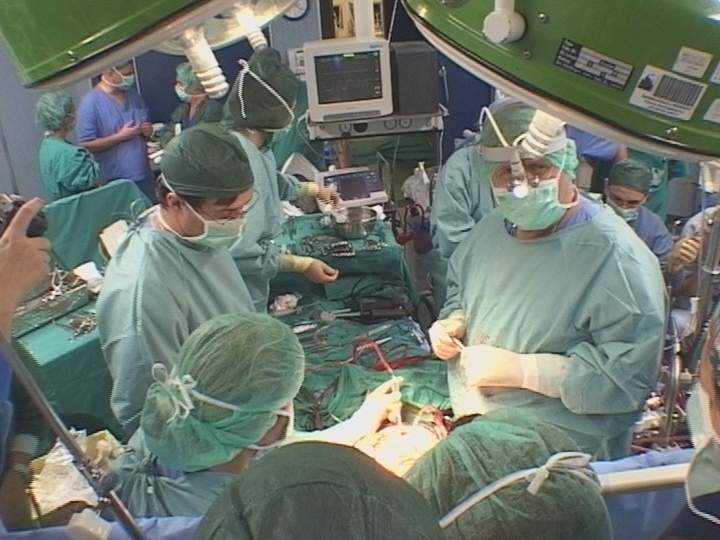
Doctors performing surgery on a patient via Wikimedia Commons with usage type - Creative Commons LicenseFeatured Image Credit
Doctors performing surgery on a patient via Wikimedia Commons with usage type - Creative Commons License


