
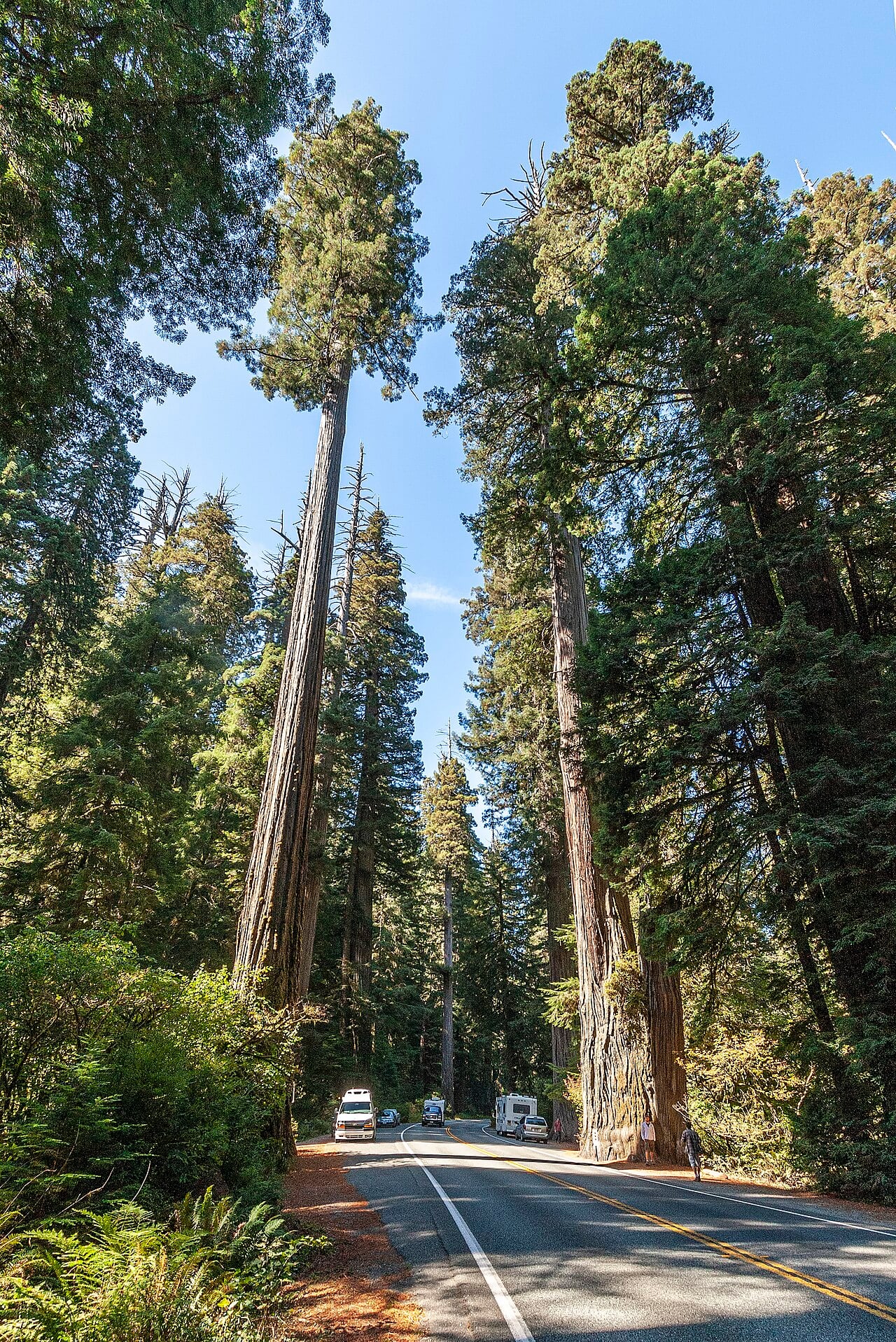
California’s coast redwoods are built for fog, moisture and relatively mild temperatures—not the increasingly brutal heat waves now pushing their leaves beyond their cooling limits. New research suggests that the world’s tallest trees sharply reduce photosynthesis during hot weather, potentially weakening both their growth and their ability to store atmospheric carbon. Live Science’s report describes the findings from a study published in JGR Biogeosciences.
Led by Lily Klinek of the University of California, Davis Plant Optics Lab, the research team monitored coast redwood (Sequoia sempervirens) leaves in Mendocino County’s Garcia River Forest from 2022 through 2024. The researchers repeatedly measured leaf temperature and fluorescence, a signal scientists can use to estimate how efficiently a plant is converting light into energy. The fieldwork produced 1,527 individual leaf measurements across three young trees, according to additional reporting on the study. Earth.com
The most striking result was the gap between the surrounding air and the trees’ sunlit leaves. During hot conditions, leaves reached temperatures as much as 18 degrees Fahrenheit—about 10 degrees Celsius—above the air around them. That matters because redwoods normally use water loss through their stomata, the microscopic pores on their leaves, to help shed heat. Closing those pores conserves water but also restricts carbon dioxide intake, leaving the tree with less raw material for photosynthesis.
Laboratory tests showed the problem is not simply drought avoidance. When detached leaves were kept in water and exposed to rising temperatures, photosynthesis still declined, even though the leaves had access to water and their stomata remained open. The study found a clear drop above roughly 86 degrees Fahrenheit, while the rate of photosynthesis in laboratory tests approximately halved as temperatures climbed from 86 to 104 degrees. The study record identifies this as a direct, non-stomatal limitation on the trees’ photosynthetic machinery.
That distinction gives the findings a larger climate significance. Redwood forests are among Earth’s major aboveground carbon stores, so a heat-driven slowdown could mean less carbon pulled from the atmosphere and less energy available for growth, repair and reproduction. The research does not establish that heat waves are killing mature redwoods, nor does it define the temperatures at which permanent injury or mortality begins. As Klinek told UC Davis, the work represents an important first look at how heat affects redwood photosynthesis rather than a final forecast for the species.
The immediate concern is greatest near the warmer, southern and inland edges of the redwood range, where extreme heat can collide with seasonal dryness. More observations across older forests, different elevations and longer periods will be needed to determine whether trees recover fully after heat events or accumulate lasting damage. For now, the message is less that California’s iconic redwoods are doomed than that their climate refuge is becoming less dependable—and that even forests famous for enduring centuries may have physiological limits that a hotter world is beginning to test.
Image Credits
In-Article Image Credits
The Simpson-Reed Grove of Coast redwoods (Sequoia sempervirens). U.S. Route 199 in California, the Redwood Highway, at Jedediah Smith State Park near Crescent City, California. via Wikimedia Commons by Acroterion with usage type - Creative Commons LicenseFeatured Image Credit
The Simpson-Reed Grove of Coast redwoods (Sequoia sempervirens). U.S. Route 199 in California, the Redwood Highway, at Jedediah Smith State Park near Crescent City, California. via Wikimedia Commons by Acroterion with usage type - Creative Commons License


