
Meta is planning an internet superhighway beneath the Atlantic. Called Petal, the roughly 4,300-mile (7,000-kilometer) submarine cable is designed to connect the United States and France with up to 1 petabit per second of capacity—equivalent to 1 million gigabits per second. Meta expects the system to enter service in 2029, positioning it as the first commercial transoceanic cable to reach petabit-class capacity. Live Science first reported the project’s headline specifications.
That number is difficult to visualize: 1 petabit per second works out to about 125 terabytes every second. In the sort of comparison made by Meta’s engineers, Petal could theoretically move around 25,000 five-gigabyte HD movies in that time. The company says the cable will provide roughly twice the capacity of existing subsea systems covering a similar transatlantic distance, although real-world throughput will depend on network equipment, traffic, and how the capacity is allocated.
The breakthrough is not simply a matter of packing more conventional strands into the cable. Petal will use multi-core fiber, with two separate optical cores inside each hair-thin strand. Those cores carry signals in opposite directions, allowing one physical fiber to perform the work traditionally handled by a pair of single-core fibers. The design includes 24 pairs of dual-core fibers, producing 96 optical cores in total—the equivalent of 48 conventional fiber pairs. Meta’s engineering team describes the architecture as a way to increase capacity without a proportional expansion in the cable’s physical infrastructure or power demands.
Making that arrangement work across an ocean requires more than innovative glass. A transatlantic cable relies on repeaters spaced along the seabed to refresh weakening optical signals, with a route of this length expected to need about 100 of them. Petal will use fan-in/fan-out equipment at those repeaters: signals arriving through the two cores will be separated into individual single-core paths for amplification, then combined back into the dual-core fiber for the next leg. That extra optical engineering is what lets the system preserve the benefits of multi-core fiber over thousands of miles.
Meta is funding and operating Petal, while Japan’s NEC is handling the system’s overall design and construction. Sumitomo Electric will supply the specialized two-core fiber, and NEC’s announcement confirms the planned United States-to-France route and 2029 operating target. Meta’s own announcement frames the project as a response to rapidly growing demand from cloud services, artificial intelligence, video, and other data-heavy applications.
For ordinary users, Petal will not automatically mean gigabit downloads at home; the cable’s capacity will still pass through national networks, data centers, and local broadband infrastructure. Its significance is more foundational. Submarine cables carry about 99% of the world’s internet traffic, so expanding the capacity of a major ocean route can give cloud providers and platforms more room for AI workloads, streaming, and global services while adding another high-capacity link between North America and Europe. Petal’s real test begins long before its 2029 launch: manufacturing the cable, installing it safely on the ocean floor, and keeping its novel fiber-and-repeater system reliable for decades.
Image Credits
In-Article Image Credits
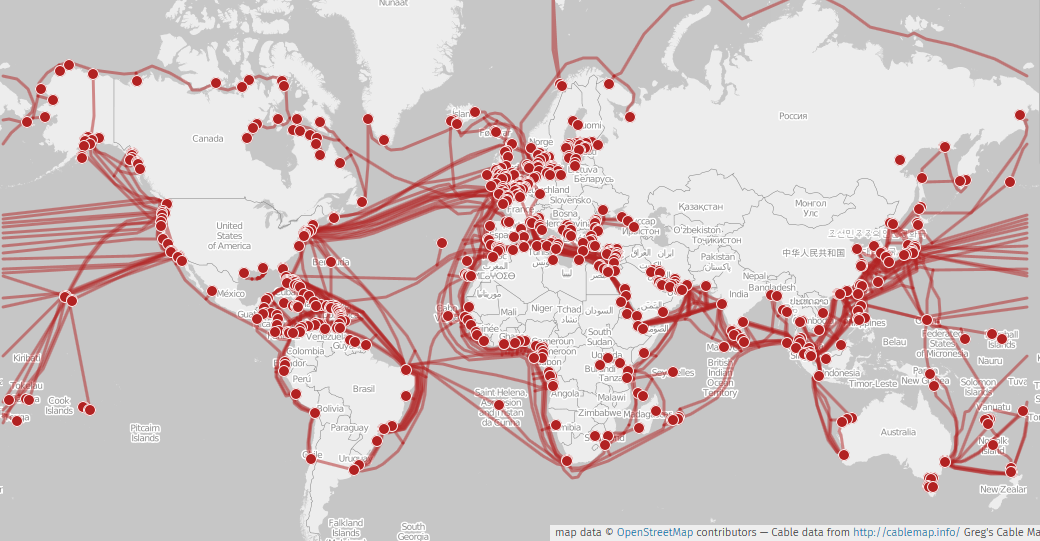
World map of submarine communication cables. cable data by Greg Mahlknecht (KML file released under GPLv3) as of 2015-07-21, world map by Openstreetmap contributors via Wikimedia Commons by cable data by Greg Mahlknecht , map by Openstreetmap contributors with usage type - Creative Commons LicenseFeatured Image Credit
World map of submarine communication cables. cable data by Greg Mahlknecht (KML file released under GPLv3) as of 2015-07-21, world map by Openstreetmap contributors via Wikimedia Commons by cable data by Greg Mahlknecht , map by Openstreetmap contributors with usage type - Creative Commons License


