
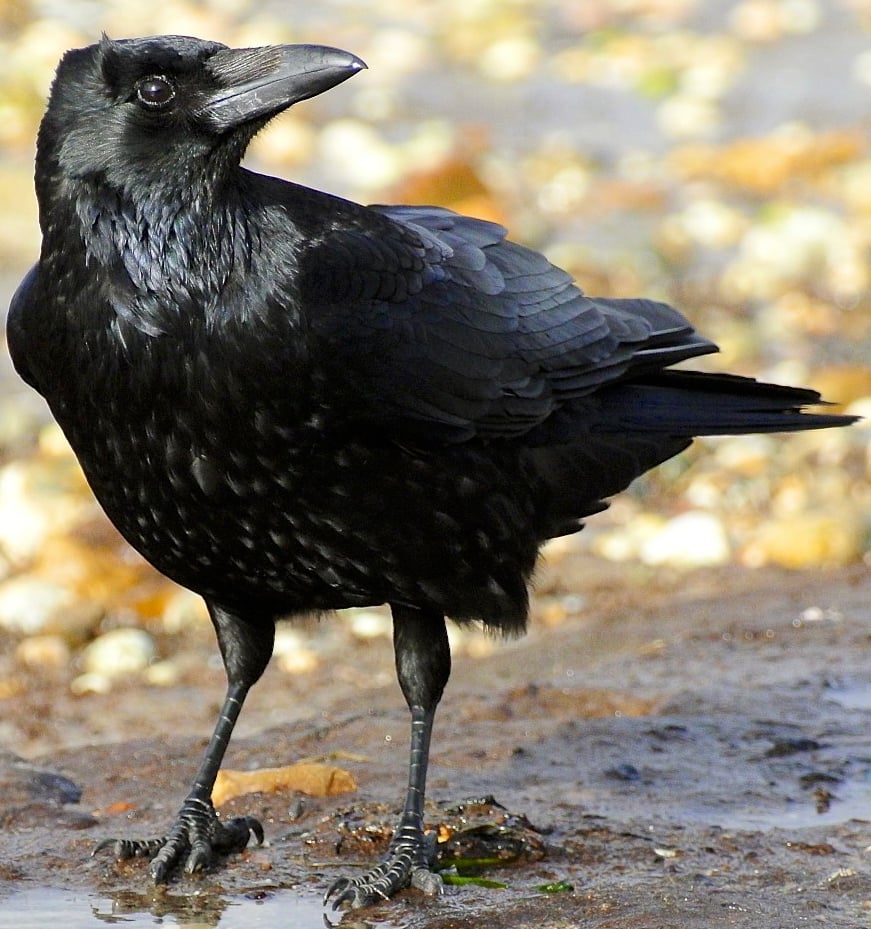
Carrion crows can shift smoothly between calling and pecking, but new experiments suggest that choosing to vocalize is not quite as effortless as choosing a physical action. In a University of Tübingen study, switching into a vocal response demanded extra mental effort, revealing a surprising asymmetry in the birds’ decision-making.
Diana A. Liao and her colleagues trained two male carrion crows (Corvus corone) to respond to visual cues by either producing a call or pecking a screen. The cues appeared in sequences that sometimes required the birds to repeat the same behavior and sometimes forced them to change from one response to the other. Both crows learned the task and remained accurate, but their reaction times exposed a crucial difference: moving from pecking to calling slowed them down, while moving into pecking produced little comparable delay.
Researchers describe this delay as a vocal-specific “switch cost.” In cognitive experiments involving humans and other primates, switch costs are commonly interpreted as the time required to disengage from one task and configure the brain for another. The crow results suggest that vocal production may involve a particularly demanding combination of action selection, timing, and control over the sound itself—not merely the reflexive release of a call.
The finding builds on a growing body of work showing that corvid vocalizations are unusually flexible. In a 2024 Science study, Liao, Katharina F. Brecht, Lena Veit, and Andreas Nieder trained three carrion crows to produce between one and four calls in response to arbitrary visual and auditory cues. The timing and acoustic properties of the first call helped predict how many calls would follow, suggesting that the birds planned the sequence before beginning to vocalize.
That earlier work showed that crows can deliberately control whether and how many times they call; the new experiment asks what happens when vocal control must compete with another learned response. The answer is not that crows are poor at switching. Rather, their accuracy shows that they can alternate flexibly, while the selective slowdown indicates that vocal behavior carries an additional executive burden. The researchers’ paper, Switch costs reveal vocal-specific executive demands during flexible action selection in crows, appears in Proceedings of the Royal Society B: Biological Sciences.
The study also points toward the next stage of crow cognition research. Because the experiment isolates the moment when a bird selects a call instead of a peck, similar tasks could eventually be paired with brain-recording or imaging techniques to identify the neural circuits involved. That could help explain how flexible communication evolved in birds—and why an animal separated from humans by hundreds of millions of years can still display executive control over its voice.


