
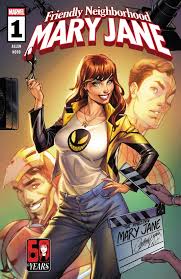
Mary Jane Watson is finally getting a fresh start that belongs to her. Friendly Neighborhood Mary Jane #1 puts the longtime Spider-Man supporting player at the center of her own story, trading super-powered identity drama for a new business, a new challenge, and the kind of grounded ambition that has always made MJ more than just Peter Parker’s partner.
Written by Ashley Allen and drawn by Phil Noto, the five-issue limited series begins with the grand opening of Watson Productions. Marvel’s premise gives Mary Jane a role she has rarely been allowed to occupy for long: producer. She wants to build a company that supports artists and creates opportunities, but the entertainment business quickly proves as dangerous as any superhero battlefield. Chameleon targets the new venture, forcing MJ to rely on her instincts, relationships, and a mysterious parting gift from Venom. Marvel announced the series as part of its post-Queen in Black plans, with the first issue arriving November 4, 2026.
The setup follows Mary Jane’s recent transformation into a superhero in her own right. Marvel’s 2026 anniversary special celebrated six decades of the character, from her early appearances in Amazing Spider-Man to her time bonded with the Venom symbiote. That issue also pointed toward the next phase of her life, making this miniseries less of a continuity detour than a deliberate handoff from one unusual identity to another.
Allen is a particularly promising choice for the assignment. Her earlier Marvel work on Magik and Psylocke established a talent for finding a strong emotional angle inside familiar superhero formulas. Here, that angle is Mary Jane’s empathy and creative drive. She is not simply trying to return to normal after Venom; she is attempting to define what “normal” means when she has already proved she can stand in the superhuman arena.
Noto’s artwork gives the book an appropriately human-scale feel. His clean, expressive figures and cinematic page composition suit a story that can move from a business meeting to a costumed confrontation without making either side feel like filler. Early reviews have likewise highlighted the grounded visual approach and Allen’s understanding of MJ’s personality, suggesting that the series works because its central conflict is personal before it becomes spectacular.
That balance may be the most important promise of Friendly Neighborhood Mary Jane. Mary Jane has spent years being pulled into stories defined by other people—Peter, Gwen, Venom, or the latest crisis threatening New York. Watson Productions gives her a mission that is recognizably hers, while Chameleon and the Venom gift ensure the book remains firmly connected to Marvel’s larger world. If the opening chapter is any indication, this is not a temporary stopgap for MJ. It is a credible new status quo—and one that could easily support more stories after the five-issue run ends.


